Showing posts with label ghost story. Show all posts

Wednesday, March 11, 2015

Why Do People Believe In Ghosts?-The Returned / Ghost Project, Ghost Beliefs


NEW YORK TIMES,  Monday, March 9, 2015, THE ARTS section, Front Page, Page C1, Television Review

and then please scroll down to

Philadelphia Inquirer, Tuesday, March 10, 2015, Page A3, STAFF REPORTS / PARANORMAL


Photo
The Returned India Ennenga stars in this drama series, which makes its debut on Monday on A&E. CreditJoseph Lederer/A&E
Be careful what you wish for. That’s the message of “The Returned,” a spooky series that debuts on Monday on A&E about dead people who suddenly come back to life for no apparent reason and with no memory of having been absent.
The first episode introduces Camille (India Ennenga), a teenager who died in a school bus accident. Four years later, Camille saunters back into her house, opens the fridge, and makes herself a sandwich. Her mother (Tandi Wright), who had been lighting candles in Camille’s room only moments before, discovers her dead daughter alive in the kitchen, sulky as ever and evidently quite hungry.
This is a ghost story for grown-ups, focused less on the dead than the people who are suddenly confronted with lost loved ones years and even decades after they have died. When the impossible happens, parents, lovers and siblings experience rolling waves of shock, euphoria, suspicion and dread.
The A&E version is an American adaptation of a French series, “Les Revenants,” and it is in itself a creepy apparition: It’s almost identical to the original.
Photo
Mat Vairo as Simon and Sophie Lowe as Lena in “The Returned,” adapted from the French series “Les Revenants.” CreditJoseph Lederer/A&E
And while neither series is at all funny, the A&E one will be inadvertently amusing to anyone who has seen the original, which is available with subtitles on Netflix.
That was set in a small, isolated town in the French mountains. This one is a similarly woody mountain area in Washington State. Many of the actors resemble their French counterparts or at least share with them a certain continental je ne sais quoi. (Almost everyone is thin in Caldwell, Wash., and men and women dress with casual flair.)
The creators seem so scared of not living up to the French version that they have replicated “Les Revenants,” almost word for word and scene for scene, with the same characters, conversations and crises. Both shows are chillingly enigmatic, but the American one is more timid about it — afraid, perhaps, of the French one’s s shadow.
And one mark of originality on television these days is, oddly enough, unfaithful imitation. So many American shows are copies of foreign ones. The best adaptations riff a little, reimagining not just the setting but also the show’s sensibility.
“Homeland,” on Showtime, was adapted from the Israeli show, “Prisoners of War,” and refigured the American version around a new character, a bipolar C.I.A. analyst played by Claire Danes. “The Slap,” is an NBC version of an Australian series by the same name, but it surrounds the central conflict with typically American class rifts and tribal loyalties.
There are small differences in the first episode of “The Returned” and “Les Revenants,” but they are minor and seem to have more to do with expedience than creativity.
The French series was moody and almost maddeningly elliptical — things were not explained immediately, and plenty of things were never explained. “The Returned” gives viewers a few shortcuts.
In one scene, a young man who returns from the dead finds his former fiancée looking at herself in the mirror. In “Les Revenants,” the beautiful, dark-haired woman wore a cream-colored lace dress; viewers discovered only later that it was her wedding dress, the one she was about to wear to marry another man. In “The Returned,” the beautiful, dark-haired woman (Mary Elizabeth Winstead) is in a black dress and she is placing a frilly white wisp of netting on the top of her head — there is no mistaking it for anything other than a bridal veil.
Some of the changes merely reflect cultural differences. In the French version, a doctor makes house calls and takes a public bus to get to her patient’s house, two things that are almost unheard-of in the United States. In the American version, the doctor drives to work and sees patients in a clinic.
But despite those accommodations to the American way of life, the creators seem intent on recreating as much of the original’s atmosphere and style. In the French version, Simon is a sensitive, pale young man with dark curls who dresses in a black suit and a white shirt like a 19th-century Romantic poet — or the writer Bernard-Henri Lévy. The American Simon (Mat Vairo) looks exactly like him.
Possibly because it works so hard to mimic the original’s gloomy restraint, “The Returned” feels strained. It’s not at all like “Resurrection,” an ABC series that also presented dead people who return to their old lives, only to turn those of their relatives and friends upside down. (The ABC show was based on a novel, “The Returned,” that was not the source for “Les Revenants” or its American adaptation.) That show has so far lasted two seasons and was as brash, colorful and loud as any network drama, a nighttime soap with lots of dramatic music and end-of-episode twists that nevertheless lost traction.
“The Returned” is much more cool, cerebral and unsettling, but it is at best a ghostly reflection of “Les Revenants.”
Looking at why people believe in ghosts
Members of Penn group are researching cultural aspects. But don’t ask them: Who ya gonna call?
By Susan Snyder INQUIRER STAFF WRITER
   The ghost hunters and the Ivy League professors were 40 minutes into their investigation at the University of Pennsylvania Museum of Archaeology and Anthropology when Projit B. Mukharji felt something.
   The rest of the group had fanned out across the darkened Harrison Auditorium, a spacious art deco room with a coffered dome. The paranormal sleuths were training their temperature guns and “electromagnetic frequency meters” — tools that, in theory, register changes should a spirit be present.
   Mukharji, 37, was sitting alone in the front row.
   “I suddenly started sweating a lot,” he said. “And I thought I got a very strong smell of perfume.”
   A major score for a ghost hunter. But for a spirit-agnostic professor?
   Mukharji, who teaches the history of science and medicine, isn’t sure what he experienced on that visit last August to the Penn Museum. But he experienced something.
   “You could either call it a panic attack,” the professor said, “or you could call it a ghost attack.”
   He’s part of a group of Penn professors who are delving into the impact of ghost beliefs across cultures and disciplines.
   Just don’t call them ghost busters.
   They’re not trying to prove or disprove ghosts.
   “We want to understand it as a sociological reality and a cultural reality,” said Justin McDaniel, a professor and chair of the religious studies department at Penn. “It should be given a forum where people can talk about it.”
   McDaniel’s group calls itself “the Penn Ghost Project” and later this semester, students will begin recording ghost stories on campus. The goal: to create an 
online ghost story archive for the ages.
   “We want to kind of map out the ghosts at Penn, where are people saying they are,” said McDaniel, 42, a former Buddhist monk who isn’t sure whether he believes in ghosts. “If it goes well, we’ll start mapping the ghost history of Philadelphia, which is extensive, probably more extensive than any city in the country, just because it’s big and it’s old.”
   McDaniel and five colleagues formed the group more than a year ago after discovering their mutual interest in the incorporeal.
   “This is a unique opportunity for us to find a connection between our research interests and everyday life interest in the supernatural,” said another member, Ilya Vinitsky, who chairs the department of Slavic languages and literatures.
   David Barnes is considered the group’s biggest skeptic. The historian of medicine and public health became interested in the subject while writing abook about the former Lazaretto quarantine station and hospital on the Delaware River outside Philadelphia. Many people died there, making it a favorite haunt of ghost hunters.
   “I don’t feel it,” Barnes said of paranormal activity. “I don’t have any room in my belief system for it, but I’m really interested in the fact that [they] do.”
   The group has received $10,000 in university funding to bring in speakers, pay student assistants, and set up a website. They’ve taken trips with ghost hunters to learn how they work and they held their first symposium in October 2013.
   It was packed, McDaniel said.
   The professors also gave a presentation last fall at homecoming, which prompted alumni to share their own ghost experiences.
   Professors have disappointed some inquirers, who had hoped Penn would investigate their haunted house.
   “That’s not our thing,” McDaniel said.
   At one time, however, it was Penn’s thing.
   In 1883, with a bequest from a 
benefactor, Henry Seybert, Penn formed the “Seybert Commission,” a group of scholars headed by the provost who investigated “modern spiritualism,” including attending séances and looking for evidence of spirits.
   It found none.
   But that hasn’t quelled the stories. The Penn museum has attracted a number of ghost stories over the years, said Alex Pezzati, senior archivist.
   Someone spotted a ghost in the archival room in the mid-1990s, he said.
   “He walked from behind that shelf just over there,” Pezzati said, pointing a short distance. “He had some old-style clothing, frilly shirt and top hat.”
   Then, poof. Gone.
   Pezzati has spent decades in the museum, including some late nights, but hasn’t experienced anything ghostly himself: “That would be kind of cool. But sorry, no.”
   Frank Cassidy, founder of the Delaware County-based Free Spirit Paranormal Investigators, who led the investigation that night, said the group found “no hard evidence” of ghosts.
   “It was just senses that we all got while we were there,” he said. “I got the smell of chicken soup. We thought we felt the
presence of a person there, an angry, elderly gentleman.”
   The students who will assist the professors in ghost-mapping Penn are split on whether they believe in ghosts. But all want people to feel comfortable sharing stories.
   “You don’t have to be crazy to have this experience,” said Beatrice Field, 19, a sophomore from West Palm Beach, Fla.
   Field, who is originally from Honduras, said her family once lived in a house possessed by a spirit. It got so bad that the family shared a bedroom and set up barriers so the ghost wouldn’t enter, she said.
   Elizabeth Gonzalez, 19, a sophomore from Miami, doesn’t believe in ghosts, but wants to hear the experiences of others.
   “My main point of studying it is to understand how it affects the medical realm,” said the aspiring geneticist.
   Her research adviser warned her not to put the project on her resume. Science isn’t ready.
   “Once I explained what we were doing,” she added, “he was a little more OK.” ssnyder@phillynews.com 
   215-854-4693 @ssnyderinq www.inquirer.com/campusinq 
Justin McDaniel, department chair of religious studies, is part of the “Penn Ghost Project.” RACHEL WISNIEWSKI / Staff Photographer
Students Elizabeth Gonzalez (left) and Khadija Tarver are also involved. Expansion toward the entire city is seen.

Thursday, February 13, 2014

!Die in 1891,Reincarnate,Dinner in Mansion by Servants for 60 Years After Death !!!!!! STRANGE WILLS

Are you kidding me?  Check this out!!:


Vermont tanner John Bowman believed that after his death, he, his dead wife, and two daughters would be reincarnated together. When he died in 1891, his will provided a $50,000 trust fund for the maintenance of his 21-room mansion and mausoleum. The will required servants to serve dinner every night just in case the Bowmans were hungry when they returned from the dead. This stipulation was carried out until 1950, when the trust money ran out.


cuttingsville-haunted-house

Bowman House - HauntedHouses.com

LOCATION:

Bowman House, Highway 103, Cuttingsville, Vermont 05738.
Visit the haunted house book shop on the grounds.
haunted-house-bowman

DESCRIPTION

Located in south-central Vermont, Bowman Mansion is a large estate, including a family mausoleum Laurel Glen Cemetery, all of which was originally built and owned by a wealthy farmer, Tanning Magnate John P Bowman. Because Mr. Bowman thought of the future, he left a substantial endowment in his will to keep the mansion and grounds in tip- top shape. Visiting Bowman House is like stepping back into the 1800s, making it a favorite of people who are interested in hiThe story of the era, and love old houses, and take the tours of the Bowman House, now a museum.
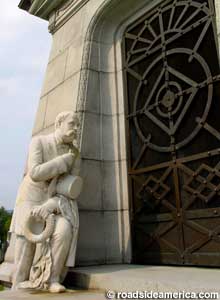
On the grounds across the road from the Bowman house, John P. Bowman, out of grief for his dead family, built the Laurel Glen Mausoleum in 1880, specifically to hold the remains of his wife and children, including a life-size statue of him, flowers in hand, walking up the steps in grief. His kneeing likeness can also be seen outside the door, holding a wreath and key. Mr. Bowman hired 125 sculptors and stonecutters, who spent more than a year to complete the unusual granite and marble mausoleum, completed in 1881.

HISTORY OF MANIFESTATIONS

Tragedy hit the Bowman family in 1880, as Bowman's wife and children died in an unknown matter. Perhaps an outbreak of typhoid or some other disease killed his family, or they suffered some sort of accident; (horse buggy, etc.) or attack, as there was a mysterious dark spot (blood?) found at the top of the stairs, which gives sensitive visitors unpleasant feelings.

MANIFESTATIONS:

1) An apparition of an unknown woman, perhaps Mrs. Bowman, has been seen throughout the mansion, going about her business. Perhaps she died before she could complete a long list of chores to do, and she can't let go of this world because she died before she was ready.
2) Visitors who stand at the top of the staircase on a darkened stain, experience uneasy feelings of "forbodence and dread." Perhaps this stain is connected to the family deaths.
While visiting the mansion, one must mind his or her manners, as misbehavior will sometimes be dealt with. A young visitor who was taking a tour of the mansion with her family, stuck her tongue out at a picture, which then came off the wall and hit her, in full view of several people. Children need to be corrected and if parents won't do it, an unseen presence in this house, perhaps Mrs. Bowman will gladly step in and provide this parental service!

STILL HAUNTED?

Yes indeed.
No one alive is allowed to be there at night, so the presences there can enjoy their house. There is a haunted house book shop on the grounds of the Bowman House, as the unseen residents have obviously inspired interest in ghosts.


Bowman Mausoleum's Mourning Man

Field review by the editors.
Cuttingsville,Vermont
In south-central Vermont, between stops at a Boy with a Leaking Boot and the Phineas Gage skull rod monument, we catch a glimpse of a stone man stepping up to the bronze door of a cemetery mausoleum.
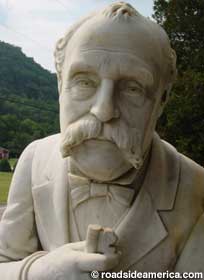
The sad-looking man, top hat and coat on his arm, holds a large key over his heart while clutching a floral wreath in his other hand. In afternoon light, the sight is eerie (a night visit would be even more unnerving).
The slightly larger than life-size marble figure is of local tanning magnate John Porter Bowman. In 1880, Bowman's wife passed away; he had lost a daughter in 1879, and another years earlier. To remember them, he had a grandiose mausoleum constructed in Laurel Glen Cemetery, dwarfing surrounding grave markers. Bowman commissioned an architect, stoneworkers and a famous sculptor to create his vision of post-mortem devotion. The structure, comprised of 750 tons of granite and 50 tons of marble, cost $75,000 -- a heap o' money at the time.
Kneeling Bowman.
The interior features sculpted busts of the deceased, and ornate stonework around the crypts. Mirrors are positioned to make the room seem larger than it really is.
When completed in 1881, the mausoleum became a local tourist attraction. Thousands converged on the cemetery to gawk. Bowman had a guest book placed inside the chamber, and hired an usher/guide to conduct short tours.
Then Bowman built an elaborate summer home -- Laurel Hall -- right across the road. While the house was under construction, he had the grieving version of himself created and installed on the tomb's steps. Eventually he moved into Laurel Hall permanently. From that vantage, he could gaze over at the Bowman sculpture ready to unlock the mausoleum. It must have been weird.
Bowman himself died in 1891, and joined the rest of the family in this unique sanctuary.
Here's Bowman, lookin' at ya.
Was it all sadness and gloom for Bowman in the final years of his life, or did the statue free him to have fun? We're pretty certain he didn't pose for "mirror image" gag photos on the mausoleum's steps (the statue on the left, him on the right).
Today, you can visit the mausoleum by pulling off Route 103. The interior is mostly visible, but locked. Over time, parts of the Bowman statue have cracked and been repaired. He left money after his death to maintain the mausoleum and grounds in perpetuity.


BACK TO HOME PAGE
JOHN P. BOWMAN’S LAUREL HALL
and LAUREL GLEN CEMETERY
in CUTTINGSVILLE, VERMONT
John P. Bowman, son of a Clarendon, Vt. farmer, was born at Pierce’sCorner in 1816. At the age of 15 he found employment in a Rutland tannery. He learned the business of turning hides into good leather and after about five years he went to New York State, working in various factories. He came to Shrewsbury, Vt. and established himself in a general tanning and currying business, dealing also in boots and shoes. He occupied the tannery south of Cuttingsville near what is now known as "Tannery Crossing". It was later operated by Huntoon and Son.
In 1849 he married Jennie E. Gates of Warren, N.Y. She was dignified and graceful in manner, self-reliant and courteous. Generous and thoughtful of others, she proved a kindly neighbor as well as a devoted wife and mother.
In 1851 Bowman was honored by election to the State Legislature. He served his Shrewsbury townsmen faithfully and with credit to himself. But business appealed far more to him than politics or public affairs. In 1852 Bowman moved with his family to Stony Creek, N.Y. and bought a tannery at Creek Center and under his management he attained an enviable position in business circles.

A daughter, Addie L., was born in 1854 but died at the age of four months. A second daughter, Ella H., was born in 1860 and grew to be a fine and cultured young woman.
ELLA BOWMANHowever, in 1879 misfortune brought an end to this pleasant home life. Ella fell ill and died. Less than a year later, Mrs. Bowman passed away, leaving her husband alone to bear his grief and sorrow. Mr. Bowman resolved to build a memorial and last resting place for them in his native Vermont hills.

A plot of land in Cuttingsville adjoining the old burying ground was chosen for the shrine. For over a year, 125 skilled sculptors, granite and marble cutters, masons and laborers were employed in erecting this classic example of Grecian architecture, designed and planned by New York architect and special designer, G. B. Croff hired by Bowman.
A life size statue of Mr. Bowman is posed outside. Bent with grief, and burdened with mourning cloak, silk hat, gloves, a huge funeral wreath, and a key, he is represented in the act of ascending the steps of the tomb.
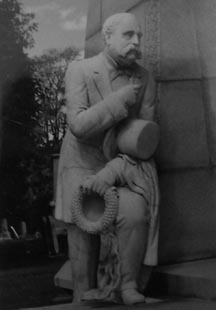
In his book describing the mausoleum, G. B. Croff expressed his thoughts in the following words: "A most pathetic family history wrought in stone, Laurel Glen Mausoleum will stand for centuries . . . and prove a laurel wreath, a crown of glory to perpetuate the well-rounded, honorable, successful life and name of its most noble founder."
In 1881, the three caskets were placed in the mausoleum. Bowman had the grounds graded, added retaining walls, arranged grass plots, had walks and drives filled with crushed purple slate and set out trees. A greenhouse and conservatory was erected on the grounds where the many plants were propagated and used to decorate the cemetery grounds. Laurel Glen Cemetery was beautifully kept and park-like, it attracted people from the city who enjoyed the trip by horse and buggy to picnic on the grounds.
LAUREL HALL 
Across the road, Bowman had G. B. Croff design and build a magnificent Victorian summer residence, and called it Laurel Hall. In the May 20, 1882 edition of the Rutland Daily Herald, it stated that "the grounds of Laurel Hall were treated as an extensive parterre or miniature landscape, with winding walks and drives, swelling terraces and shrubbery of various sorts, and graced with one large allegorical Grecian fountain, in composition, a water nymph mid sweet accessories, with laughing sprays of water singing amid the trees and flowers their songs of parting salutation to their homes high in the mountain side, and lulling one to sleep and pleasant dreams, in hammock swung beneath the shadows of the spacious covered gallery nearby."

As poignantly written in the October 31, 1882 edition of the Rutland Daily Herald, "Laurel Hall’s style is a fresh, bold treatment of Elizabethan and Queen Anne details. An open terrace on the north blends into a covered gallery on the main facade, approached at the entrance by a broad, inviting flight of swelling steps with buttresses of curvilinear form with paneled newels capped with rich bronze urns filled with foliage plants and blooming flowers. Over the entrance rises through the roof a tower with pyramidal termination and spacious balconies at each floor, with shadowy canopies and gables here and there, of heights and inclination varied, given greatercharacter still by several massive chimney stacks with heavy, moulded hoods that rise above them all and stand like sentinels defined in bold relief against the sky.

"But, pleasing as the exterior is, it by no means prepares the visitor for the sweet surprise awaiting him at the entrance to the broad, grand staircase hall that traverses the structure through from front to rear, divided in the centre by a quaint arcade with central passage arch and smaller supplemental arches at each side, in each of which a life-size female figure sweetly draped, in graceful attitude, bear light bronze candelabras o’er their heads, filled with wax candles of soft hues. And still beyond a broad Italian rambling staircase rich in each detail gives access to the floors above. Two lofty stained glass windows on the central landing of the staircase fill the hall with floods of soft, warm ambient light, and at one end a French plate mirror richly framed gives transverse duplication of the staircase at the second flight, and at the end of the second hall another mirror reproduces still again in longitude the hall, with all its forms and shapes.
"The mural decorations are extremely rich throughout, with paneled ceilings treated in befitting allegory, differing in design in every room in paneling, frieze and dado. The windows are all margined, top and base, with many hued cathedral glass. The dining hall and library are treated in mahogany, with open fireplaces, with lofty-mirrored chimney pieces, with border tiles of scenes from Shakespeare, with margins, fender rails and andirons of burnished brass, and hearths of inlaid English tiles. The fixtures for illumination are of bright, rich burnished bronze.
" In addition to the artistic features of the establishment, it embraces every feature of utility found in a first class New York City house – hot and cold water, closets, baths, basins, porcelain lined sinks, stationary wash trays, modern range, etc.
"Nearby the villa, as one of its accessories, there is a fine modern stable, capacitated to receive four horses and as many carriages, fitted up with hydrants, washing floors, wardrobes, etc."
The writer ended the article with these words: "A public benefaction this great work has been in stern materiality, and still a greater legacy and benefaction to the intellectual world. It has already borne the honored name of John P. Bowman far and wide o’er this and other lands and will to generations yet unborn a touching story tell and stamp indelible his name on many hearts and lives, a character most truly great and worthy emulation to the last."
Mr. Bowman enjoyed entertaining friends and family in his summer residence and in 1891, passed away and joined his family in the Laurel Glen mausoleum.
The Laurel Glen Cemetery Association, a corporation created in 1894, has full charge of the estate in perpetuity and according to the specific terms of John P. Bowman’s will. Laurel Hall is at present closed to the public due to repair and restoration efforts. During the winter months, the statue of Mr. Bowman is covered to protect it from the elements. The cemetery is still park-like with lilacs in the spring and snowball bushes in the summer and fall.
Information for this article came from booklet written by Honorary Trustee of the Historical Society, the late Marjorie A. Pierce in 1995 and from the aforementioned articles found in the May 20, 1882 and October 31, 1882 issues of the Rutland Daily Herald which were donated to the Shrewsbury Historical Society by member Morris G. Tucker.