Showing posts with label longevity. Show all posts

Saturday, November 4, 2017

The Future of Anti-Aging


Harper's Bazaar, November 2017, 150th Anniversary Issue, P. 316 :

The Future of Anti-Aging

Experts believe that exciting new innovations in the longevity space may one day redefine the way we age—and help us look better as we do it.

Fake fuller, younger-looking lips with Laura Mercier Lip Glacé in Poppy($26).
Kenneth Willardt
“Technology has reached a point where extending animal life span by 30 percent is routine,” says David Sinclair, a professor of genetics at Harvard Medical School and a renowned authority on longevity. “Dozens of companies are testing aging-reversal technologies in human clinical trials, and the combination of these could extend life span by decades.” Why is that a good thing? Because with science, those additional years could be happier, healthier ones. It does seem cruel, however, to have all that extra time if we’ll also look 150 years old. Fortunately, the most visionary anti-aging treatments on the horizon make pioneering plastic-surgery procedures seem run-of-the-mill. Read on to find out how a key supplement, DNA editing, and young blood could someday add years to your life, erase wrinkles, and potentially wipe out age-related diseases.
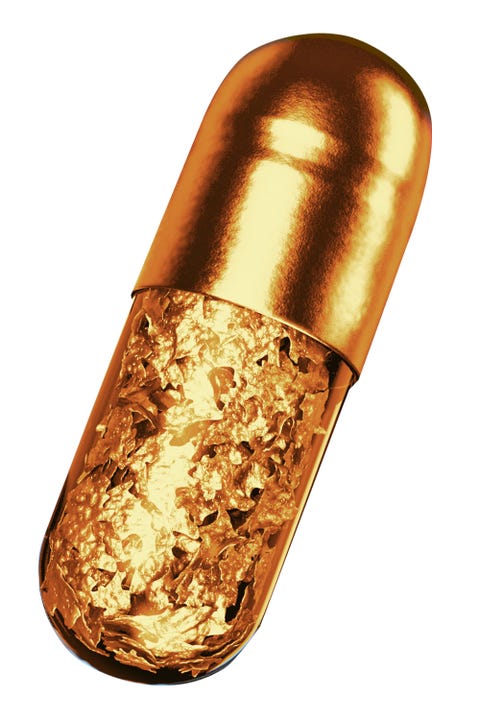
A molecule called NAD+ may hold the secret to boundless energy. The good news: Our cells already produce it, as it helps regulate our metabolism. The bad news: NAD+ declines as we age—by 50, levels are half of what they were at age 20. But scientists have discovered some powerful boosters that can help cells produce more NAD+. One of the most promising is NMN (nicotinamide mononucleotide), a form of vitamin B3 found in fruits and vegetables like avocado and broccoli. A 2013 study showed that older mice that were given an NAD+-boosting compound containing NMN had dramatically healthier cells and muscle tissue. “We took a mouse that was the human equivalent of a 65-year-old back to a 25-year-old—in a week,” says Sinclair, one of the study’s authors. What’s more, he says, the mice not only had more energy and could run farther but were resistant to diseases like cancer and diabetes. “If you reverse aging in one organ or tissue, usually the whole body is reversed, because all cells have the same underlying defects,” he explains.
Could NMN have the same effect on us? Sinclair, 48, has been taking his own custom NMN supplement (500 milligrams) for almost two years. Tests have revealed that his cells now behave like that of a 31-year-old. “I started taking it in my late 40s, and sometimes in your late 40s you feel tired during the day or you don’t feel like getting up early in the morning,” he says. “I don’t feel that way anymore. I feel upbeat mentally and physically, and I have the endurance of an athlete, but I don’t exercise.”
"You may one day be able to delete the negative signs of aging from your DNA for good, say scientists."
Another NAD+ booster, NR (nicotinamide riboside), found in ChromaDex’s Tru Niagen supplement (different in molecular structure from NMN, which Sinclair says is “better” and more stable than NR), can easily be purchased online, and has been shown to be safe in humans. “A single dose of 100 milligrams can raise NAD+ levels,” says Amy Boileau, director of scientific affairs for ChromaDex. Boileau believes that restoring depleted NAD+ levels could lead to fewer wrinkles but that additional testing is required. “It’s not hard to find a disease associated with NAD+ depletion that doesn’t also affect [visible aging],” she says. “I would like to see it work in skin because there’s so much promise there. It’s going to be an important question as to the role NAD+ can play.”
Advertisement - Continue Reading Below
In August, Sinclair and his team began human trials on a prescription-strength NMN NAD+ booster. “We’re trying to see if it’s safe, and what the best dosage would be before going into Phase II studies with a particular disease, like diabetes or obesity,” he explains. The idea that a simple molecule could restore lost energy and wipe out major diseases seems like a fantasy. But Sinclair is resolute. “Antibiotics are pretty simple too,” he says with a shrug. “We first showed that NAD+ extends the life span of cells back in 2003, but now it’s really taken off. It’s real.”

Look Younger by Editing Your Genes

You may one day be able to delete the negative signs of aging from your DNA for good. In late summer, the news was ablaze with talk of a fascinating procedure. Scientists at Oregon Health & Science University successfully removed harmful gene mutations from human embryos. Specifically, they fixed a mutation behind a common heart condition. Using a gene-editing tool known as CRISPR, or “genetic scissors,” they cut out the mutation and inserted a reparative enzyme. “If you want to add functionality to a gene, knock it out altogether, or change it just a little bit— that’s what CRISPR gave us the ability to do,” says biologist Daisy Robinton, a postdoctoral scientist at Boston Children’s Hospital who has used it in her work on cancer cells to positive result.
Though there were related stories warning of more nefarious uses for gene editing—designer babies, for example—for now, the focus is on higher-stakes concerns. Many CRISPR human trials are currently being done in China on patients with HPV, HIV, and lung cancer. “At first it’s going to be used only on cases where it’s worth the risk,” Robinton says, “and on people who are willing to take the risk because they don’t have many options.” As to whether CRISPR will be used for vainer pursuits—think curing baldness, eliminating gray hair, erasing wrinkles—Robinton, 30, is optimistic. “This isn’t the first time that biotech has invaded the beauty space,” she says. “It’s not [yet] real, but it’s our hopeful reality.”
Shutterstock
Other forms of genetic rejuvenation are being pursued by BioViva, a Seattle biotech company led by Elizabeth Parrish, 46, a self-described humanitarian, entrepreneur, and innovator. Two years ago, Parrish traveled to Colombia to receive two experimental anti-aging gene therapies: one meant to decrease the depletion of lean muscle mass; the other to increase the length of her telomeres, the end segments of DNA that shorten each time a cell divides. When telomeres reach a certain length, cells no longer divide and eventually die. If they could be extended, the thinking goes, so would the life cycle of the cell, thus prolonging its—and, by extension, our—existence. BioViva wants to make gene therapies like these as common as preventative medicine, Parrish says, and is developing targeted treatments for aging-related degenerative conditions, such as Alzheimer’s, and cosmetic procedures, like skin rejuvenation. “If we can’t regenerate the skin, the largest organ, you’re going to die,” explains Parrish. “People need to understand that this is not aesthetics—this is survival.”
Advertisement - Continue Reading Below
And it’s also not a fantasy: The FDA recently approved a gene-altering leukemia treatment developed by the pharmaceutical giant Novartis. Yet some in the scientific community were rattled by Parrish’s self-experimentation. For her part, Parrish, who, it must be noted, is not a scientist, professes to be unconcerned, claiming that her biomarkers (such as triglycerides and inflammation—both down since her personal trial) are “fantastic,” and believes that her company’s therapies will be available to consumers within the next two decades. “This is proven science,” she says. “We just need to prove it in humans.”

Blood Transfusions to Turn Back the Clock

Another youth-focused start-up is the San Francisco–based Ambrosia, which specializes in infusing blood—specifically “young” blood, from teenage donors (ages 16 and up)—into older clients, in hopes of regaining stamina, improving cognition, and repairing muscles. Why teens? Because younger blood has far lower levels of the harmful proteins that build up with age, which may cause decreased production of brain cells and inflammation. (If it sounds ghoulish, keep in mind that platelet-rich plasma therapy, which uses vials of your own blood, has long been used to treat injuries, osteoarthritis, and hair loss.)
Still, the science behind young-blood transfusions, which has focused primarily on mice, is somewhat inconclusive. That hasn’t deterred Ambrosia founder Jesse Karmazin, M.D., from trying for a moon shot. Yet when word of Ambrosia’s efforts began to spread, it was met with some healthy skepticism and not a little ribbing: Recall the “blood boy” episode of Silicon Valley. The problem, according to Karmazin, 32, is that what he’s doing is still so new, it’s misunderstood. “People thought my idea was crazy. Until recently, anti-aging wasn’t really a field. But it’s amazing how quickly it’s exploded,” he says. “There’s all this research and decades of experiments in mice showing that it reverses aging, so I thought, ‘Why aren’t we doing this in people?’ ” Ambrosia is recruiting participants between the ages of 35 and 100 for a clinical trial to evaluate Karmazin’s theory, and expects to publish the findings within the next year. So far, Karmazin says, the results are “strong.” He has estimated that patients would need to have transfusions only twice a year to maintain the benefits. “People look younger when they leave the clinic. We’ve all been surprised at how well it seems to work,” he says. “A crucial part of the picture is that [blood transfusions are] an already proven medical treatment—we’re just purposefully using younger donors. If you get a transfusion, you’re likely going to get blood from someone who is older than you. But if we could encourage younger people to donate blood, it could help reverse aging.”
"Encouraging younger people to donate blood could help reverse aging," says Jesse Karmazin, M.D.

The Future Is Soon

Given how promising this sounds, it would be tempting to seek out a doctor who specializes in longevity and offer yourself up to science. Not so fast, says Sinclair. “Gene therapy is risky. Unlike a pill, if there’s a problem you can’t just stop taking it. It’s there forever.” And right now it’s also breathtakingly expensive: Novartis’s gene therapy costs $475,000. That makes the $45 price tag for a month’s supply of Tru Niagen feel like couch change. There is good news, however, and it’s not just for babies. With a wellspring of money into longevity research from tech companies like Google, experts feel confident that in the next five to 10 years, supercharged anti-aging treatments like these will begin to come to market. “I don’t want to get wrinkles or gray hair, and I want to be able to lift weights and run forever,” says Robinton. “It’s important to be grounded in reality, but I feel the science is closer than ever before.”

Tuesday, August 22, 2017

Great Advice on Aging&ElderCare in Books !!!!!!!!!


New York Times, August 19, 2017, Page B1 :


Your Money

Hard-Won Advice in Books on Aging and Elder Care

Photo
Loretta Anne Woodward Veney with her mother, Doris Woodward. Ms. Veney’s upbeat memoir, “Being My Mom’s Mom,” describes the years she has spent caring for her mother. Credit Alex Wroblewski for The New York Times
Longevity is generally better than its alternative. But when the body or especially the mind wears out, caring for yourself or finding someone else to do it for you can impoverish you in short order.
We fail to plan for it at our peril. So when it seemed that Republicans in Washington were close to passing legislation that could fundamentally change Medicaid, I wrote five straight columns about the program. Already, the majority of Americans need Medicaid to pay for at least some of their nursing home costs or care at home because they’ve run out of money. Proposed caps on Medicaid, which have not come to pass for now, had the potential to cause enormous problems.
In the wake of those articles, you wrote in, hundreds of you, with harrowing stories and hard-won advice, more of which I intend to present in future columns. But a smaller number of people wrote in unprompted to assign me homework — books that they found useful as they were navigating their own changing conditions or those of spouses, close friends or other family members.
This week, I read all four books that came up at least twice in your correspondence. I don’t recommend you do the same, for if you’re more empathetic than average or prone to anxiety, you’ll finish the reading sprint, as I did, emotionally wrung out and worried sick.
Still, these books are all in their own way utterly essential reading. Few of us are prepared for the financial and emotional complexities of managing the last several years of our lives. But as we live longer, drain what may prove to be inadequate retirement savings and lean harder on already strained government programs, we’ll probably find ourselves facing ever more challenging questions and unfortunate compromises.

We may as well know what’s coming. Here’s what I learned.

Being Mortal,” by Atul Gawande

Photo
I started here, with this book by a New Yorker writer and physician who aims to help readers avoid what he calls a “warehoused oblivion,” even if none of us will win the ultimate battle.
The book is a good introductory text in part because of the sobering statistics. By age 85, 40 percent of people have some form of dementia. There are 350,000 falls each year that lead to broken hips. Once you’ve got a fracture there, there’s a 40 percent chance you’ll end up in a nursing home and a 20 percent chance you’ll never walk again.
A good geriatrician, one hopes, will school you in stability to lessen the chance of taking a spill. But good luck finding one, since their numbers have declined even as studies show that people do better over all under their care. Think your family will be there to steady you or at least check in? According to Dr. Gawande, half of the very old among us live without a spouse, and we’re having fewer children than ever before.
He writes movingly of his own father’s death, and I felt the lump rising in my throat five times over 263 pages. But it is the chapter titled “Letting Go” that I found most useful. There, he discusses the powerful effect of frequent, concerted conversations about goals and wishes at the end of life — not just bland, advanced medical directives in writing but continuing talks out loud.
“It is not death that the very old tell me they fear,” he writes. “It is what happens short of death.” But we don’t think about it enough, and we talk about it even less. Having read this book, I won’t make that mistake or let anyone close to me make it either.

The 36-Hour Day,” by Nancy L. Mace and Peter V. Rabins

Photo
The title is a sympathetic nod to what it feels like to care for someone with Alzheimer’s, other dementias or memory loss, and it could take nearly that long to read this book and absorb.
Still, its value is in its encyclopedic nature, including detours into necessary but often uncomfortable topics like adult diapering and masturbation. These authors have clearly heard and seen it all.
The tips in Chapter 16 for people shopping for long-term care residences of various sorts are particularly comprehensive. You’ll finish thinking that this is a selection process that shouldn’t happen within 24 hours of a hospital discharge but should instead unfold over weeks, and you’ll be right.

A Bittersweet Season,” by Jane Gross

Photo
The reward for living a reasonably long life, according to Jane Gross’s mother, was getting to “rot to death” rather than merely dying. As a physician Ms. Gross quotes later in her book confirms, this “inching toward oblivion” is no longer bad luck but a “generalizable phenomenon.”
With that bit of foreboding as a baseline, Ms. Gross takes us on a no-holds-barred tour through the years that she and her brother spent caring for their late mother. The author, a former New York Times reporter whom I’ve never met save for a few encounters on social media, is unafraid to admit all the mistakes she made out of sheer ignorance and how often even the most high-functioning adult children simply do not know what they do not know.
The book explains the financial side of her mother’s care — including her eventual qualification for Medicaid — plain as day. I also picked up even more tips for a list I’ll eventually publish of questions to ask before picking a nursing home or assisted living facility.
As someone with a sister and two sisters-in-law, I found the book most useful as a sort of post-mortem meditation on gender. Women often lose out twice or more in the aging derby, first when they take on disproportionate responsibility for their aging parents and then again when they outlive their spouses in old age. Ms. Gross’s raw honesty about her feelings about all of this — often fair and sometimes not, by her own admission — makes this book mandatory reading for any man with a sister who wants to be thoughtful about planning for aging parents.

Being My Mom’s Mom,” by Loretta Anne Woodward Veney

Photo
There is no sugarcoating the number of physical and emotional challenges that come with aging, so it’s clear why Ms. Veney’s upbeat memoir of the years she has spent caring for her mother, Doris Woodward, who has dementia, is so appealing.
Ms. Veney’s steadfast focus on her own mental health is something others will want to mimic. Her aim is tranquillity and patience, with an emphasis on reprogramming her reactions, like her frustration with being late.
She’s also practical about doing whatever works to make her mother happy. While Ms. Woodward had no taste for McDonald’s in her younger years, she found it soothing for whatever reason once her decline began. Often, the two of them would stay there for hours.
Finally, Ms. Veney devotes a chapter to humor. Laughing with someone afflicted with dementia can, in her view, be life-affirming in a period when joy may be elusive. So we hear of her mother’s confusion over her new memory foam slippers. How was something on her feet going to help her brain? she wondered.
Photo
Ms. Veney and Ms. Woodward in Fort Washington, Md. Credit Alex Wroblewski for The New York Times
At the end of one particularly challenging day out, the pair stopped for dessert. When they arrived back at her mother’s group home where she had lived for more than a year, she did not recognize it though she did thank her daughter for the treat. “I just don’t remember where I live,” Ms. Woodward told her daughter. “But of course I remember the ice cream.”

Paying for the Nursing Home: Tell Us Your Story

For future reporting projects related to finding and paying for nursing homes, assisted living communities and similar residences for older people, we're hoping you could answer a few questions for us.
Required fields are marked with an asterisk.
You have 900 words left.
Continue
Email: lieber@nytimes.com
A version of this article appears in print on August 19, 2017, on Page B1 of the New York edition with the headline: Facing Dread Of ‘Inching Toward Oblivion’.

Sunday, January 22, 2017

Living to 100 - Parade - Michael Roizen M.D.

Parade magazine:


Click "launch gallery" above to  see  10 of the ways Dr. Roizen boosts his energy  each day>
Click "launch gallery" above to see 10 of the ways Dr. Roizen boosts his energy each day>(iStock)
Courtesy Michael Roizen's Facebook
Michael and Nancy Roizen (Courtesy Michael Roizen's Facebook)
With longevity a hot topic, we’ve teamed up with the world-renowned Cleveland Clinic and its chief wellness officer, Michael Roizen, M.D., for a yearlong series on living to 100. At 71, Roizen keeps a schedule of patient visits, radio interviews, research, writing and, yes, even some fun that would exhaust people decades younger. But that’s hardly a surprise. “Young Dr. Mike” (as he’s known on Twitter) has dedicated much of the past 20 years to the study of longevity—specifically, the idea that simple daily choices can make your body and mind years younger than your calendar age. And there’s no question the co-author of the upcoming book AgeProof: Living Longer Without Running Out of Money or Breaking a Hip (available Feb. 28) practices what he preaches.
Click launch gallery to see just a few of the ways Roizen boosts his longevity every day.
Do You Want to Live to 100? Take Our Survey for a Chance to Win a $500 Amazon gift card
Cleveland Clinic
(Cleveland Clinic)
90
The number of minutes Roizen aims to spend on his treadmill desk by walking during conference calls and radio interviews
10,000
The number of steps Roizen tries to log daily on his fitness tracker. If he hasn’t hit his goal, he walks on the treadmill while he watches TV. “That’s about the only time I catch The Daily Show live,” he says.
25
The calories in a small piece of dark chocolate, a favorite Roizen pick-me-up (along with a handful of walnuts) if dinner will be late
Related: See Stars Taking Advantage of 5 Surprising Keys to Longevity


http://parade.com/540445/kneal-2/living-to-100-a-day-in-the-life-of-cleveland-clinics-chief-wellness-officer/#addthis