Deathternity talks about all things death related. There are 1 million+ owned graves in cemeteries in America that people will not use. Cemeteries do not buy graves back. I would encourage people to begin thinking about either selling or buying these graves at a deep discount to what your cemetery charges. Or you can donate unused graves for a tax deduction. If I can help you with this please contact me here, email me at deathternity@gmail.com, or call me at 215-341-8745. My fees vary.
Showing posts with label queen elizabeth. Show all posts
Showing posts with label queen elizabeth. Show all posts
She turns 91 in April, so perhaps it should come as no
surprise that extravagant and secret funeral plans are in place and
ready to be put into action when Britain’s longest-reigning monarch
passes away.
But some of the funeral details that The Guardian lists
are almost the stuff of fantasy. For example, who would have thought
that a coffin is already on standby, ready to be flown at a moment’s
notice to wherever in the world Queen Elizabeth II happens to be when she dies?
The
funeral plans—known as ‘London Bridge’—encompass everything from
breaking the news of the queen’s death to the public to the funeral
itself 10 days later.
‘London Bridge is down,’ the British prime
minister will be told on a secure phone line, and at that moment he or
she will know that the age of Queen Elizabeth is over and a new reign
about to begin.
Shortly afterwards, the Press Association will be informed and a notice will be pinned to the gates of Buckingham Palace.
Staff
at the BBC already receive regular training in the event of being faced
with the death of a major royal figure, and a cold-war era alarm known
as Rats (radio alert transmission system) will alert them to the fact
that something serious is unfolding.
Meanwhile, at British radio
stations flashing blue lights on their boards will tell DJs and
presenters that either a major catastrophe is unfolding or that someone
hugely important in British society has died. Most likely they will
guess what has happened. Who else could command such spectacle and
rehearsed drama as the queen?
Once the public has been informed—including those traveling on
commercial planes—the implications of a world without the queen will
begin to settle in. The 25-year-old Princess Elizabeth was crowned in
1953, and has been the only monarch that most of her subjects have ever
known.
It is her eldest son, Prince Charles, who
will be proclaimed king after her death, and there will be a huge amount
of pressure on him as the nation plunges into nine days of mourning.
Not least of these pressures will involve asking the public to accept
his wife Camilla as their queen, who was cast as the evil mistress
during the deterioration of Charles’ marriage to Princess Diana.
After
the queen’s body is returned to Buckingham Palace, it will lie in state
in the throne room while the outside world gets preparations underway
for the funeral. Everything must be approved by King Charles, who on the
evening of the queen’s death will make his first-ever address as
Britain’s head of state.
Dignitaries and heads of state will
arrive from all over the world to pay their respects, while members of
parliament will begin to swear oaths of allegiance to Charles. After he
is proclaimed king, he’ll embark on a four-day tour of the United
Kingdom, attending services in his mother’s memory in Edinburgh, Belfast
and Cardiff.
On the day of the funeral, 10 pallbearers will be
entrusted with the immense weight of the queen’s coffin, lead-lined in
the royal tradition (The Guardian reports that Diana’s coffin weighed half a ton.)
The
coffin will have lain in state in Westminster Hall for four days before
the funeral itself, piled with the glittering crown jewels. The jewels
having been removed and published, the coffin will be brought to
Westminster Abbey for the funeral service.
It is not proper
etiquette for broadcasters to show the faces of royal family members
during the service, but the coffin’s final 23-mile journey to Windsor
Castle will be shown in its entirety.
This will be the resting
place of the queen, and the end of the journey for the cameras. But for
King Charles, who will oversee the lowering of the coffin into the
vault, the journey will be only just beginning.
'London Bridge is down': the secret plan for the days after the Queen’s death
She is venerated around the world. She has outlasted 12 US
presidents. She stands for stability and order. But her kingdom is in
turmoil, and her subjects are in denial that her reign will ever end.
That’s why the palace has a plan.
by Sam Knight
In
the plans that exist for the death of the Queen – and there are many
versions, held by Buckingham Palace, the government and the BBC – most
envisage that she will die after a short illness. Her family and doctors
will be there. When the Queen Mother passed away on the afternoon of
Easter Saturday, in 2002, at the Royal Lodge in Windsor, she had time to
telephone friends to say goodbye, and to give away some of her horses.
In these last hours, the Queen’s senior doctor, a gastroenterologist
named Professor Huw Thomas, will be in charge. He will look after his
patient, control access to her room and consider what information should
be made public. The bond between sovereign and subjects is a strange
and mostly unknowable thing. A nation’s life becomes a person’s, and
then the string must break.
There will be bulletins from the palace – not many, but enough. “The
Queen is suffering from great physical prostration, accompanied by
symptoms which cause much anxiety,” announced Sir James Reid, Queen
Victoria’s physician, two days before her death in 1901. “The King’s
life is moving peacefully towards its close,” was the final notice
issued by George V’s doctor,Lord Dawson, at 9.30pm on
the night of 20 January 1936. Not long afterwards, Dawson injected the
king with 750mg of morphine and a gram of cocaine – enough to kill him
twice over – in order to ease the monarch’s suffering, and to have him
expire in time for the printing presses of the Times, which rolled at
midnight.
Her eyes will be closed and Charles will be king. His siblings will
kiss his hands. The first official to deal with the news will be Sir
Christopher Geidt, the Queen’s private secretary, a former diplomat who
was given a second knighthood in 2014, in part for planning her
succession.
Geidt will contact the prime minister. The last time a British
monarch died, 65 years ago, the demise of George VI was conveyed in a
code word, “Hyde Park Corner”, to Buckingham Palace, to prevent
switchboard operators from finding out. For Elizabeth II, the plan for
what happens next is known as “London Bridge.” The prime minister will
be woken, if she is not already awake, and civil servants will say
“London Bridge is down” on secure lines. From the Foreign Office’s
Global Response Centre, at an undisclosed location in the capital, the
news will go out to the 15 governments outside the UK where the Queen is
also the head of state, and the 36 other nations of the Commonwealth
for whom she has served as a symbolic figurehead – a face familiar in
dreams and the untidy drawings of a billion schoolchildren – since the
dawn of the atomic age.
For a time, she will be gone without our knowing it. The information
will travel like the compressional wave ahead of an earthquake,
detectable only by special equipment. Governors general, ambassadors and
prime ministers will learn first. Cupboards will be opened in search of
black armbands, three-and-a-quarter inches wide, to be worn on the left
arm.
The
rest of us will find out more quickly than before. On 6 February 1952,
George VI was found by his valet at Sandringham at 7.30am. The BBC did
not broadcast the news until 11.15am, almost four hours later. When
Princess Diana died at 4am local time at the Pitié-Salpêtrière hospital
in Paris on 31 August 1997, journalists accompanying the former foreign
secretary, Robin Cook, on a visit to the Philippines knew within 15
minutes. For many years the BBC was told about royal deaths first, but
its monopoly on broadcasting to the empire has gone now. When the Queen
dies, the announcement will go out as a newsflash to the Press
Association and the rest of the world’s media simultaneously. At the
same instant, a footman in mourning clothes will emerge from a door at
Buckingham Palace, cross the dull pink gravel and pin a black-edged
notice to the gates. While he does this, the palace website will be
transformed into a sombre, single page, showing the same text on a dark
background.
Screens will glow. There will be tweets. At the BBC, the
“radio alert transmission system” (Rats), will be activated – a cold
war-era alarm designed to withstand an attack on the nation’s
infrastructure. Rats, which is also sometimes referred to as “royal
about to snuff it”, is a near mythical part of the intricate
architecture of ritual and rehearsals for the death of major royal
personalities that the BBC has maintained since the 1930s. Most staff
have only ever seen it work in tests; many have never seen it work at
all. “Whenever there is a strange noise in the newsroom, someone always
asks, ‘Is that the Rats?’ Because we don’t know what it sounds like,”
one regional reporter told me.
All news organisations will scramble to get films on air and
obituaries online. At the Guardian, the deputy editor has a list of
prepared stories pinned to his wall. The Times is said to have 11 days
of coverage ready to go. At Sky News and ITN, which for years rehearsed
the death of the Queen substituting the name “Mrs Robinson”, calls will
go out to royal experts who have already signed contracts to speak
exclusively on those channels. “I am going to be sitting outside the
doors of the Abbey on a hugely enlarged trestle table commentating to
300 million Americans about this,” one told me.
For people stuck in traffic, or with Heart FM on in the background,
there will only be the subtlest of indications, at first, that something
is going on.Britain’s commercial radio stations have a
network of blue “obit lights”, which is tested once a week and supposed
to light up in the event of a national catastrophe. When the news
breaks, these lights will start flashing, to alert DJs to switch to the
news in the next few minutes and to play inoffensive music in the
meantime. Every station, down to hospital radio, has prepared music
lists made up of “Mood 2” (sad) or “Mood 1” (saddest) songs to reach for
in times of sudden mourning. “If you ever hear Haunted Dancehall
(Nursery Remix) by Sabres of Paradise on daytime Radio 1, turn the TV
on,” wrote Chris Price, a BBC radio producer, for the Huffington Post in 2011. “Something terrible has just happened.”
Having plans in place for the death of leading royals is a practice
that makes some journalists uncomfortable. “There is one story which is
deemed to be so much more important than others,” one former Today
programme producer complained to me. For 30 years, BBC news teams were
hauled to work on quiet Sunday mornings to perform mock storylines about
the Queen Mother choking on a fishbone. There was once a scenario about
Princess Diana dying in a car crash on the M4.
These well-laid plans have not always helped. In 2002, when the Queen
Mother died, the obit lights didn’t come on because someone failed to
push the button down properly. On the BBC, Peter Sissons, the veteran
anchor, was criticised for wearing a maroon tie. Sissons was the victim
of a BBC policy change, issued after the September 11 attacks, to
moderate its coverage and reduce the number of “category one” royals
eligible for the full obituary procedure. The last words in Sissons’s
ear before going on air were: “Don’t go overboard. She’s a very old
woman who had to go some time.”
But there will be no extemporising with the Queen. The newsreaders
will wear black suits and black ties. Category one was made for her.
Programmes will stop. Networks will merge. BBC 1, 2 and 4 will be
interrupted and revert silently to their respective idents – an exercise
class in a village hall, a swan waiting on a pond – before coming
together for the news. Listeners to Radio 4 and Radio 5 live will hear a
specific formulation of words, “This is the BBC from London,” which,
intentionally or not, will summon a spirit of national emergency.
The main reason for rehearsals is to have words that are roughly
approximate to the moment. “It is with the greatest sorrow that we make
the following announcement,” said John Snagge, the BBC presenter who
informed the world of the death of George VI. (The news was repeated
seven times, every 15 minutes, and then the BBC went silent for five
hours). According to one former head of BBC news, a very similar set of
words will be used for the Queen. The rehearsals for her are different
to the other members of the family, he explained. People become upset,
and contemplate the unthinkable oddness of her absence. “She is the only
monarch that most of us have ever known,” he said. The royal standard
will appear on the screen. The national anthem will play. You will
remember where you were. When
people think of a contemporary royal death in Britain, they think,
inescapably, of Diana. The passing of the Queen will be monumental by
comparison. It may not be as nakedly emotional, but its reach will be
wider, and its implications more dramatic. “It will be quite
fundamental,” as one former courtier told me.
Part of the effect will come from the overwhelming weight of things
happening. The routine for modern royal funerals is more or less
familiar (Diana’s was based on “Tay Bridge”, the plan for the Queen
Mother’s). But the death of a British monarch, and the accession of a
new head of state, is a ritual that is passing out of living memory:
three of the Queen’s last four prime ministers were born after she came
to the throne. When she dies, both houses of parliament will be
recalled, people will go home from work early, and aircraft pilots will
announce the news to their passengers. In the nine days that follow (in
London Bridge planning documents, these are known as “D-day”, “D+1” and
so on) there will be ritual proclamations, a four-nation tour by the new
king, bowdlerised television programming, and a diplomatic assembling
in London not seen since the death of Winston Churchill in 1965.
More overwhelming than any of this, though, there will be an almighty
psychological reckoning for the kingdom that she leaves behind. The Queen
is Britain’s last living link with our former greatness – the nation’s
id, its problematic self-regard – which is still defined by our victory
in the second world war. One leading historian, who like most people I
interviewed for this article declined to be named, stressed that the
farewell for this country’s longest-serving monarch will be magnificent.
“Oh, she will get everything,” he said. “We were all told that the
funeral of Churchill was the requiem for Britain as a great power. But
actually it will really be over when she goes.”
Unlike the US presidency, say, monarchies allow huge passages of time
– a century, in some cases – to become entwined with an individual. The
second Elizabethan age is likely to be remembered as a reign of
uninterrupted national decline, and even, if she lives long enough and
Scotland departs the union, as one of disintegration. Life and politics
at the end of her rule will be unrecognisable from their grandeur and
innocence at its beginning. “We don’t blame her for it,” Philip Ziegler,
the historian and royal biographer, told me. “We have declined with
her, so to speak.”
The obituary films will remind us what a different country she
inherited. One piece of footage will be played again and again: from her
21st birthday, in 1947, when Princess Elizabeth was on holiday with her parents in Cape Town.
She was 6,000 miles from home and comfortably within the pale of the
British Empire. The princess sits at a table with a microphone. The
shadow of a tree plays on her shoulder. The camera adjusts three or four
times as she talks, and on each occasion, she twitches momentarily,
betraying tiny flashes of aristocratic irritation. “I declare before you
all that my whole life, whether it be long or short, shall be devoted
to your service, and the service of our great imperial family to which
we all belong,” she says, enunciating vowels and a conception of the
world that have both vanished.
It is not unusual for a country to succumb to a state of denial as a
long chapter in its history is about to end. When it became public that
Queen Victoria was dying, at the age of 82, a widow for half her life,
“astonished grief … swept the country”, wrote her biographer, Lytton
Strachey. In the minds of her subjects, the queen’s mortality had become
unimaginable; and with her demise, everything was suddenly at risk,
placed in the hands of an elderly and untrusted heir, Edward VII. “The
wild waters are upon us now,” wrote the American Henry James, who had
moved to London 30 years before.
The parallels with the unease that we will feel at the death of
Elizabeth II are obvious, but without the consolation of Britain’s
status in 1901 as the world’s most successful country. “We have to have
narratives for royal events,” the historian told me. “In the Victorian
reign, everything got better and better, and bigger and bigger. We
certainly can’t tell that story today.”
The result is an enormous objection to even thinking about – let
alone talking or writing about – what will happen when the Queen dies.
We avoid the subject as we avoid it in our own families. It seems like
good manners, but it is also fear. The reporting for this article
involved dozens of interviews with broadcasters, government officials,
and departed palace staff, several of whom have worked on London Bridge
directly. Almost all insisted on complete secrecy. “This meeting never
happened,” I was told after one conversation in a gentleman’s club on
Pall Mall. Buckingham Palace, meanwhile, has a policy of not commenting
on funeral arrangements for members of the royal family.
And yet this taboo, like much to do with the monarchy, is not
entirely rational, and masks a parallel reality. The next great rupture
in Britain’s national life has, in fact, been planned to the minute. It
involves matters of major public importance, will be paid for by us, and
is definitely going to happen. According to the Office of National
Statistics, a British woman who reaches the age of 91 – as the Queen
will in April – has an average life expectancy of four years and three
months. The Queen is approaching the end of her reign at a time of
maximum disquiet about Britain’s place in the world, at a moment when
internal political tensions are close to breaking her kingdom apart. Her
death will also release its own destabilising forces: in the accession
of Queen Camilla; in the optics of a new king who is already an old man;
and in the future of the Commonwealth, an invention largely of her
making. (The Queen’s title of “Head of the Commonwealth” is not
hereditary.) Australia’s prime minister and leader of the opposition
both want the country to become a republic.
Coping with the way these events fall is the next great challenge of
the House of Windsor, the last European royal family to practise
coronations and to persist – with the complicity of a willing public –
in the magic of the whole enterprise. That is why the planning for the
Queen’s death and its ceremonial aftermath is so extensive. Succession
is part of the job. It is an opportunity for order to be affirmed. Queen
Victoria had written down the contents of her coffin by 1875. The Queen
Mother’s funeral was rehearsed for 22 years. Louis Mountbatten, the
last Viceroy of India, prepared a winter and a summer menu for his
funeral lunch. London Bridge is the Queen’s exit plan. “It’s history,”
as one of her courtiers said. It will be 10 days of sorrow and spectacle
in which, rather like the dazzling mirror of the monarchy itself, we
will revel in who we were and avoid the question of what we have become. The
idea is for nothing to be unforeseen. If the Queen dies abroad, a BAe
146 jet from the RAF’s No 32 squadron, known as the Royal Flight, will
take off from Northolt, at the western edge of London, with a coffin on
board. The royal undertakers, Leverton & Sons, keep what they call a
“first call coffin” ready in case of royal emergencies. Both George V
and George VI were buried in oak grown on the Sandringham estate in
Norfolk. If the Queen dies there, her body will come to London by car
after a day or two.
The most elaborate plans are for what happens if she passes away at
Balmoral, where she spends three months of the year. This will trigger
an initial wave of Scottish ritual. First, the Queen’s body will lie at
rest in her smallest palace, at Holyroodhouse, in Edinburgh, where she
is traditionally guarded by the Royal Company of Archers, who wear eagle
feathers in their bonnets. Then the coffin will be carried up the Royal
Mile to St Giles’s cathedral, for a service of reception, before being
put on board the Royal Train at Waverley station for a sad progress down
the east coast mainline. Crowds are expected at level crossings and on
station platforms the length of the country – from Musselburgh and
Thirsk in the north, to Peterborough and Hatfield in the south – to
throw flowers on the passing train. (Another locomotive will follow
behind, to clear debris from the tracks.) “It’s actually very
complicated,” one transport official told me.
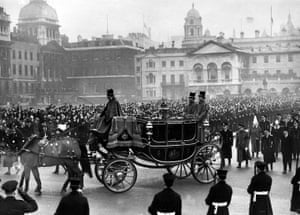
The funeral procession of the late King George VI in 1952. Photograph: Popperfoto
In every scenario, the Queen’s body returns to the throne room in
Buckingham Palace, which overlooks the north-west corner of the
Quadrangle, its interior courtyard. There will be an altar, the pall,
the royal standard, and four Grenadier Guards, their bearskin hats
inclined, their rifles pointing to the floor, standing watch. In the
corridors, staff employed by the Queen for more than 50 years will pass,
following procedures they know by heart. “Your professionalism takes
over because there is a job to be done,” said one veteran of royal
funerals. There will be no time for sadness, or to worry about what
happens next. Charles will bring in many of his own staff when he
accedes. “Bear in mind,” the courtier said, “everybody who works in the
palace is actually on borrowed time.”
Outside, news crews will assemble on pre-agreed sites next to Canada Gate, at the bottom of Green Park.(Special
fibre-optic cable runs under the Mall, for broadcasting British state
occasions.) “I have got in front of me an instruction book a couple of
inches thick,” said one TV director, who will cover the ceremonies, when
we spoke on the phone. “Everything in there is planned. Everyone knows
what to do.” Across the country, flags will come down and bells will
toll. In 1952, Great Tom was rung at St Paul’s every minute for two
hours when the news was announced. The bells at Westminster Abbey
sounded and the Sebastopol bell, taken from the Black Sea city during
the Crimean war and rung only on the occasion of a sovereign’s death,
was tolled 56 times at Windsor – once for each year of George VI’s life –
from 1.27pm until 2.22pm.
The 18th Duke of Norfolk, the Earl Marshal, will be in charge.
Norfolks have overseen royal funerals since 1672. During the 20th
century, a set of offices in St James’s Palace was always earmarked for
their use. On the morning of George VI’s death, in 1952, these were
being renovated. By five o’clock in the afternoon, the scaffolding was
down and the rooms were re-carpeted, furnished and equipped with phones,
lights and heating. During London Bridge, the Lord Chamberlain’s office
in the palace will be the centre of operations. The current version of
the plan is largely the work of Lieutenant-Colonel Anthony Mather, a
former equerry who retired from the palace in 2014. As a 23-year-old
guardsman in 1965, Mather led the pallbearers at Churchill’s funeral.
(He declined to speak with me.) The government’s team – coordinating the
police, security, transport and armed forces – will assemble at the
Department of Culture, Media and Sport. Someone will have the job of
printing around 10,000 tickets for invited guests, the first of which
will be required for the proclamation of King Charles in about 24 hours
time. Everyoneon
the conference calls and around the table will know each other. For a
narrow stratum of the British aristocracy and civil service, the art of
planning major funerals – the solemnity, the excessive detail – is an
expression of a certain national competence. Thirty-one people gathered
for the first meeting to plan Churchill’s funeral, “Operation Hope Not”,
in June 1959, six years before his death. Those working on London
Bridge (and Tay Bridgeand Forth Bridge, the Duke of
Edinburgh’s funeral) will have corresponded for years in a language of
bureaucratic euphemism, about “a possible future ceremony”; “a future
problem”; “some inevitable occasion, the timing of which, however, is
quite uncertain”.
The first plans for London Bridge date back to the 1960s, before
being refined in detail at the turn of the century. Since then, there
have been meetings two or three times a year for the various actors
involved (around a dozen government departments, the police, army,
broadcasters and the Royal Parks) in Church House, Westminster, the
Palace, or elsewhere in Whitehall. Participants described them to me as
deeply civil and methodical. “Everyone around the world is looking to us
to do this again perfectly,” said one, “and we will.” Plans are updated
and old versions are destroyed. Arcane and highly specific knowledge is
shared. It takes 28 minutes at a slow march from the doors of St
James’s to the entrance of Westminster Hall. The coffin must have a
false lid,to hold the crown jewels,with a rim at least three inches high.
In theory, everything is settled. But in the hours after the Queen
has gone, there will be details that only Charles can decide.
“Everything has to be signed off by the Duke of Norfolk and the King,”
one official told me. The Prince of Wales has waited longer to assume
the British throne than any heir, and the world will now swirl around
him at a new and uncrossable distance. “For a little while,” wrote
Edward VIII, of the days between his father’s death and funeral, “I had
the uneasy sensation of being left alone on a vast stage.” In recent
years, much of the work on London Bridge has focused on the precise
choreography of Charles’s accession. “There are really two things
happening,” as one of his advisers told me. “There is the demise of a
sovereign and then there is the making of a king.” Charles is scheduled
to make his first address as head of state on the evening of his
mother’s death.
Switchboards – the Palace, Downing Street, the Department of Culture,
Media and Sport – will be swamped with calls during the first 48 hours.
It is such a long time since the death of a monarch that many national
organisations won’t know what to do. The official advice, as it was last
time, will be that business should continue as usual. This won’t
necessarily happen. If the Queen dies during Royal Ascot, the meet will
be scrapped. The Marylebone Cricket Club is said to hold insurance for a
similar outcome if she passes away during a home test match at Lord’s.
After the death of George VI in 1952, rugby and hockey fixtures were
called off, while football matches went ahead. Fans sang Abide With Me
and the national anthem before kick off. The National Theatre will close
if the news breaks before 4pm, and stay open if not. All games,
including golf, will be banned in the Royal Parks.
In 2014, the National Association of Civic Officers circulated
protocols for local authorities to follow in case of “the death of a
senior national figure”. It advised stockpiling books of condolence –
loose leaf, so inappropriate messages can be removed – to be placed in
town halls, libraries and museums the day after the Queen dies. Mayors
will mask their decorations (maces will be shrouded with black bags). In
provincial cities, big screens will be erected so crowds can follow
events taking place in London, and flags of all possible descriptions,
including beach flags (but not red danger flags), will be flown at half
mast. The country must be seen to know what it is doing. The most recent
set of instructions to embassies in London went out just before
Christmas. One of the biggest headaches will be for the Foreign Office,
dealing with all the dignitaries who descend from all corners of the
earth. In Papua New Guinea, where the Queen is the head of state, she is
known as “Mama belong big family”. European royal families will be put
up at the palace; the rest will stay at Claridge’s hotel.
Parliament will gather. If possible, both houses will sit within
hours of the monarch’s death. In 1952, the Commons convened for two
minutes before noon. “We cannot at this moment do more than record a
spontaneous expression of our grief,” said Churchill, who was prime
minister. The house met again in the evening, when MPs began swearing
the oath of allegiance to the new sovereign. Messages rained in from
parliaments and presidents. The US House of Representatives adjourned.
Ethiopia announced two weeks of mourning. In the House of Lords, the two
thrones will be replaced by a single chair and a cushion bearing the
golden outline of a crown.
On D+1, the day after the Queen’s death, the flags will go back up,
and at 11am, Charles will be proclaimed king. The Accession Council,
which convenes in the red-carpeted Entrée Room of St James’s Palace,
long predates parliament. The meeting, of the “Lords Spiritual and
Temporal of this Realm”, derives from the Witan, the Anglo-Saxon feudal
assembly of more than a thousand years ago. In theory, all 670 current
members of the Privy Council, from Jeremy Corbyn to Ezekiel Alebua, the
former prime minister of the Solomon Islands, are invited – but there is
space for only 150 or so. In 1952, the Queen was one of two women
present at her proclamation.
The clerk, a senior civil servant named Richard Tilbrook, will read
out the formal wording, “Whereas it has pleased Almighty God to call to
His Mercy our late Sovereign Lady Queen Elizabeth the Second of Blessed
and Glorious memory…” and Charles will carry out the first official
duties of his reign, swearing to protect the Church in Scotland, and
speaking of the heavy burden that is now his.
At dawn, the central window overlooking Friary Court, on the palace’s
eastern front, will have been removed and the roof outside covered in
red felt. After Charles has spoken, trumpeters from the Life Guards,
wearing red plumes on their helmets, will step outside, give three
blasts and the Garter King of Arms, a genealogist named Thomas Woodcock,
will stand on the balcony and begin the ritual proclamations of King
Charles III. “I will make the first one,” said Woodcock, whose official
salary of £49.07 has not been raised since the 1830s. In 1952, four
newsreel cameras recorded the moment. This time there will be an
audience of billions. People will look for auguries – in the weather, in
birds flying overhead – for Charles’s reign. At Elizabeth’s accession,
everyone was convinced that the new queen was too calm. The band of the
Coldstream Guards will play the national anthem on drums that are
wrapped in black cloth.
The proclamations will only just be getting started. From St James’s, the Garter King of Armsand
half a dozen other heralds, looking like extras from an expensive
Shakespeare production, will go by carriage to the statue of Charles I,
at the base of Trafalgar Square, which marks London’s official midpoint,
and read out the news again. A 41-gun salute – almost seven minutes of
artillery – will be fired from Hyde Park. “There is no concession to
modernity in this,” one former palace official told me. There will be
cocked hats and horses everywhere. One of the concerns of the
broadcasters is what the crowds will look like as they seek to record
these moments of history. “The whole world is going to be bloody doing
this,” said one news executive, holding up his phone in front of his
face.
On the old boundary of the City of London, outside the Royal Courts
of Justice, a red cord will hang across the road. The City Marshal, a
former police detective chief superintendent named Philip Jordan, will
be waiting on a horse. The heralds will be formally admitted to the
City, and there will be more trumpets and more announcements: at the
Royal Exchange, and then in a chain reaction across the country.
Sixty-five years ago, there were crowds of 10,000 in Birmingham; 5,000
in Manchester; 15,000 in Edinburgh. High Sheriffs stood on the steps of
town halls, and announced the new sovereign according to local custom.
In York, the Mayor raised a toast to the Queen from a cup made of solid
gold.
The same rituals will take place,but this time
around the new king will also go out to meet his people. From his
proclamation at St James’s, Charles will immediately tour the country,
visiting Edinburgh, Belfast and Cardiff to attend services of
remembrance for his mother and to meet the leaders of the devolved
governments. There will also be civic receptions, for teachers, doctors
and other ordinary folk, which are intended to reflect the altered
spirit of his reign. “From day one, it is about the people rather than
just the leaders being part of this new monarchy,” said one of his
advisers, who described the plans for Charles’s progress as: “Lots of
not being in a car, but actually walking around.” In the capital, the
pageantry of royal death and accession will be archaic and bewildering.
But from another city each day, there will be images of the new king
mourning alongside his subjects, assuming his almighty, lonely role in
the public imagination. “It is see and be seen,” the adviser said. For
a long time, the art of royal spectacle was for other, weaker peoples:
Italians, Russians, and Habsburgs. British ritual occasions were a mess.
At the funeral of Princess Charlotte, in 1817, the undertakers were
drunk. Ten years later, St George’s Chapel was so cold during the burial
of the Duke of York that George Canning, the foreign secretary,
contracted rheumatic fever and the bishop of London died. “We never saw
so motley, so rude, so ill-managed a body of persons,” reported the
Times on the funeral of George IV, in 1830. Victoria’s coronation a few
years later was nothing to write home about. The clergy got lost in the
words; the singing was awful; and the royal jewellers made the
coronation ring for the wrong finger. “Some nations have a gift for
ceremonial,” the Marquess of Salisbury wrote in 1860. “In England the
case is exactly the reverse.”
What we think of as the ancient rituals of the monarchy were mainly
crafted in the late 19th century, towards the end of Victoria’s reign.
Courtiers, politicians and constitutional theorists such as Walter
Bagehot worried about the dismal sight of the Empress of India trooping
around Windsor in her donkey cart. If the crown was going to give up its
executive authority, it would have to inspire loyalty and awe by other
means – and theatre was part of the answer. “The more democratic we
get,” wrote Bagehot in 1867, “the more we shall get to like state and
show.”
Obsessed by death, Victoria planned her own funeral with some style.
But it was her son, Edward VII, who is largely responsible for reviving
royal display. One courtier praised his “curious power of visualising a
pageant”. He turned the state opening of parliament and military drills,
like the Trooping of the Colour, into full fancy-dress occasions, and
at his own passing, resurrected the medieval ritual of lying in state.
Hundreds of thousands of subjects filed past his coffin in Westminster
Hall in 1910, granting a new sense of intimacy to the body of the
sovereign. By 1932, George V was a national father figure, giving the
first royal Christmas speech to the nation – a tradition that persists
today – in a radio address written for him by Rudyard Kipling.
The shambles and the remoteness of the 19th-century monarchy were
replaced by an idealised family and historic pageantry invented in the
20th. In 1909, Kaiser Wilhelm II boasted about the quality of German
martial processions: “The English cannot come up to us in this sort of
thing.” Now we all know that no one else quite does it like the British.
The Queen, by all accounts a practical and unsentimental person,
understands the theatrical power of the crown. “I have to be seen to be
believed,” is said to be one of her catchphrases. And there is no reason
to doubt that her funeral rites will evoke a rush of collective
feeling. “I think there will be a huge and very genuine outpouring of
deep emotion,” said Andrew Roberts, the historian. It will be all about
her, and it will really be about us. There will be an urge to stand in
the street, to see it with your own eyes, to be part of a multitude. The
cumulative effect will be conservative. “I suspect the Queen’s death
will intensify patriotic feelings,” one constitutional thinker told me,
“and therefore fit the Brexit mood, if you like, and intensify the
feeling that there is nothing to learn from foreigners.”
The wave of feeling will help to swamp the awkward facts of the succession.The
rehabilitation of Camilla as the Duchess of Cornwall has been a quiet
success for the monarchy, but her accession as queen will test how far
that has come. Since she married Charles in 2005, Camilla has been
officially known as Princess Consort, a formulation that has no
historical or legal meaning. (“It’s bullshit,” one former courtier told
me, describing it as “a sop to Diana”.) The fiction will end when
Elizabeth II dies. Under common law, Camilla will become queen — the
title always given to the wives of kings. There is no alternative. “She
is queen whatever she is called,” as one scholar put it. “If she is
called Princess Consort there is an implication that she is not quite up
to it. It’s a problem.” There are plans to clarify this situation
before the Queen dies, but King Charles is currently expected to
introduce Queen Camilla at his Accession Council on D+1. (Camilla was
invited to join the Privy Council last June, so she will be present.)
Confirmation of her title will form part of the first tumultuous 24
hours.
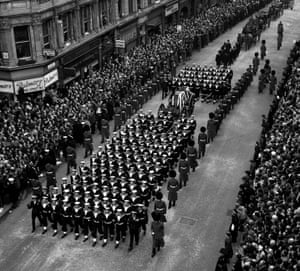
Crowds watch naval ratings pulling the gun carriage
bearing the coffin of Sir Winston Churchill to St Paul’s Cathedral.
Photograph: PA
The Commonwealth is the other knot. In 1952, at the last accession,
there were only eight members of the new entity taking shape in the
outline of the British Empire. The Queen was the head of state in seven
of them, and she was proclaimed Head of the Commonwealth to accommodate
India’s lone status as a republic. Sixty-five years later, there are 36
republics in the organisation, which the Queen has attended assiduously
throughout her reign, and now comprises a third of the world’s
population. The problem is that the role is not hereditary, and there is
no procedure for choosing the next one. “It’s a complete grey area,”
said Philip Murphy, director of the Institute of Commonwealth Studies at
the University of London.
For several years, the palace has been discreetly trying to ensure
Charles’s succession as head of the bloc, in the absence of any other
obvious option. Last October, Julia Gillard, the former prime minister
of Australia, revealed that Christopher Geidt, the Queen’s private
secretary, had visited her in February 2013 to ask her to support the
idea. Canada and New Zealand have since fallen into line, but the title
is unlikely to be included in King Charles’s proclamation. Instead it
will be part of the discreet international lobbying that takes place as
London fills up with diplomats and presidents in the days after the
Queen’s death. There will be serious, busy receptions at the palace. “We
are not talking about entertaining. But you have to show some form of
respect for the fact that they have come,” said one courtier. “Such
feasting and commingling, with my father still unburied, seemed to me
unfitting and heartless,” wrote Edward VIII in his memoirs. The show
must go on. Business will mix with grief. There
will be a thousand final preparations in the nine days before the
funeral. Soldiers will walk the processional routes. Prayers will be
rehearsed. On D+1, Westminster Hall will be locked, cleaned and its
stone floor covered with 1,500 metres of carpet. Candles, their wicks
already burnt in, will be brought over from the Abbey. The streets
around will be converted into ceremonial spaces. The bollards on the
Mall will be removed, and rails put up to protect the hedges. There is
space for 7,000 seats on Horse Guards Parade and 1,345 on Carlton House
Terrace. In 1952, all the rhododendrons in Parliament Square were pulled
up and women were barred from the roof of Admiralty Arch. “Nothing can
be done to protect the bulbs,” noted the Ministry of Works. The Queen’s
10 pallbearers will be chosen, and practise carrying their burden out of
sight in a barracks somewhere. British royals are buried in lead-lined
coffins. Diana’s weighed a quarter of a ton.
The population will slide between sadness and irritability. In 2002,
130 people complained to the BBC about its insensitive coverage of the
Queen Mother’s death; another 1,500 complained that Casualty was moved
to BBC2. The TV schedules in the days after the Queen’s death will
change again. Comedy won’t be taken off the BBCcompletely, but most satire will. There will be Dad’s Armyreruns, but no Have I Got News For You.
People will be touchy either way. After the death of George VI, in a
society much more Christian and deferential than this one, a Mass
Observation survey showed that people objected to the endless maudlin
music, the forelock-tugging coverage. “Don’t they think of old folk,
sick people, invalids?” one 60-year old woman asked. “It’s been terrible
for them, all this gloom.” In a bar in Notting Hill, one drinker said,
“He’s only shit and soil now like anyone else,”which
started a fight. Social media will be a tinderbox. In 1972, the writer
Brian Masters estimated that around a third of us have dreamed about the
Queen – she stands for authority and our mothers. People who are not
expecting to cry will cry.
On D+4, the coffin will move to Westminster Hall, to lie in state for
four full days. The procession from Buckingham Palace will be the first
great military parade of London Bridge: down the Mall, through Horse
Guards, and past the Cenotaph. More or less the same slow march, from St
James’s Palace for the Queen Mother in 2002, involved 1,600 personnel
and stretched for half a mile. The bands played Beethoven and a gun was
fired every minute from Hyde Park. The route is thought to hold around a
million people. The plan to get them there is based on the logistics
for the London 2012 Olympics.
There may be corgis. In 1910, the mourners for Edward VII were led by
his fox terrier, Caesar. His son’s coffin was followed to Wolferton
station, at Sandringham, by Jock, a white shooting pony. The procession
will reach Westminster Hall on the hour. The timing will be just so.
“Big Ben beginning to chime as the wheels come to a stop,” as one
broadcaster put it.
Inside the hall, there will be psalms as the coffin is placed on a catafalque draped in purple. King Charleswill
be back from his tour of the home nations, to lead the mourners. The
orb, the sceptre and the Imperial Crown will be fixed in place, soldiers
will stand guard and then the doors opened to the multitude that will
have formed outside and will now stream past the Queen for 23 hours a
day. For George VI, 305,000 subjects came. The line was four miles long.
The palace is expecting half a million for the Queen. There will be a
wondrous queue – the ultimate British ritual undertaking, with canteens,
police, portable toilets and strangers talking cautiously to one
another – stretching down to Vauxhall Bridge and then over the river and
back along the Albert Embankment. MPs will skip to the front.
Under the chestnut roof of the hall, everything will feel
fantastically well-ordered and consoling and designed to within a
quarter of an inch, because it is. A 47-page internal report compiled
after George VI’s funeral suggested attaching metal rollers to the
catafalque, to smooth the landing of the coffin when it arrives. Four
soldiers will stand silent vigil for 20 minutes at a time, with two
ready in reserve. The RAF, the Army, the Royal Navy, the Beefeaters, the
Gurkhas – everyone will take part. The most senior officer of the four
will stand at the foot of the coffin, the most junior at the head. The
wreaths on the coffin will be renewed every day. For Churchill’s lying
in state in 1965, a replica of the hall was set up in the ballroom of
the St Ermin’s hotel nearby, so soldiers could practise their movements
before they went on duty. In 1936, the four sons of George V revived The
Prince’s Vigil, in which members of the royal family arrive unannounced
and stand watch. The Queen’s children and grandchildren – including
women for the first time – will do the same.
Before dawn on D+9, the day of the funeral, in the silent hall, the
jewels will be taken off the coffin and cleaned. In 1952, it took three
jewellers almost two hours to remove all the dust. (The Star of Africa,
on the royal sceptre, is the second-largest cut diamond in the world.)
Most of the country will be waking to a day off. Shops will close, or go
to bank holiday hours. Some will display pictures of the Queen in their
windows. The stock market will not open. The night before, there will
have been church services in towns across the UK. There are plans to
open football stadiums for memorial services if necessary.
At 9am, Big Ben will strike. The bell’s hammer will then be covered
with a leather pad seven-sixteenths of an inch thick, and it will ring
out in muffled tones. The distance from Westminster Hall to the Abbey is
only a few hundred metres. The occasion will feel familiar, even though
it is new: the Queen will be the first British monarch to have her
funeral in the Abbey since 1760. The 2,000 guests will be sitting
inside. Television cameras, in hides made of painted bricks, will search
for the images that we will remember. In 1965, the dockers dipped their
cranes for Churchill. In 1997, it was the word “Mummy” on the flowers
for Diana from her sons.
When the coffin reaches the abbey doors, at 11 o’clock, the country
will fall silent. The clatter will still. Train stations will cease
announcements. Buses will stop and drivers will get out at the side of
the road. In 1952, at the same moment, all of the passengers on a flight
from London to New York rose from their seats and stood, 18,000 feet
above Canada, and bowed their heads.
Back then, the stakes were clearer, or at least they seemed that way.
A stammering king had been part of the embattled British way of life
that had survived an existential war. The wreath that Churchill laid
said: “For Gallantry.” The BBC commentator in 1952, the man who
deciphered the rubies and the rituals for the nation, was Richard
Dimbleby, the first British reporter to enter Bergen-Belsen and convey
its horrors, seven years before. “How true tonight that statement spoken
by an unknown man of his beloved father,” murmured Dimbleby, describing
the lying in state to millions. “The sunset of his death tinged the
whole world’s sky.”
The trumpets and the ancientness were proof of our survival; and the
king’s young daughter would rule the peace. “These royal ceremonies
represented decency, tradition, and public duty, in contradiction to the
ghastliness of Nazism,” as one historian told me. The monarchy had
traded power for theatre, and in the aftermath of war, the illusion
became more powerful than anyone could have imagined. “It was
restorative,” Jonathan Dimbleby, Richard’s son and biographer, told me.
His brother, David, is likely to be behind the BBC microphone this
time. The question will be what the bells and the emblems and the
heralds represent now. At what point does the pomp of an imperial
monarchy become ridiculous amid the circumstances of a diminished
nation? “The worry,” a historian said, “is that it is just circus
animals.”
If the monarchy exists as theatre, then this doubt is the part of the
drama. Can they still pull it off? Knowing everything that we know in
2017, how can it possibly hold that a single person might contain the
soul of a nation? The point of the monarchy is not to answer such
questions. It is to continue. “What a lot of our life we spend in
acting,” the Queen Mother used to say.
Inside the Abbey, the archbishop will speak. During prayers, the
broadcasters will refrain from showing royal faces. When the coffin
emerges again, the pallbearers will place it on the green gun carriage
that was used for the Queen’s father, and his father and his father’s
father, and 138 junior sailors will drop their heads to their chests and
pull. The tradition of being hauled by the Royal Navy began in 1901
when Victoria’s funeral horses, all white, threatened to bolt at Windsor
Station and a waiting contingent of ratings stepped in to pull the
coffin instead.
The procession will swing on to the Mall. In 1952, the RAF was
grounded out of respect for King George VI. In 2002, at 12.45pm, a
Lancaster bomber and two Spitfires flew over the cortege for his wife
and dipped their wings. The crowds will be deep for the Queen. She will
get everything. From Hyde Park Corner, the hearse will go 23 miles by
road to Windsor Castle, which claims the bodies of British sovereigns.
The royal household will be waiting for her, standing on the grass. Then
the cloister gates will be closed and cameras will stop broadcasting.
Inside the chapel, the lift to the royal vault will descend, and King
Charles will drop a handful of red earth from a silver bowl. • This article was amended on 16 March
2017 to correct some minor errors including the fact that three of the
Queen’s last four prime ministers, not the last three, were born after
her accession – Blair, Cameron and May; that the Star of Africa on the
royal sceptre is not the largest diamond in the world, but the
second-largest cut diamond; and that the word “son’s” was originally
missing from the second sentence in this passage: “In 1910, the mourners
for Edward VII were led by his fox terrier, Caesar. His son’s coffin
was followed to Wolferton station, at Sandringham, by Jock, a white
shooting pony.” • Follow the Long Read on Twitter at @gdnlongread, or sign up to the long read weekly email here.
WOW! Long but wonderful poem by Lord Alfred Tennyson. "In Memoriam A.H.H." is considered his masterpiece. Per The Writer's Almanac: "Tennyson started writing the elegy in 1833 after his close friend Arthur Hallam had a cerebral hemorrhage and died suddenly. The poem was controversial because it questioned the tenets of Christian faith. Tennyson wrote: 'Who trusted God was love indeed / And love Creation's final law - / Tho' Nature, red in tooth and claw / With ravine, shriek'd against his creed.' It wasn't until 1850 that he published the poem, 17 years after Hallam's death. After the death of her husband, Albert, Queen Elizabeth was said to have kept a copy of Tennyson's elegy always within reach.
In Memoriam A.H.H.
Strong Son of God, immortal Love, Whom we, that have not seen thy face, By faith, and faith alone, embrace, Believing where we cannot prove;
Thine are these orbs of light and shade; Thou madest Life in man and brute; Thou madest Death; and lo, thy foot Is on the skull which thou hast made.
Thou wilt not leave us in the dust: Thou madest man, he knows not why, He thinks he was not made to die; And thou hast made him: thou art just.
Thou seemest human and divine, The highest, holiest manhood, thou. Our wills are ours, we know not how; Our wills are ours, to make them thine.
Our little systems have their day; They have their day and cease to be: They are but broken lights of thee, And thou, O Lord, art more than they.
We have but faith: we cannot know; For knowledge is of things we see And yet we trust it comes from thee, A beam in darkness: let it grow.
Let knowledge grow from more to more, But more of reverence in us dwell; That mind and soul, according well, May make one music as before,
But vaster. We are fools and slight; We mock thee when we do not fear: But help thy foolish ones to bear; Help thy vain worlds to bear thy light.
Forgive what seem'd my sin in me; What seem'd my worth since I began; For merit lives from man to man, And not from man, O Lord, to thee.
Forgive my grief for one removed, Thy creature, whom I found so fair. I trust he lives in thee, and there I find him worthier to be loved.
Forgive these wild and wandering cries, Confusions of a wasted youth; Forgive them where they fail in truth, And in thy wisdom make me wise.
1849.
I I held it truth, with him who sings To one clear harp in divers tones, That men may rise on stepping-stones Of their dead selves to higher things.
But who shall so forecast the years And find in loss a gain to match? Or reach a hand thro' time to catch The far-off interest of tears?
Let Love clasp Grief lest both be drown'd, Let darkness keep her raven gloss: Ah, sweeter to be drunk with loss, To dance with death, to beat the ground,
Than that the victor Hours should scorn The long result of love, and boast, `Behold the man that loved and lost, But all he was is overworn.'
II Old Yew, which graspest at the stones That name the under-lying dead, Thy fibres net the dreamless head, Thy roots are wrapt about the bones.
The seasons bring the flower again, And bring the firstling to the flock; And in the dusk of thee, the clock Beats out the little lives of men.
O, not for thee the glow, the bloom, Who changest not in any gale, Nor branding summer suns avail To touch thy thousand years of gloom:
And gazing on thee, sullen tree, Sick for thy stubborn hardihood, I seem to fail from out my blood And grow incorporate into thee.
III O Sorrow, cruel fellowship, O Priestess in the vaults of Death, O sweet and bitter in a breath, What whispers from thy lying lip?
'The stars,' she whispers, `blindly run; A web is wov'n across the sky; From out waste places comes a cry, And murmurs from the dying sun:
'And all the phantom, Nature, stands— With all the music in her tone, A hollow echo of my own,— A hollow form with empty hands.'
And shall I take a thing so blind, Embrace her as my natural good; Or crush her, like a vice of blood, Upon the threshold of the mind?
IV To Sleep I give my powers away; My will is bondsman to the dark; I sit within a helmless bark, And with my heart I muse and say:
O heart, how fares it with thee now, That thou should'st fail from thy desire, Who scarcely darest to inquire, 'What is it makes me beat so low?'
Something it is which thou hast lost, Some pleasure from thine early years. Break, thou deep vase of chilling tears, That grief hath shaken into frost!
Such clouds of nameless trouble cross All night below the darken'd eyes; With morning wakes the will, and cries, 'Thou shalt not be the fool of loss.'
V I sometimes hold it half a sin To put in words the grief I feel; For words, like Nature, half reveal And half conceal the Soul within.
But, for the unquiet heart and brain, A use in measured language lies; The sad mechanic exercise, Like dull narcotics, numbing pain.
In words, like weeds, I'll wrap me o'er, Like coarsest clothes against the cold: But that large grief which these enfold Is given in outline and no more.
VI One writes, that `Other friends remain,' That `Loss is common to the race'— And common is the commonplace, And vacant chaff well meant for grain.
That loss is common would not make My own less bitter, rather more: Too common! Never morning wore To evening, but some heart did break.
O father, wheresoe'er thou be, Who pledgest now thy gallant son; A shot, ere half thy draught be done, Hath still'd the life that beat from thee.
O mother, praying God will save Thy sailor,—while thy head is bow'd, His heavy-shotted hammock-shroud Drops in his vast and wandering grave.
Ye know no more than I who wrought At that last hour to please him well; Who mused on all I had to tell, And something written, something thought;
Expecting still his advent home; And ever met him on his way With wishes, thinking, `here to-day,' Or `here to-morrow will he come.'
O somewhere, meek, unconscious dove, That sittest ranging golden hair; And glad to find thyself so fair, Poor child, that waitest for thy love!
For now her father's chimney glows In expectation of a guest; And thinking `this will please him best,' She takes a riband or a rose;
For he will see them on to-night; And with the thought her colour burns; And, having left the glass, she turns Once more to set a ringlet right;
And, even when she turn'd, the curse Had fallen, and her future Lord Was drown'd in passing thro' the ford, Or kill'd in falling from his horse.
O what to her shall be the end? And what to me remains of good? To her, perpetual maidenhood, And unto me no second friend.
VII Dark house, by which once more I stand Here in the long unlovely street, Doors, where my heart was used to beat So quickly, waiting for a hand,
A hand that can be clasp'd no more— Behold me, for I cannot sleep, And like a guilty thing I creep At earliest morning to the door.
He is not here; but far away The noise of life begins again, And ghastly thro' the drizzling rain On the bald street breaks the blank day.
VIII A happy lover who has come To look on her that loves him well, Who 'lights and rings the gateway bell, And learns her gone and far from home;
He saddens, all the magic light Dies off at once from bower and hall, And all the place is dark, and all The chambers emptied of delight:
So find I every pleasant spot In which we two were wont to meet, The field, the chamber, and the street, For all is dark where thou art not.
Yet as that other, wandering there In those deserted walks, may find A flower beat with rain and wind, Which once she foster'd up with care;
So seems it in my deep regret, O my forsaken heart, with thee And this poor flower of poesy Which little cared for fades not yet.
But since it pleased a vanish'd eye, I go to plant it on his tomb, That if it can it there may bloom, Or, dying, there at least may die.
IX Fair ship, that from the Italian shore Sailest the placid ocean-plains With my lost Arthur's loved remains, Spread thy full wings, and waft him o'er.
So draw him home to those that mourn In vain; a favourable speed Ruffle thy mirror'd mast, and lead Thro' prosperous floods his holy urn.
All night no ruder air perplex Thy sliding keel, till Phosphor, bright As our pure love, thro' early light Shall glimmer on the dewy decks.
Sphere all your lights around, above; Sleep, gentle heavens, before the prow; Sleep, gentle winds, as he sleeps now, My friend, the brother of my love;
My Arthur, whom I shall not see Till all my widow'd race be run; Dear as the mother to the son, More than my brothers are to me.
X I hear the noise about thy keel; I hear the bell struck in the night: I see the cabin-window bright; I see the sailor at the wheel.
Thou bring'st the sailor to his wife, And travell'd men from foreign lands; And letters unto trembling hands; And, thy dark freight, a vanish'd life.
So bring him; we have idle dreams: This look of quiet flatters thus Our home-bred fancies. O to us, The fools of habit, sweeter seems
To rest beneath the clover sod, That takes the sunshine and the rains, Or where the kneeling hamlet drains The chalice of the grapes of God;
Than if with thee the roaring wells Should gulf him fathom-deep in brine; And hands so often clasp'd in mine, Should toss with tangle and with shells.
XI Calm is the morn without a sound, Calm as to suit a calmer grief, And only thro' the faded leaf The chestnut pattering to the ground:
Calm and deep peace on this high world, And on these dews that drench the furze, And all the silvery gossamers That twinkle into green and gold:
Calm and still light on yon great plain That sweeps with all its autumn bowers, And crowded farms and lessening towers, To mingle with the bounding main:
Calm and deep peace in this wide air, These leaves that redden to the fall; And in my heart, if calm at all, If any calm, a calm despair:
Calm on the seas, and silver sleep, And waves that sway themselves in rest, And dead calm in that noble breast Which heaves but with the heaving deep.
XII Lo, as a dove when up she springs To bear thro' Heaven a tale of woe, Some dolorous message knit below The wild pulsation of her wings;
Like her I go; I cannot stay; I leave this mortal ark behind, A weight of nerves without a mind, And leave the cliffs, and haste away
O'er ocean-mirrors rounded large, And reach the glow of southern skies, And see the sails at distance rise, And linger weeping on the marge,
And saying; `Comes he thus, my friend? Is this the end of all my care?' And circle moaning in the air: 'Is this the end? Is this the end?'
And forward dart again, and play About the prow, and back return To where the body sits, and learn That I have been an hour away.
XIII Tears of the widower, when he sees A late-lost form that sleep reveals, And moves his doubtful arms, and feels Her place is empty, fall like these;
Which weep a loss for ever new, A void where heart on heart reposed; And, where warm hands have prest and closed, Silence, till I be silent too.
Which weep the comrade of my choice, An awful thought, a life removed, The human-hearted man I loved, A Spirit, not a breathing voice.
Come, Time, and teach me, many years, I do not suffer in a dream; For now so strange do these things seem, Mine eyes have leisure for their tears;
My fancies time to rise on wing, And glance about the approaching sails, As tho' they brought but merchants' bales, And not the burthen that they bring.
XIV If one should bring me this report, That thou hadst touch'd the land to-day, And I went down unto the quay, And found thee lying in the port;
And standing, muffled round with woe, Should see thy passengers in rank Come stepping lightly down the plank, And beckoning unto those they know;
And if along with these should come The man I held as half-divine; Should strike a sudden hand in mine, And ask a thousand things of home;
And I should tell him all my pain, And how my life had droop'd of late, And he should sorrow o'er my state And marvel what possess'd my brain;
And I perceived no touch of change, No hint of death in all his frame, But found him all in all the same, I should not feel it to be strange.
XV To-night the winds begin to rise And roar from yonder dropping day: The last red leaf is whirl'd away, The rooks are blown about the skies;
The forest crack'd, the waters curl'd, The cattle huddled on the lea; And wildly dash'd on tower and tree The sunbeam strikes along the world:
And but for fancies, which aver That all thy motions gently pass Athwart a plane of molten glass, I scarce could brook the strain and stir
That makes the barren branches loud; And but for fear it is not so, The wild unrest that lives in woe Would dote and pore on yonder cloud
That rises upward always higher, And onward drags a labouring breast, And topples round the dreary west, A looming bastion fringed with fire.
XVI What words are these have falle'n from me? Can calm despair and wild unrest Be tenants of a single breast, Or sorrow such a changeling be?
Or cloth she only seem to take The touch of change in calm or storm; But knows no more of transient form In her deep self, than some dead lake
That holds the shadow of a lark Hung in the shadow of a heaven? Or has the shock, so harshly given, Confused me like the unhappy bark
That strikes by night a craggy shelf, And staggers blindly ere she sink? And stunn'd me from my power to think And all my knowledge of myself;
And made me that delirious man Whose fancy fuses old and new, And flashes into false and true, And mingles all without a plan?
XVII Thou comest, much wept for: such a breeze Compell'd thy canvas, and my prayer Was as the whisper of an air To breathe thee over lonely seas.
For I in spirit saw thee move Thro' circles of the bounding sky, Week after week: the days go by: Come quick, thou bringest all I love.
Henceforth, wherever thou may'st roam, My blessing, like a line of light, Is on the waters day and night, And like a beacon guards thee home.
So may whatever tempest mars Mid-ocean, spare thee, sacred bark; And balmy drops in summer dark Slide from the bosom of the stars.
So kind an office hath been done, Such precious relics brought by thee; The dust of him I shall not see Till all my widow'd race be run.
XVIII 'Tis well; 'tis something; we may stand Where he in English earth is laid, And from his ashes may be made The violet of his native land.
'Tis little; but it looks in truth As if the quiet bones were blest Among familiar names to rest And in the places of his youth.
Come then, pure hands, and bear the head That sleeps or wears the mask of sleep, And come, whatever loves to weep, And hear the ritual of the dead.
Ah yet, ev'n yet, if this might be, I, falling on his faithful heart, Would breathing thro' his lips impart The life that almost dies in me;
That dies not, but endures with pain, And slowly forms the firmer mind, Treasuring the look it cannot find, The words that are not heard again.
XIX The Danube to the Severn gave The darken'd heart that beat no more; They laid him by the pleasant shore, And in the hearing of the wave.
There twice a day the Severn fills; The salt sea-water passes by, And hushes half the babbling Wye, And makes a silence in the hills.
The Wye is hush'd nor moved along, And hush'd my deepest grief of all, When fill'd with tears that cannot fall, I brim with sorrow drowning song.
The tide flows down, the wave again Is vocal in its wooded walls; My deeper anguish also falls, And I can speak a little then.
XX The lesser griefs that may be said, That breathe a thousand tender vows, Are but as servants in a house Where lies the master newly dead;
Who speak their feeling as it is, And weep the fulness from the mind: `It will be hard,' they say, `to find Another service such as this.'
My lighter moods are like to these, That out of words a comfort win; But there are other griefs within, And tears that at their fountain freeze;
For by the hearth the children sit Cold in that atmosphere of Death, And scarce endure to draw the breath, Or like to noiseless phantoms flit;
But open converse is there none, So much the vital spirits sink To see the vacant chair, and think, 'How good! how kind! and he is gone.'
XXI I sing to him that rests below, And, since the grasses round me wave, I take the grasses of the grave, And make them pipes whereon to blow.
The traveller hears me now and then, And sometimes harshly will he speak: `This fellow would make weakness weak, And melt the waxen hearts of men.'
Another answers, `Let him be, He loves to make parade of pain That with his piping he may gain The praise that comes to constancy.'
A third is wroth: `Is this an hour For private sorrow's barren song, When more and more the people throng The chairs and thrones of civil power?
'A time to sicken and to swoon, When Science reaches forth her arms To feel from world to world, and charms Her secret from the latest moon?'
Behold, ye speak an idle thing: Ye never knew the sacred dust: I do but sing because I must, And pipe but as the linnets sing:
And one is glad; her note is gay, For now her little ones have ranged; And one is sad; her note is changed, Because her brood is stol'n away.
XXII The path by which we twain did go, Which led by tracts that pleased us well, Thro' four sweet years arose and fell, From flower to flower, from snow to snow:
And we with singing cheer'd the way, And, crown'd with all the season lent, From April on to April went, And glad at heart from May to May:
But where the path we walk'd began To slant the fifth autumnal slope, As we descended following Hope, There sat the Shadow fear'd of man;
Who broke our fair companionship, And spread his mantle dark and cold, And wrapt thee formless in the fold, And dull'd the murmur on thy lip,
And bore thee where I could not see Nor follow, tho' I walk in haste, And think, that somewhere in the waste The Shadow sits and waits for me.
XXIII Now, sometimes in my sorrow shut, Or breaking into song by fits, Alone, alone, to where he sits, The Shadow cloak'd from head to foot,
Who keeps the keys of all the creeds, I wander, often falling lame, And looking back to whence I came, Or on to where the pathway leads;
And crying, How changed from where it ran Thro' lands where not a leaf was dumb; But all the lavish hills would hum The murmur of a happy Pan:
When each by turns was guide to each, And Fancy light from Fancy caught, And Thought leapt out to wed with Thought Ere Thought could wed itself with Speech;
And all we met was fair and good, And all was good that Time could bring, And all the secret of the Spring Moved in the chambers of the blood;
And many an old philosophy On Argive heights divinely sang, And round us all the thicket rang To many a flute of Arcady.
XXIV And was the day of my delight As pure and perfect as I say? The very source and fount of Day Is dash'd with wandering isles of night.
If all was good and fair we met, This earth had been the Paradise It never look'd to human eyes Since our first Sun arose and set.
And is it that the haze of grief Makes former gladness loom so great? The lowness of the present state, That sets the past in this relief?
Or that the past will always win A glory from its being far; And orb into the perfect star We saw not, when we moved therein?
XXV I know that this was Life,—the track Whereon with equal feet we fared; And then, as now, the day prepared The daily burden for the back.
But this it was that made me move As light as carrier-birds in air; I loved the weight I had to bear, Because it needed help of Love:
Nor could I weary, heart or limb, When mighty Love would cleave in twain The lading of a single pain, And part it, giving half to him.
XXVI Still onward winds the dreary way; I with it; for I long to prove No lapse of moons can canker Love, Whatever fickle tongues may say.
And if that eye which watches guilt And goodness, and hath power to see Within the green the moulder'd tree, And towers fall'n as soon as built—
Oh, if indeed that eye foresee Or see (in Him is no before) In more of life true life no more And Love the indifference to be,
Then might I find, ere yet the morn Breaks hither over Indian seas, That Shadow waiting with the keys, To shroud me from my proper scorn.
XXVII I envy not in any moods The captive void of noble rage, The linnet born within the cage, That never knew the summer woods:
I envy not the beast that takes His license in the field of time, Unfetter'd by the sense of crime, To whom a conscience never wakes;
Nor, what may count itself as blest, The heart that never plighted troth But stagnates in the weeds of sloth; Nor any want-begotten rest.
I hold it true, whate'er befall; I feel it, when I sorrow most; 'Tis better to have loved and lost Than never to have loved at all.
XXVIII The time draws near the birth of Christ: The moon is hid; the night is still; The Christmas bells from hill to hill Answer each other in the mist.
Four voices of four hamlets round, From far and near, on mead and moor, Swell out and fail, as if a door Were shut between me and the sound:
Each voice four changes on the wind, That now dilate, and now decrease, Peace and goodwill, goodwill and peace, Peace and goodwill, to all mankind.
This year I slept and woke with pain, I almost wish'd no more to wake, And that my hold on life would break Before I heard those bells again:
But they my troubled spirit rule, For they controll'd me when a boy; They bring me sorrow touch'd with joy, The merry merry bells of Yule.
XXIX With such compelling cause to grieve As daily vexes household peace, And chains regret to his decease, How dare we keep our Christmas-eve;
Which brings no more a welcome guest To enrich the threshold of the night With shower'd largess of delight In dance and song and game and jest?
Yet go, and while the holly boughs Entwine the cold baptismal font, Make one wreath more for Use and Wont, That guard the portals of the house;
Old sisters of a day gone by, Gray nurses, loving nothing new; Why should they miss their yearly due Before their time? They too will die.
XXX With trembling fingers did we weave The holly round the Chrismas hearth; A rainy cloud possess'd the earth, And sadly fell our Christmas-eve.
At our old pastimes in the hall We gambol'd, making vain pretence Of gladness, with an awful sense Of one mute Shadow watching all.
We paused: the winds were in the beech: We heard them sweep the winter land; And in a circle hand-in-hand Sat silent, looking each at each.
Then echo-like our voices rang; We sung, tho' every eye was dim, A merry song we sang with him Last year: impetuously we sang:br>
We ceased:a gentler feeling crept Upon us: surely rest is meet: `They rest,' we said, `their sleep is sweet,' And silence follow'd, and we wept.
Our voices took a higher range; Once more we sang: `They do not die Nor lose their mortal sympathy, Nor change to us, although they change;
'Rapt from the fickle and the frail With gather'd power, yet the same, Pierces the keen seraphic flame From orb to orb, from veil to veil.'
Rise, happy morn, rise, holy morn, Draw forth the cheerful day from night: O Father, touch the east, and light The light that shone when Hope was born.
XXXI When Lazarus left his charnel-cave, And home to Mary's house return'd, Was this demanded—if he yearn'd To hear her weeping by his grave?
'Where wert thou, brother, those four days?' There lives no record of reply, Which telling what it is to die Had surely added praise to praise.
From every house the neighbours met, The streets were fill'd with joyful sound, A solemn gladness even crown'd The purple brows of Olivet.
Behold a man raised up by Christ! The rest remaineth unreveal'd; He told it not; or something seal'd The lips of that Evangelist.
XXXII Her eyes are homes of silent prayer, Nor other thought her mind admits But, he was dead, and there he sits, And he that brought him back is there.
Then one deep love doth supersede All other, when her ardent gaze Roves from the living brother's face, And rests upon the Life indeed.
All subtle thought, all curious fears, Borne down by gladness so complete, She bows, she bathes the Saviour's feet With costly spikenard and with tears.
Thrice blest whose lives are faithful prayers, Whose loves in higher love endure; What souls possess themselves so pure, Or is there blessedness like theirs?
XXXIII O thou that after toil and storm Mayst seem to have reach'd a purer air, Whose faith has centre everywhere, Nor cares to fix itself to form,
Leave thou thy sister when she prays, Her early Heaven, her happy views; Nor thou with shadow'd hint confuse A life that leads melodious days.
Her faith thro' form is pure as thine, Her hands are quicker unto good: Oh, sacred be the flesh and blood To which she links a truth divine!
See thou, that countess reason ripe In holding by the law within, Thou fail not in a world of sin, And ev'n for want of such a type.
XXXIV My own dim life should teach me this, That life shall live for evermore, Else earth is darkness at the core, And dust and ashes all that is;
This round of green, this orb of flame, Fantastic beauty such as lurks In some wild Poet, when he works Without a conscience or an aim.
What then were God to such as I? 'Twere hardly worth my while to choose Of things all mortal, or to use A tattle patience ere I die;
'Twere best at once to sink to peace, Like birds the charming serpent draws, To drop head-foremost in the jaws Of vacant darkness and to cease.
XXXV Yet if some voice that man could trust Should murmur from the narrow house, `The cheeks drop in; the body bows; Man dies: nor is there hope in dust:'
Might I not say? `Yet even here, But for one hour, O Love, I strive To keep so sweet a thing alive:' But I should turn mine ears and hear
The moanings of the homeless sea, The sound of streams that swift or slow Draw down Æonian hills, and sow The dust of continents to be;
And Love would answer with a sigh, `The sound of that forgetful shore Will change my sweetness more and more, Half-dead to know that I shall die.'
O me, what profits it to put An idle case? If Death were seen At first as Death, Love had not been, Or been in narrowest working shut,
Mere fellowship of sluggish moods, Or in his coarsest Satyr-shape Had bruised the herb and crush'd the grape, And bask'd and batten'd in the woods.
XXXVI Tho' truths in manhood darkly join, Deep-seated in our mystic frame, We yield all blessing to the name Of Him that made them current coin;
For Wisdom dealt with mortal powers, Where truth in closest words shall fail, When truth embodied in a tale Shall enter in at lowly doors.
And so the Word had breath, and wrought With human hands the creed of creeds In loveliness of perfect deeds, More strong than all poetic thought;
Which he may read that binds the sheaf, Or builds the house, or digs the grave, And those wild eyes that watch the wave In roarings round the coral reef.
XXXVII Urania speaks with darken'd brow: `Thou pratest here where thou art least; This faith has many a purer priest, And many an abler voice than thou.
'Go down beside thy native rill, On thy Parnassus set thy feet, And hear thy laurel whisper sweet About the ledges of the hill.'
And my Melpomene replies, A touch of shame upon her cheek: `I am not worthy ev'n to speak Of thy prevailing mysteries;
'For I am but an earthly Muse, And owning but a little art To lull with song an aching heart, And render human love his dues;
'But brooding on the dear one dead, And all he said of things divine, (And dear to me as sacred wine To dying lips is all he said),
'I murmur'd, as I came along, Of comfort clasp'd in truth reveal'd; And loiter'd in the master's field, And darken'd sanctities with song.'
XXXVIII With weary steps I loiter on, Tho' always under alter'd skies The purple from the distance dies, My prospect and horizon gone.
No joy the blowing season gives, The herald melodies of spring, But in the songs I love to sing A doubtful gleam of solace lives.
If any care for what is here Survive in spirits render'd free, Then are these songs I sing of thee Not all ungrateful to thine ear.
XXXIX Old warder of these buried bones, And answering now my random stroke With fruitful cloud and living smoke, Dark yew, that graspest at the stones
And dippest toward the dreamless head, To thee too comes the golden hour When flower is feeling after flower; But Sorrow—fixt upon the dead,
And darkening the dark graves of men,— What whisper'd from her lying lips? Thy gloom is kindled at the tips, And passes into gloom again.
XL Could we forget the widow'd hour And look on Spirits breathed away, As on a maiden in the day When first she wears her orange-flower!
When crown'd with blessing she doth rise To take her latest leave of home, And hopes and light regrets that come Make April of her tender eyes;
And doubtful joys the father move, And tears are on the mother's face, As parting with a long embrace She enters other realms of love;
Her office there to rear, to teach, Becoming as is meet and fit A link among the days, to knit The generations each with each;
And, doubtless, unto thee is given A life that bears immortal fruit In those great offices that suit The full-grown energies of heaven.
Ay me, the difference I discern! How often shall her old fireside Be cheer'd with tidings of the bride, How often she herself return,
And tell them all they would have told, And bring her babe, and make her boast, Till even those that miss'd her most Shall count new things as dear as old:
But thou and I have shaken hands, Till growing winters lay me low; My paths are in the fields I know. And thine in undiscover'd lands.
XLI Thy spirit ere our fatal loss Did ever rise from high to higher; As mounts the heavenward altar-fire, As flies the lighter thro' the gross.
But thou art turn'd to something strange, And I have lost the links that bound Thy changes; here upon the ground, No more partaker of thy change.
Deep folly! yet that this could be— That I could wing my will with might To leap the grades of life and light, And flash at once, my friend, to thee.
For tho' my nature rarely yields To that vague fear implied in death; Nor shudders at the gulfs beneath, The howlings from forgotten fields;
Yet oft when sundown skirts the moor An inner trouble I behold, A spectral doubt which makes me cold, That I shall be thy mate no more,
Tho' following with an upward mind The wonders that have come to thee, Thro' all the secular to-be, But evermore a life behind.
XLII I vex my heart with fancies dim: He still outstript me in the race; It was but unity of place That made me dream I rank'd with him.
And so may Place retain us still, And he the much-beloved again, A lord of large experience, train To riper growth the mind and will:
And what delights can equal those That stir the spirit's inner deeps, When one that loves but knows not, reaps A truth from one that loves and knows?
XLIII If Sleep and Death be truly one, And every spirit's folded bloom Thro' all its intervital gloom In some long trance should slumber on;
Unconscious of the sliding hour, Bare of the body, might it last, And silent traces of the past Be all the colour of the flower:
So then were nothing lost to man; So that still garden of the souls In many a figured leaf enrolls The total world since life began;
And love will last as pure and whole As when he loved me here in Time, And at the spiritual prime Rewaken with the dawning soul.
XLIV How fares it with the happy dead? For here the man is more and more; But he forgets the days before God shut the doorways of his head.
The days have vanish'd, tone and tint, And yet perhaps the hoarding sense Gives out at times (he knows not whence) A little flash, a mystic hint;
And in the long harmonious years (If Death so taste Lethean springs May some dim touch of earthly things) Surprise thee ranging with thy peers.
If such a dreamy touch should fall, O, turn thee round, resolve the doubt; My guardian angel will speak out In that high place, and tell thee all.
XLV The baby new to earth and sky, What time his tender palm is prest Against the circle of the breast, Has never thought that `this is I:'
But as he grows he gathers much, And learns the use of `I' and `me,' And finds `I am not what I see, And other than the things I touch.'
So rounds he to a separate mind From whence clear memory may begin, As thro' the frame that binds him in His isolation grows defined.
This use may lie in blood and breath, Which else were fruitless of their due, Had man to learn himself anew Beyond the second birth of Death.
XLVI We ranging down this lower track, The path we came by, thorn and flower, Is shadow'd by the growing hour, Lest life should fail in looking back.
So be it: there no shade can last In that deep dawn behind the tomb, But clear from marge to marge shall bloom The eternal landscape of the past;
A lifelong tract of time reveal'd; The fruitful hours of still increase; Days order'd in a wealthy peace, And those five years its richest field.
O Love, thy province were not large, A bounded field, nor stretching far; Look also, Love, a brooding star, A rosy warmth from marge to marge.
XLVII That each, who seems a separate whole, Should move his rounds, and fusing all The skirts of self again, should fall Remerging in the general Soul,
Is faith as vague as all unsweet: Eternal form shall still divide The eternal soul from all beside; And I shall know him when we meet:
And we shall sit at endless feast, Enjoying each the other's good: What vaster dream can hit the mood Of Love on earth? He seeks at least
Upon the last and sharpest height, Before the spirits fade away, Some landing-place, to clasp and say, 'Farewell! We lose ourselves in light.'
XLVIII If these brief lays, of Sorrow born, Were taken to be such as closed Grave doubts and answers here proposed, Then these were such as men might scorn:
Her care is not to part and prove; She takes, when harsher moods remit, What slender shade of doubt may flit, And makes it vassal unto love:
And hence, indeed, she sports with words, But better serves a wholesome law, And holds it sin and shame to draw The deepest measure from the chords:
Nor dare she trust a larger lay, But rather loosens from the lip Short swallow-flights of song, that dip Their wings in tears, and skim away.
XLIX From art, from nature, from the schools, Let random influences glance, Like light in many a shiver'd lance That breaks about the dappled pools:
The lightest wave of thought shall lisp, The fancy's tenderest eddy wreathe, The slightest air of song shall breathe To make the sullen surface crisp.
And look thy look, and go thy way, But blame not thou the winds that make The seeming-wanton ripple break, The tender-pencil'd shadow play.
Beneath all fancied hopes and fears Ay me, the sorrow deepens down. Whose muffled motions blindly drown The bases of my life in tears.
L Be near me when my light is low, When the blood creeps, and the nerves prick And tingle; and the heart is sick, And all the wheels of Being slow.
Be near me when the sensuous frame Is rack'd with pangs that conquer trust; And Time, a maniac scattering dust, And Life, a Fury slinging flame.
Be near me when my faith is dry, And men the flies of latter spring, That lay their eggs, and sting and sing And weave their petty cells and die.
Be near me when I fade away, To point the term of human strife, And on the low dark verge of life The twilight of eternal day.
LI Do we indeed desire the dead Should still be near us at our side? Is there no baseness we would hide? No inner vileness that we dread?
Shall he for whose applause I strove, I had such reverence for his blame, See with clear eye some hidden shame And I be lessen'd in his love?
I wrong the grave with fears untrue: Shall love be blamed for want of faith? There must be wisdom with great Death: The dead shall look me thro' and thro'.
Be near us when we climb or fall: Ye watch, like God, the rolling hours With larger other eyes than ours, To make allowance for us all.
LII I cannot love thee as I ought, For love reflects the thing beloved; My words are only words, and moved Upon the topmost froth of thought.
'Yet blame not thou thy plaintive song,' The Spirit of true love replied; `Thou canst not move me from thy side, Nor human frailty do me wrong.
'What keeps a spirit wholly true To that ideal which he bears? What record? not the sinless years That breathed beneath the Syrian blue:
'So fret not, like an idle girl, That life is dash'd with flecks of sin. Abide: thy wealth is gather'd in, When Time hath sunder'd shell from pearl.'
LIII How many a father have I seen, A sober man, among his boys, Whose youth was full of foolish noise, Who wears his manhood hale and green:
And dare we to this fancy give, That had the wild oat not been sown, The soil, left barren, scarce had grown The grain by which a man may live?
Or, if we held the doctrine sound For life outliving heats of youth, Yet who would preach it as a truth To those that eddy round and round?
Hold thou the good: define it well: For fear divine Philosophy Should push beyond her mark, and be Procuress to the Lords of Hell.
LIV Oh yet we trust that somehow good Will be the final goal of ill, To pangs of nature, sins of will, Defects of doubt, and taints of blood;
That nothing walks with aimless feet; That not one life shall be destroy'd, Or cast as rubbish to the void, When God hath made the pile complete;
That not a worm is cloven in vain; That not a moth with vain desire Is shrivell'd in a fruitless fire, Or but subserves another's gain.
Behold, we know not anything; I can but trust that good shall fall At last—far off—at last, to all, And every winter change to spring.
So runs my dream: but what am I? An infant crying in the night: An infant crying for the light: And with no language but a cry.
LV The wish, that of the living whole No life may fail beyond the grave, Derives it not from what we have The likest God within the soul?
Are God and Nature then at strife, That Nature lends such evil dreams? So careful of the type she seems, So careless of the single life;
That I, considering everywhere Her secret meaning in her deeds, And finding that of fifty seeds She often brings but one to bear,
I falter where I firmly trod, And falling with my weight of cares Upon the great world's altar-stairs That slope thro' darkness up to God,
I stretch lame hands of faith, and grope, And gather dust and chaff, and call To what I feel is Lord of all, And faintly trust the larger hope.
LVI 'So careful of the type?' but no. From scarped cliff and quarried stone She cries, `A thousand types are gone: I care for nothing, all shall go.
'Thou makest thine appeal to me: I bring to life, I bring to death: The spirit does but mean the breath: I know no more.' And he, shall he,
Man, her last work, who seem'd so fair, Such splendid purpose in his eyes, Who roll'd the psalm to wintry skies, Who built him fanes of fruitless prayer,
Who trusted God was love indeed And love Creation's final law— Tho' Nature, red in tooth and claw With ravine, shriek'd against his creed—
Who loved, who suffer'd countless ills, Who battled for the True, the Just, Be blown about the desert dust, Or seal'd within the iron hills?
No more? A monster then, a dream, A discord. Dragons of the prime, That tare each other in their slime, Were mellow music match'd with him.
O life as futile, then, as frail! O for thy voice to soothe and bless! What hope of answer, or redress? Behind the veil, behind the veil.
LVII Peace; come away: the song of woe Is after all an earthly song: Peace; come away: we do him wrong To sing so wildly: let us go.
Come; let us go: your cheeks are pale; But half my life I leave behind: Methinks my friend is richly shrined; But I shall pass; my work will fail.
Yet in these ears, till hearing dies, One set slow bell will seem to toll The passing of the sweetest soul That ever look'd with human eyes.
I hear it now, and o'er and o'er, Eternal greetings to the dead; And `Ave, Ave, Ave,' said, 'Adieu, adieu,' for evermore.
LVIII In those sad words I took farewell: Like echoes in sepulchral halls, As drop by drop the water falls In vaults and catacombs, they fell;
And, falling, idly broke the peace Of hearts that beat from day to day, Half-conscious of their dying clay, And those cold crypts where they shall cease.
The high Muse answer'd: `Wherefore grieve Thy brethren with a fruitless tear? Abide a little longer here, And thou shalt take a nobler leave.'
LIX O Sorrow, wilt thou live with me No casual mistress, but a wife, My bosom-friend and half of life; As I confess it needs must be;
O Sorrow, wilt thou rule my blood, Be sometimes lovely like a bride, And put thy harsher moods aside, If thou wilt have me wise and good.
My centred passion cannot move, Nor will it lessen from to-day; But I'll have leave at times to play As with the creature of my love;
And set thee forth, for thou art mine, With so much hope for years to come, That, howsoe'er I know thee, some Could hardly tell what name were thine.
LX He past; a soul of nobler tone: My spirit loved and loves him yet, Like some poor girl whose heart is set On one whose rank exceeds her own.
He mixing with his proper sphere, She finds the baseness of her lot, Half jealous of she knows not what, And envying all that meet him there.
The little village looks forlorn; She sighs amid her narrow days, Moving about the household ways, In that dark house where she was born.
The foolish neighbors come and go, And tease her till the day draws by: At night she weeps, `How vain am I!' How should he love a thing so low?'
LXI If, in thy second state sublime, Thy ransom'd reason change replies With all the circle of the wise, The perfect flower of human time;
And if thou cast thine eyes below, How dimly character'd and slight, How dwarf'd a growth of cold and night, How blanch'd with darkness must I grow!
Yet turn thee to the doubtful shore, Where thy first form was made a man; I loved thee, Spirit, and love, nor can The soul of Shakspeare love thee more.
LXII Tho' if an eye that's downward cast Could make thee somewhat blench or fail, Then be my love an idle tale, And fading legend of the past;
And thou, as one that once declined, When he was little more than boy, On some unworthy heart with joy, But lives to wed an equal mind;
And breathes a novel world, the while His other passion wholly dies, Or in the light of deeper eyes Is matter for a flying smile.
LXIII Yet pity for a horse o'er-driven, And love in which my hound has part, Can hang no weight upon my heart In its assumptions up to heaven;
And I am so much more than these, As thou, perchance, art more than I, And yet I spare them sympathy, And I would set their pains at ease.
So mayst thou watch me where I weep, As, unto vaster motions bound, The circuits of thine orbit round A higher height, a deeper deep.
LXIV Dost thou look back on what hath been, As some divinely gifted man, Whose life in low estate began And on a simple village green;
Who breaks his birth's invidious bar, And grasps the skirts of happy chance, And breasts the blows of circumstance, And grapples with his evil star;
Who makes by force his merit known And lives to clutch the golden keys, To mould a mighty state's decrees, And shape the whisper of the throne;
And moving up from high to higher, Becomes on Fortune's crowning slope The pillar of a people's hope, The centre of a world's desire;
Yet feels, as in a pensive dream, When all his active powers are still, A distant dearness in the hill, A secret sweetness in the stream,
The limit of his narrower fate, While yet beside its vocal springs He play'd at counsellors and kings, With one that was his earliest mate;
Who ploughs with pain his native lea And reaps the labour of his hands, Or in the furrow musing stands; 'Does my old friend remember me?'
LXV Sweet soul, do with me as thou wilt; I lull a fancy trouble-tost With `Love's too precious to be lost, A little grain shall not be spilt.'
And in that solace can I sing, Till out of painful phases wrought There flutters up a happy thought, Self-balanced on a lightsome wing:
Since we deserved the name of friends, And thine effect so lives in me, A part of mine may live in thee And move thee on to noble ends.
LXVI You thought my heart too far diseased; You wonder when my fancies play To find me gay among the gay, Like one with any trifle pleased.
The shade by which my life was crost, Which makes a desert in the mind, Has made me kindly with my kind, And like to him whose sight is lost;
Whose feet are guided thro' the land, Whose jest among his friends is free, Who takes the children on his knee, And winds their curls about his hand:
He plays with threads, he beats his chair For pastime, dreaming of the sky; His inner day can never die, His night of loss is always there.
LXVII When on my bed the moonlight falls, I know that in thy place of rest By that broad water of the west, There comes a glory on the walls;
Thy marble bright in dark appears, As slowly steals a silver flame Along the letters of thy name, And o'er the number of thy years.
The mystic glory swims away; From off my bed the moonlight dies; And closing eaves of wearied eyes I sleep till dusk is dipt in gray;
And then I know the mist is drawn A lucid veil from coast to coast, And in the dark church like a ghost Thy tablet glimmers to the dawn.
LXVIII When in the down I sink my head, Sleep, Death's twin-brother, times my breath; Sleep, Death's twin-brother, knows not Death, Nor can I dream of thee as dead:
I walk as ere I walk'd forlorn, When all our path was fresh with dew, And all the bugle breezes blew Reveillée to the breaking morn.
But what is this? I turn about, I find a trouble in thine eye, Which makes me sad I know not why, Nor can my dream resolve the doubt:
But ere the lark hath left the lea I wake, and I discern the truth; It is the trouble of my youth That foolish sleep transfers to thee.
LXIX I dream'd there would be Spring no more, That Nature's ancient power was lost: The streets were black with smoke and frost, They chatter'd trifles at the door:
I wander'd from the noisy town, I found a wood with thorny boughs: I took the thorns to bind my brows, I wore them like a civic crown:
I met with scoffs, I met with scorns From youth and babe and hoary hairs: They call'd me in the public squares The fool that wears a crown of thorns:
They call'd me fool, they call'd me child: I found an angel of the night; The voice was low, the look was bright; He look'd upon my crown and smiled:
He reach'd the glory of a hand, That seem'd to touch it into leaf: The voice was not the voice of grief, The words were hard to understand.
LXX I cannot see the features right, When on the gloom I strive to paint The face I know; the hues are faint And mix with hollow masks of night;
Cloud-towers by ghostly masons wrought, A gulf that ever shuts and gapes, A hand that points, and palled shapes In shadowy thoroughfares of thought;
And crowds that stream from yawning doors, And shoals of pucker'd faces drive; Dark bulks that tumble half alive, And lazy lengths on boundless shores;
Till all at once beyond the will I hear a wizard music roll, And thro' a lattice on the soul Looks thy fair face and makes it still.
LXXI Sleep, kinsman thou to death and trance And madness, thou hast forged at last A night-long Present of the Past In which we went thro' summer France.
Hadst thou such credit with the soul? Then bring an opiate trebly strong, Drug down the blindfold sense of wrong That so my pleasure may be whole;
While now we talk as once we talk'd Of men and minds, the dust of change, The days that grow to something strange, In walking as of old we walk'd
Beside the river's wooded reach, The fortress, and the mountain ridge, The cataract flashing from the bridge, The breaker breaking on the beach.
LXXII Risest thou thus, dim dawn, again, And howlest, issuing out of night, With blasts that blow the poplar white, And lash with storm the streaming pane?
Day, when my crown'd estate begun To pine in that reverse of doom, Which sicken'd every living bloom, And blurr'd the splendour of the sun;
Who usherest in the dolorous hour With thy quick tears that make the rose Pull sideways, and the daisy close Her crimson fringes to the shower;
Who might'st have heaved a windless flame Up the deep East, or, whispering, play'd A chequer-work of beam and shade Along the hills, yet look'd the same.
As wan, as chill, as wild as now; Day, mark'd as with some hideous crime, When the dark hand struck down thro' time, And cancell'd nature's best: but thou,
Lift as thou may'st thy burthen'd brows Thro' clouds that drench the morning star, And whirl the ungarner'd sheaf afar, And sow the sky with flying boughs,
And up thy vault with roaring sound Climb thy thick noon, disastrous day; Touch thy dull goal of joyless gray, And hide thy shame beneath the ground.
LXXIII So many worlds, so much to do, So little done, such things to be, How know I what had need of thee, For thou wert strong as thou wert true?
The fame is quench'd that I foresaw, The head hath miss'd an earthly wreath: I curse not nature, no, nor death; For nothing is that errs from law.
We pass; the path that each man trod Is dim, or will be dim, with weeds: What fame is left for human deeds In endless age? It rests with God.
O hollow wraith of dying fame, Fade wholly, while the soul exults, And self-infolds the large results Of force that would have forged a name.
LXXIV As sometimes in a dead man's face, To those that watch it more and more, A likeness, hardly seen before, Comes out—to some one of his race:
So, dearest, now thy brows are cold, I see thee what thou art, and know Thy likeness to the wise below, Thy kindred with the great of old.
But there is more than I can see, And what I see I leave unsaid, Nor speak it, knowing Death has made His darkness beautiful with thee.
I leave thy praises unexpress'd In verse that brings myself relief, And by the measure of my grief I leave thy greatness to be guess'd;
What practice howsoe'er expert In fitting aptest words to things, Or voice the richest-toned that sings, Hath power to give thee as thou wert?
I care not in these fading days To raise a cry that lasts not long, And round thee with the breeze of song To stir a little dust of praise.
Thy leaf has perish'd in the green, And, while we breathe beneath the sun, The world which credits what is done Is cold to all that might have been.
So here shall silence guard thy fame; But somewhere, out of human view, Whate'er thy hands are set to do Is wrought with tumult of acclaim.
LXXVI Take wings of fancy, and ascend, And in a moment set thy face Where all the starry heavens of space Are sharpen'd to a needle's end;
Take wings of foresight; lighten thro' The secular abyss to come, And lo, thy deepest lays are dumb Before the mouldering of a yew;
And if the matin songs, that woke The darkness of our planet, last, Thine own shall wither in the vast, Ere half the lifetime of an oak.
Ere these have clothed their branchy bowers With fifty Mays, thy songs are vain; And what are they when these remain The ruin'd shells of hollow towers?
LXXVII What hope is here for modern rhyme To him, who turns a musing eye On songs, and deeds, and lives, that lie Foreshorten'd in the tract of time?
These mortal lullabies of pain May bind a book, may line a box, May serve to curl a maiden's locks; Or when a thousand moons shall wane
A man upon a stall may find, And, passing, turn the page that tells A grief, then changed to something else, Sung by a long-forgotten mind.
But what of that? My darken'd ways Shall ring with music all the same; To breathe my loss is more than fame, To utter love more sweet than praise.
LXXVIII Again at Christmas did we weave The holly round the Christmas hearth; The silent snow possess'd the earth, And calmly fell our Christmas-eve:
The yule-clog sparkled keen with frost, No wing of wind the region swept, But over all things brooding slept The quiet sense of something lost.
As in the winters left behind, Again our ancient games had place, The mimic picture's breathing grace, And dance and song and hoodman-blind.
Who show'd a token of distress? No single tear, no mark of pain: O sorrow, then can sorrow wane? O grief, can grief be changed to less?
O last regret, regret can die! No—mixt with all this mystic frame, Her deep relations are the same, But with long use her tears are dry.
LXXIX 'More than my brothers are to me,'— Let this not vex thee, noble heart! I know thee of what force thou art To hold the costliest love in fee.
But thou and I are one in kind, As moulded like in Nature's mint; And hill and wood and field did print The same sweet forms in either mind.
For us the same cold streamlet curl'd Thro' all his eddying coves, the same All winds that roam the twilight came In whispers of the beauteous world.
At one dear knee we proffer'd vows, One lesson from one book we learn'd, Ere childhood's flaxen ringlet turn'd To black and brown on kindred brows.
And so my wealth resembles thine, But he was rich where I was poor, And he supplied my want the more As his unlikeness fitted mine.
LXXX If any vague desire should rise, That holy Death ere Arthur died Had moved me kindly from his side, And dropt the dust on tearless eyes;
Then fancy shapes, as fancy can, The grief my loss in him had wrought, A grief as deep as life or thought, But stay'd in peace with God and man.
I make a picture in the brain; I hear the sentence that he speaks; He bears the burthen of the weeks But turns his burthen into gain.
His credit thus shall set me free; And, influence-rich to soothe and save, Unused example from the grave Reach out dead hands to comfort me.
LXXXI Could I have said while he was here, `My love shall now no further range; There cannot come a mellower change, For now is love mature in ear'?
Love, then, had hope of richer store: What end is here to my complaint? This haunting whisper makes me faint, 'More years had made me love thee more.'
But Death returns an answer sweet: `My sudden frost was sudden gain, And gave all ripeness to the grain, It might have drawn from after-heat.'
LXXXII I wage not any feud with Death For changes wrought on form and face; No lower life that earth's embrace May breed with him, can fright my faith.
Eternal process moving on, From state to state the spirit walks; And these are but the shatter'd stalks, Or ruin'd chrysalis of one.
Nor blame I Death, because he bare The use of virtue out of earth: I know transplanted human worth Will bloom to profit, otherwhere.
For this alone on Death I wreak The wrath that garners in my heart; He put our lives so far apart We cannot hear each other speak.
LXXIII Dip down upon the northern shore, O sweet new-year delaying long; Thou doest expectant nature wrong; Delaying long, delay no more.
What stays thee from the clouded noons, Thy sweetness from its proper place? Can trouble live with April days, Or sadness in the summer moons?
Bring orchis, bring the foxglove spire, The little speedwell's darling blue, Deep tulips dash'd with fiery dew, Laburnums, dropping-wells of fire.
O thou, new-year, delaying long, Delayest the sorrow in my blood, That longs to burst a frozen bud And flood a fresher throat with song.
LXXXIV When I contemplate all alone The life that had been thine below, And fix my thoughts on all the glow To which thy crescent would have grown;
I see thee sitting crown'd with good, A central warmth diffusing bliss In glance and smile, and clasp and kiss, On all the branches of thy blood;
Thy blood, my friend, and partly mine; For now the day was drawing on, When thou should'st link thy life with one Of mine own house, and boys of thine
Had babbled `Uncle' on my knee; But that remorseless iron hour Made cypress of her orange flower, Despair of Hope, and earth of thee.
I seem to meet their least desire, To clap their cheeks, to call them mine. I see their unborn faces shine Beside the never-lighted fire.
I see myself an honor'd guest, Thy partner in the flowery walk Of letters, genial table-talk, Or deep dispute, and graceful jest;
While now thy prosperous labor fills The lips of men with honest praise, And sun by sun the happy days Descend below the golden hills
With promise of a morn as fair; And all the train of bounteous hours Conduct by paths of growing powers, To reverence and the silver hair;
Till slowly worn her earthly robe, Her lavish mission richly wrought, Leaving great legacies of thought, Thy spirit should fail from off the globe;
What time mine own might also flee, As link'd with thine in love and fate, And, hovering o'er the dolorous strait To the other shore, involved in thee,
Arrive at last the blessed goal, And He that died in Holy Land Would reach us out the shining hand, And take us as a single soul.
What reed was that on which I leant? Ah, backward fancy, wherefore wake The old bitterness again, and break The low beginnings of content.
LXXXV This truth came borne with bier and pall, I felt it, when I sorrow'd most, 'Tis better to have loved and lost, Than never to have loved at all—
O true in word, and tried in deed, Demanding, so to bring relief To this which is our common grief, What kind of life is that I lead;
And whether trust in things above Be dimm'd of sorrow, or sustain'd; And whether love for him have drain'd My capabilities of love;
Your words have virtue such as draws A faithful answer from the breast, Thro' light reproaches, half exprest, And loyal unto kindly laws.
My blood an even tenor kept, Till on mine ear this message falls, That in Vienna's fatal walls God's finger touch'd him, and he slept.
The great Intelligences fair That range above our mortal state, In circle round the blessed gate, Received and gave him welcome there;
And led him thro' the blissful climes, And show'd him in the fountain fresh All knowledge that the sons of flesh Shall gather in the cycled times.
But I remain'd, whose hopes were dim, Whose life, whose thoughts were little worth, To wander on a darken'd earth, Where all things round me breathed of him. '
O friendship, equal-poised control, O heart, with kindliest motion warm, O sacred essence, other form, O solemn ghost, O crowned soul!
Yet none could better know than I, How much of act at human hands The sense of human will demands By which we dare to live or die.
Whatever way my days decline, I felt and feel, tho' left alone, His being working in mine own, The footsteps of his life in mine;
A life that all the Muses deck'd With gifts of grace, that might express All-comprehensive tenderness, All-subtilising intellect:
And so my passion hath not swerved To works of weakness, but I find An image comforting the mind, And in my grief a strength reserved.
Likewise the imaginative woe, That loved to handle spiritual strife Diffused the shock thro' all my life, But in the present broke the blow.
My pulses therefore beat again For other friends that once I met; Nor can it suit me to forget The mighty hopes that make us men.
I woo your love: I count it crime To mourn for any overmuch; I, the divided half of such A friendship as had master'd Time;
Which masters Time indeed, and is Eternal, separate from fears: The all-assuming months and years Can take no part away from this:
But Summer on the steaming floods, And Spring that swells the narrow brooks, And Autumn, with a noise of rooks, That gather in the waning woods,
And every pulse of wind and wave Recalls, in change of light or gloom, My old affection of the tomb, And my prime passion in the grave:
My old affection of the tomb, A part of stillness, yearns to speak: `Arise, and get thee forth and seek A friendship for the years to come.
'I watch thee from the quiet shore; Thy spirit up to mine can reach; But in dear words of human speech We two communicate no more.'
And I, `Can clouds of nature stain The starry clearness of the free? How is it? Canst thou feel for me Some painless sympathy with pain?'
And lightly does the whisper fall: `'Tis hard for thee to fathom this; I triumph in conclusive bliss, And that serene result of all.'
So hold I commerce with the dead; Or so methinks the dead would say; Or so shall grief with symbols play And pining life be fancy-fed.
Now looking to some settled end, That these things pass, and I shall prove A meeting somewhere, love with love, I crave your pardon, O my friend;
If not so fresh, with love as true, I, clasping brother-hands, aver I could not, if I would, transfer The whole I felt for him to you.
For which be they that hold apart The promise of the golden hours? First love, first friendship, equal powers, That marry with the virgin heart.
Still mine, that cannot but deplore, That beats within a lonely place, That yet remembers his embrace, But at his footstep leaps no more,
My heart, tho' widow'd, may not rest Quite in the love of what is gone, But seeks to beat in time with one That warms another living breast.
Ah, take the imperfect gift I bring, Knowing the primrose yet is dear, The primrose of the later year, As not unlike to that of Spring.
LXXXVI Sweet after showers, ambrosial air, That rollest from the gorgeous gloom Of evening over brake and bloom And meadow, slowly breathing bare
The round of space, and rapt below Thro' all the dewy-tassell'd wood, And shadowing down the horned flood In ripples, fan my brows and blow
The fever from my cheek, and sigh The full new life that feeds thy breath Throughout my frame, till Doubt and Death, Ill brethren, let the fancy fly
From belt to belt of crimson seas On leagues of odour streaming far, To where in yonder orient star A hundred spirits whisper `Peace.'
LXXXVII I past beside the reverend walls In which of old I wore the gown; I roved at random thro' the town, And saw the tumult of the halls;
And heard once more in college fanes The storm their high-built organs make, And thunder-music, rolling, shake The prophet blazon'd on the panes;
And caught once more the distant shout, The measured pulse of racing oars Among the willows; paced the shores And many a bridge, and all about
The same gray flats again, and felt The same, but not the same; and last Up that long walk of limes I past To see the rooms in which he dwelt.
Another name was on the door: I linger'd; all within was noise Of songs, and clapping hands, and boys That crash'd the glass and beat the floor;
Where once we held debate, a band Of youthful friends, on mind and art, And labour, and the changing mart, And all the framework of the land;
When one would aim an arrow fair, But send it slackly from the string; And one would pierce an outer ring, And one an inner, here and there;
And last the master-bowman, he, Would cleave the mark. A willing ear We lent him. Who, but hung to hear The rapt oration flowing free
From point to point, with power and grace And music in the bounds of law, To those conclusions when we saw The God within him light his face,
And seem to lift the form, and glow In azure orbits heavenly-wise; And over those ethereal eyes The bar of Michael Angelo?
LXXXVIII Wild bird, whose warble, liquid sweet, Rings Eden thro' the budded quicks, O tell me where the senses mix, O tell me where the passions meet,
Whence radiate: fierce extremes employ Thy spirits in the darkening leaf, And in the midmost heart of grief Thy passion clasps a secret joy:
And I—my harp would prelude woe— I cannot all command the strings; The glory of the sum of things Will flash along the chords and go.
LXXXIX Witch-elms that counterchange the floor Of this flat lawn with dusk and bright; And thou, with all thy breadth and height Of foliage, towering sycamore;
How often, hither wandering down, My Arthur found your shadows fair, And shook to all the liberal air The dust and din and steam of town:
He brought an eye for all he saw; He mixt in all our simple sports; They pleased him, fresh from brawling courts And dusty purlieus of the law.
O joy to him in this retreat, Inmantled in ambrosial dark, To drink the cooler air, and mark The landscape winking thro' the heat:
O sound to rout the brood of cares, The sweep of scythe in morning dew, The gust that round the garden flew, And tumbled half the mellowing pears!
O bliss, when all in circle drawn About him, heart and ear were fed To hear him, as he lay and read The Tuscan poets on the lawn:
Or in the all-golden afternoon A guest, or happy sister, sung, Or here she brought the harp and flung A ballad to the brightening moon:
Nor less it pleased in livelier moods, Beyond the bounding hill to stray, And break the livelong summer day With banquet in the distant woods;
Whereat we glanced from theme to theme, Discuss'd the books to love or hate, Or touch'd the changes of the state, Or threaded some Socratic dream;
But if I praised the busy town, He loved to rail against it still, For `ground in yonder social mill We rub each other's angles down,
'And merge,' he said, `in form and gloss The picturesque of man and man.' We talk'd: the stream beneath us ran, The wine-flask lying couch'd in moss,
Or cool'd within the glooming wave; And last, returning from afar, Before the crimson-circled star Had fall'n into her father's grave,
And brushing ankle-deep in flowers, We heard behind the woodbine veil The milk that bubbled in the pail, And buzzings of the honied hours.
XC He tasted love with half his mind, Nor ever drank the inviolate spring Where nighest heaven, who first could fling This bitter seed among mankind;
That could the dead, whose dying eyes Were closed with wail, resume their life, They would but find in child and wife An iron welcome when they rise:
'Twas well, indeed, when warm with wine, To pledge them with a kindly tear, To talk them o'er, to wish them here, To count their memories half divine;
But if they came who past away, Behold their brides in other hands; The hard heir strides about their lands, And will not yield them for a day.
Yea, tho' their sons were none of these, Not less the yet-loved sire would make Confusion worse than death, and shake The pillars of domestic peace.
Ah dear, but come thou back to me: Whatever change the years have wrought, I find not yet one lonely thought That cries against my wish for thee.
XCI When rosy plumelets tuft the larch, And rarely pipes the mounted thrush; Or underneath the barren bush Flits by the sea-blue bird of March;
Come, wear the form by which I know Thy spirit in time among thy peers; The hope of unaccomplish'd years Be large and lucid round thy brow.
When summer's hourly-mellowing change May breathe, with many roses sweet, Upon the thousand waves of wheat, That ripple round the lonely grange;
Come: not in watches of the night, But where the sunbeam broodeth warm, Come, beauteous in thine after form, And like a finer light in light.
XCII If any vision should reveal Thy likeness, I might count it vain As but the canker of the brain; Yea, tho' it spake and made appeal
To chances where our lots were cast Together in the days behind, I might but say, I hear a wind Of memory murmuring the past.
Yea, tho' it spake and bared to view A fact within the coming year; And tho' the months, revolving near, Should prove the phantom-warning true,
They might not seem thy prophecies, But spiritual presentiments, And such refraction of events As often rises ere they rise.
XCIII I shall not see thee. Dare I say No spirit ever brake the band That stays him from the native land Where first he walk'd when claspt in clay?
No visual shade of some one lost, But he, the Spirit himself, may come Where all the nerve of sense is numb; Spirit to Spirit, Ghost to Ghost.
O, therefore from thy sightless range With gods in unconjectured bliss, O, from the distance of the abyss Of tenfold-complicated change,
Descend, and touch, and enter; hear The wish too strong for words to name; That in this blindness of the frame My Ghost may feel that thine is near.
XCIV How pure at heart and sound in head, With what divine affections bold Should be the man whose thought would hold An hour's communion with the dead.
In vain shalt thou, or any, call The spirits from their golden day, Except, like them, thou too canst say, My spirit is at peace with all.
They haunt the silence of the breast, Imaginations calm and fair, The memory like a cloudless air, The conscience as a sea at rest:
But when the heart is full of din, And doubt beside the portal waits, They can but listen at the gates And hear the household jar within.
XCV By night we linger'd on the lawn, For underfoot the herb was dry; And genial warmth; and o'er the sky The silvery haze of summer drawn;
And calm that let the tapers burn Unwavering: not a cricket chirr'd: The brook alone far-off was heard, And on the board the fluttering urn:
And bats went round in fragrant skies, And wheel'd or lit the filmy shapes That haunt the dusk, with ermine capes And woolly breasts and beaded eyes;
While now we sang old songs that peal'd From knoll to knoll, where, couch'd at ease, The white kine glimmer'd, and the trees Laid their dark arms about the field.
But when those others, one by one, Withdrew themselves from me and night, And in the house light after light Went out, and I was all alone,
A hunger seized my heart; I read Of that glad year which once had been, In those fall'n leaves which kept their green, The noble letters of the dead:
And strangely on the silence broke The silent-speaking words, and strange Was love's dumb cry defying change To test his worth; and strangely spoke
The faith, the vigour, bold to dwell On doubts that drive the coward back, And keen thro' wordy snares to track Suggestion to her inmost cell.
So word by word, and line by line, The dead man touch'd me from the past, And all at once it seem'd at last The living soul was flash'd on mine,
And mine in his was wound, and whirl'd About empyreal heights of thought, And came on that which is, and caught The deep pulsations of the world,
Æonian music measuring out The steps of Time—the shocks of Chance-- The blows of Death. At length my trance Was cancell'd, stricken thro' with doubt.
Vague words! but ah, how hard to frame In matter-moulded forms of speech, Or ev'n for intellect to reach Thro' memory that which I became:
Till now the doubtful dusk reveal'd The knolls once more where, couch'd at ease, The white kine glimmer'd, and the trees Laid their dark arms about the field;
And suck'd from out the distant gloom A breeze began to tremble o'er The large leaves of the sycamore, And fluctuate all the still perfume,
And gathering freshlier overhead, Rock'd the full-foliaged elms, and swung The heavy-folded rose, and flung The lilies to and fro, and said,
'The dawn, the dawn,' and died away; And East and West, without a breath, Mixt their dim lights, like life and death, To broaden into boundless day.
XCVI You say, but with no touch of scorn, Sweet-hearted, you, whose light-blue eyes Are tender over drowning flies, You tell me, doubt is Devil-born.
I know not: one indeed I knew In many a subtle question versed, Who touch'd a jarring lyre at first, But ever strove to make it true:
Perplext in faith, but pure in deeds, At last he beat his music out. There lives more faith in honest doubt, Believe me, than in half the creeds.
He fought his doubts and gather'd strength, He would not make his judgment blind, He faced the spectres of the mind And laid them: thus he came at length
To find a stronger faith his own; And Power was with him in the night, Which makes the darkness and the light, And dwells not in the light alone,
But in the darkness and the cloud, As over Sinaï's peaks of old, While Israel made their gods of gold, Altho' the trumpet blew so loud.
XCVII My love has talk'd with rocks and trees; He finds on misty mountain-ground His own vast shadow glory-crown'd; He sees himself in all he sees.
Two partners of a married life— I look'd on these and thought of thee In vastness and in mystery, And of my spirit as of a wife.
These two—they dwelt with eye on eye, Their hearts of old have beat in tune, Their meetings made December June Their every parting was to die.
Their love has never past away; The days she never can forget Are earnest that he loves her yet, Whate'er the faithless people say.
Her life is lone, he sits apart, He loves her yet, she will not weep, Tho' rapt in matters dark and deep He seems to slight her simple heart.
He thrids the labyrinth of the mind, He reads the secret of the star, He seems so near and yet so far, He looks so cold: she thinks him kind.
She keeps the gift of years before A wither'd violet is her bliss She knows not what his greatness is, For that, for all, she loves him more.
For him she plays, to him she sings Of early faith and plighted vows; She knows but matters of the house, And he, he knows a thousand things.
Her faith is fixt and cannot move, She darkly feels him great and wise, She dwells on him with faithful eyes, 'I cannot understand: I love.'
XCVIII You leave us: you will see the Rhine, And those fair hills I sail'd below, When I was there with him; and go By summer belts of wheat and vine
To where he breathed his latest breath, That City. All her splendour seems No livelier than the wisp that gleams On Lethe in the eyes of Death.
Let her great Danube rolling fair Enwind her isles, unmark'd of me: I have not seen, I will not see Vienna; rather dream that there,
A treble darkness, Evil haunts The birth, the bridal; friend from friend Is oftener parted, fathers bend Above more graves, a thousand wants
Gnarr at the heels of men, and prey By each cold hearth, and sadness flings Her shadow on the blaze of kings: And yet myself have heard him say,
That not in any mother town With statelier progress to and fro The double tides of chariots flow By park and suburb under brown
Of lustier leaves; nor more content, He told me, lives in any crowd, When all is gay with lamps, and loud With sport and song, in booth and tent,
Imperial halls, or open plain; And wheels the circled dance, and breaks The rocket molten into flakes Of crimson or in emerald rain.
XCIX Risest thou thus, dim dawn, again, So loud with voices of the birds, So thick with lowings of the herds, Day, when I lost the flower of men;
Who tremblest thro' thy darkling red On yon swoll'n brook that bubbles fast By meadows breathing of the past, And woodlands holy to the dead;
Who murmurest in the foliaged eaves A song that slights the coming care, And Autumn laying here and there A fiery finger on the leaves;
Who wakenest with thy balmy breath To myriads on the genial earth, Memories of bridal, or of birth, And unto myriads more, of death.
O, wheresoever those may be, Betwixt the slumber of the poles, To-day they count as kindred souls; They know me not, but mourn with me.
C I climb the hill: from end to end Of all the landscape underneath, I find no place that does not breathe Some gracious memory of my friend;
No gray old grange, or lonely fold, Or low morass and whispering reed, Or simple stile from mead to mead, Or sheepwalk up the windy wold;
Nor hoary knoll of ash and hew That hears the latest linnet trill, Nor quarry trench'd along the hill And haunted by the wrangling daw;
Nor runlet tinkling from the rock; Nor pastoral rivulet that swerves To left and right thro' meadowy curves, That feed the mothers of the flock;
But each has pleased a kindred eye, And each reflects a kindlier day; And, leaving these, to pass away, I think once more he seems to die.
CI Unwatch'd, the garden bough shall sway, The tender blossom flutter down, Unloved, that beech will gather brown, This maple burn itself away;
Unloved, the sun-flower, shining fair, Ray round with flames her disk of seed, And many a rose-carnation feed With summer spice the humming air;
Unloved, by many a sandy bar, The brook shall babble down the plain, At noon or when the lesser wain Is twisting round the polar star;
Uncared for, gird the windy grove, And flood the haunts of hern and crake; Or into silver arrows break The sailing moon in creek and cove;
Till from the garden and the wild A fresh association blow, And year by year the landscape grow Familiar to the stranger's child;
As year by year the labourer tills His wonted glebe, or lops the glades; And year by year our memory fades From all the circle of the hills.
CII We leave the well-beloved place Where first we gazed upon the sky; The roofs, that heard our earliest cry, Will shelter one of stranger race.
We go, but ere we go from home, As down the garden-walks I move, Two spirits of a diverse love Contend for loving masterdom.
One whispers, `Here thy boyhood sung Long since its matin song, and heard The low love-language of the bird In native hazels tassel-hung.'
The other answers, `Yea, but here Thy feet have stray'd in after hours With thy lost friend among the bowers, And this hath made them trebly dear.'
These two have striven half the day, And each prefers his separate claim, Poor rivals in a losing game, That will not yield each other way.
I turn to go: my feet are set To leave the pleasant fields and farms; They mix in one another's arms To one pure image of regret.
CIII On that last night before we went From out the doors where I was bred, I dream'd a vision of the dead, Which left my after-morn content.
Methought I dwelt within a hall, And maidens with me: distant hills From hidden summits fed with rills A river sliding by the wall.
The hall with harp and carol rang. They sang of what is wise and good And graceful. In the centre stood A statue veil'd, to which they sang;
And which, tho' veil'd, was known to me, The shape of him I loved, and love For ever: then flew in a dove And brought a summons from the sea:
And when they learnt that I must go They wept and wail'd, but led the way To where a little shallop lay At anchor in the flood below;
And on by many a level mead, And shadowing bluff that made the banks, We glided winding under ranks Of iris, and the golden reed;
And still as vaster grew the shore And roll'd the floods in grander space, The maidens gather'd strength and grace And presence, lordlier than before;
And I myself, who sat apart And watch'd them, wax'd in every limb; I felt the thews of Anakim, The pulses of a Titan's heart;
As one would sing the death of war, And one would chant the history Of that great race, which is to be, And one the shaping of a star;
Until the forward-creeping tides Began to foam, and we to draw From deep to deep, to where we saw A great ship lift her shining sides.
The man we loved was there on deck, But thrice as large as man he bent To greet us. Up the side I went, And fell in silence on his neck;
Whereat those maidens with one mind Bewail'd their lot; I did them wrong: `We served thee here,' they said, `so long, And wilt thou leave us now behind?'
So rapt I was, they could not win An answer from my lips, but he Replying, `Enter likewise ye And go with us:' they enter'd in.
And while the wind began to sweep A music out of sheet and shroud, We steer'd her toward a crimson cloud That landlike slept along the deep.
CIV The time draws near the birth of Christ; The moon is hid, the night is still; A single church below the hill Is pealing, folded in the mist.
A single peal of bells below, That wakens at this hour of rest A single murmur in the breast, That these are not the bells I know.
Like strangers' voices here they sound, In lands where not a memory strays, Nor landmark breathes of other days, But all is new unhallow'd ground.
CV To-night ungather'd let us leave This laurel, let this holly stand: We live within the stranger's land, And strangely falls our Christmas-eve.
Our father's dust is left alone And silent under other snows: There in due time the woodbine blows, The violet comes, but we are gone.
No more shall wayward grief abuse The genial hour with mask and mime, For change of place, like growth of time, Has broke the bond of dying use.
Let cares that petty shadows cast, By which our lives are chiefly proved, A little spare the night I loved, And hold it solemn to the past.
But let no footstep beat the floor, Nor bowl of wassail mantle warm; For who would keep an ancient form Thro' which the spirit breathes no more?
Be neither song, nor game, nor feast; Nor harp be touch'd, nor flute be blown; No dance, no motion, save alone What lightens in the lucid east
Of rising worlds by yonder wood. Long sleeps the summer in the seed; Run out your measured arcs, and lead The closing cycle rich in good.
CVI Ring out, wild bells, to the wild sky, The flying cloud, the frosty light: The year is dying in the night; Ring out, wild bells, and let him die.
Ring out the old, ring in the new, Ring, happy bells, across the snow: The year is going, let him go; Ring out the false, ring in the true.
Ring out the grief that saps the mind, For those that here we see no more; Ring out the feud of rich and poor, Ring in redress to all mankind.
Ring out a slowly dying cause, And ancient forms of party strife; Ring in the nobler modes of life, With sweeter manners, purer laws.
Ring out the want, the care, the sin, The faithless coldness of the times; Ring out, ring out my mournful rhymes, But ring the fuller minstrel in.
Ring out false pride in place and blood, The civic slander and the spite; Ring in the love of truth and right, Ring in the common love of good.
Ring out old shapes of foul disease; Ring out the narrowing lust of gold; Ring out the thousand wars of old, Ring in the thousand years of peace.
Ring in the valiant man and free, The larger heart, the kindlier hand; Ring out the darkness of the land, Ring in the Christ that is to be.
CVII It is the day when he was born, A bitter day that early sank Behind a purple-frosty bank Of vapour, leaving night forlorn.
The time admits not flowers or leaves To deck the banquet. Fiercely flies The blast of North and East, and ice Makes daggers at the sharpen'd eaves,
And bristles all the brakes and thorns To yon hard crescent, as she hangs Above the wood which grides and clangs Its leafless ribs and iron horns
Together, in the drifts that pass To darken on the rolling brine That breaks the coast. But fetch the wine, Arrange the board and brim the glass;
Bring in great logs and let them lie, To make a solid core of heat; Be cheerful-minded, talk and treat Of all things ev'n as he were by;
We keep the day. With festal cheer, With books and music, surely we Will drink to him, whate'er he be, And sing the songs he loved to hear.
CVIII I will not shut me from my kind, And, lest I stiffen into stone, I will not eat my heart alone, Nor feed with sighs a passing wind:
What profit lies in barren faith, And vacant yearning, tho' with might To scale the heaven's highest height, Or dive below the wells of Death?
What find I in the highest place, But mine own phantom chanting hymns? And on the depths of death there swims The reflex of a human face.
I'll rather take what fruit may be Of sorrow under human skies: 'Tis held that sorrow makes us wise, Whatever wisdom sleep with thee.
CIX Heart-affluence in discursive talk From household fountains never dry; The critic clearness of an eye, That saw thro' all the Muses' walk;
Seraphic intellect and force To seize and throw the doubts of man; Impassion'd logic, which outran The hearer in its fiery course;
High nature amorous of the good, But touch'd with no ascetic gloom; And passion pure in snowy bloom Thro' all the years of April blood;
A love of freedom rarely felt, Of freedom in her regal seat Of England; not the schoolboy heat, The blind hysterics of the Celt;
And manhood fused with female grace In such a sort, the child would twine A trustful hand, unask'd, in thine, And find his comfort in thy face;
All these have been, and thee mine eyes Have look'd on: if they look'd in vain, My shame is greater who remain, Nor let thy wisdom make me wise.
CX Thy converse drew us with delight, The men of rathe and riper years: The feeble soul, a haunt of fears, Forgot his weakness in thy sight.
On thee the loyal-hearted hung, The proud was half disarm'd of pride, Nor cared the serpent at thy side To flicker with his double tongue.
The stern were mild when thou wert by, The flippant put himself to school And heard thee, and the brazen fool Was soften'd, and he knew not why;
While I, thy nearest, sat apart, And felt thy triumph was as mine; And loved them more, that they were thine, The graceful tact, the Christian art;
Nor mine the sweetness or the skill, But mine the love that will not tire, And, born of love, the vague desire That spurs an imitative will.
CXI The churl in spirit, up or down Along the scale of ranks, thro' all, To him who grasps a golden ball, By blood a king, at heart a clown;
The churl in spirit, howe'er he veil His want in forms for fashion's sake, Will let his coltish nature break At seasons thro' the gilded pale:
For who can always act? but he, To whom a thousand memories call, Not being less but more than all The gentleness he seem'd to be,
Best seem'd the thing he was, and join'd Each office of the social hour To noble manners, as the flower And native growth of noble mind;
Nor ever narrowness or spite, Or villain fancy fleeting by, Drew in the expression of an eye, Where God and Nature met in light;
And thus he bore without abuse The grand old name of gentleman, Defamed by every charlatan, And soil'd with all ignoble use.
CXII High wisdom holds my wisdom less, That I, who gaze with temperate eyes On glorious insufficiencies, Set light by narrower perfectness.
But thou, that fillest all the room Of all my love, art reason why I seem to cast a careless eye On souls, the lesser lords of doom.
For what wert thou? some novel power Sprang up for ever at a touch, And hope could never hope too much, In watching thee from hour to hour,
Large elements in order brought, And tracts of calm from tempest made, And world-wide fluctuation sway'd In vassal tides that follow'd thought.
CXIII 'Tis held that sorrow makes us wise; Yet how much wisdom sleeps with thee Which not alone had guided me, But served the seasons that may rise;
For can I doubt, who knew thee keen In intellect, with force and skill To strive, to fashion, to fulfil— I doubt not what thou wouldst have been:
A life in civic action warm, A soul on highest mission sent, A potent voice of Parliament, A pillar steadfast in the storm,
Should licensed boldness gather force, Becoming, when the time has birth, A lever to uplift the earth And roll it in another course,
With thousand shocks that come and go, With agonies, with energies, With overthrowings, and with cries And undulations to and fro.
CXIV Who loves not Knowledge? Who shall rail Against her beauty? May she mix With men and prosper! Who shall fix Her pillars? Let her work prevail.
But on her forehead sits a fire: She sets her forward countenance And leaps into the future chance, Submitting all things to desire.
Half-grown as yet, a child, and vain— She cannot fight the fear of death. What is she, cut from love and faith, But some wild Pallas from the brain
Of Demons? fiery-hot to burst All barriers in her onward race For power. Let her know her place; She is the second, not the first.
A higher hand must make her mild, If all be not in vain; and guide Her footsteps, moving side by side With wisdom, like the younger child:
For she is earthly of the mind, But Wisdom heavenly of the soul. O, friend, who camest to thy goal So early, leaving me behind,
I would the great world grew like thee, Who grewest not alone in power And knowledge, but by year and hour In reverence and in charity.
CXV Now fades the last long streak of snow, Now burgeons every maze of quick About the flowering squares, and thick By ashen roots the violets blow.
Now rings the woodland loud and long, The distance takes a lovelier hue, And drown'd in yonder living blue The lark becomes a sightless song.
Now dance the lights on lawn and lea, The flocks are whiter down the vale, And milkier every milky sail On winding stream or distant sea;
Where now the seamew pipes, or dives In yonder greening gleam, and fly The happy birds, that change their sky To build and brood; that live their lives
From land to land; and in my breast Spring wakens too; and my regret Becomes an April violet, And buds and blossoms like the rest.
CXVI Is it, then, regret for buried time That keenlier in sweet April wakes, And meets the year, and gives and takes The colours of the crescent prime?
Not all: the songs, the stirring air, The life re-orient out of dust Cry thro' the sense to hearten trust In that which made the world so fair.
Not all regret: the face will shine Upon me, while I muse alone; And that dear voice, I once have known, Still speak to me of me and mine:
Yet less of sorrow lives in me For days of happy commune dead; Less yearning for the friendship fled, Than some strong bond which is to be.
CXVII O days and hours, your work is this To hold me from my proper place, A little while from his embrace, For fuller gain of after bliss:
That out of distance might ensue Desire of nearness doubly sweet; And unto meeting when we meet, Delight a hundredfold accrue,
For every grain of sand that runs, And every span of shade that steals, And every kiss of toothed wheels, And all the courses of the suns.
CXVIII Contemplate all this work of Time, The giant labouring in his youth; Nor dream of human love and truth, As dying Nature's earth and lime;
But trust that those we call the dead Are breathers of an ampler day For ever nobler ends. They say, The solid earth whereon we tread
In tracts of fluent heat began, And grew to seeming-random forms, The seeming prey of cyclic storms, Till at the last arose the man;
Who throve and branch'd from clime to clime, The herald of a higher race, And of himself in higher place, If so he type this work of time
Within himself, from more to more; Or, crown'd with attributes of woe Like glories, move his course, and show That life is not as idle ore,
But iron dug from central gloom, And heated hot with burning fears, And dipt in baths of hissing tears, And batter'd with the shocks of doom
To shape and use. Arise and fly The reeling Faun, the sensual feast; Move upward, working out the beast, And let the ape and tiger die.
CXIX Doors, where my heart was used to beat So quickly, not as one that weeps I come once more; the city sleeps; I smell the meadow in the street;
I hear a chirp of birds; I see Betwixt the black fronts long-withdrawn A light-blue lane of early dawn, And think of early days and thee,
And bless thee, for thy lips are bland, And bright the friendship of thine eye; And in my thoughts with scarce a sigh I take the pressure of thine hand.
CXX I trust I have not wasted breath: I think we are not wholly brain, Magnetic mockeries; not in vain, Like Paul with beasts, I fought with Death;
Not only cunning casts in clay: Let Science prove we are, and then What matters Science unto men, At least to me? I would not stay.
Let him, the wiser man who springs Hereafter, up from childhood shape His action like the greater ape, But I was born to other things.
CXXI Sad Hesper o'er the buried sun And ready, thou, to die with him, Thou watchest all things ever dim And dimmer, and a glory done:
The team is loosen'd from the wain, The boat is drawn upon the shore; Thou listenest to the closing door, And life is darken'd in the brain.
Bright Phosphor, fresher for the night, By thee the world's great work is heard Beginning, and the wakeful bird; Behind thee comes the greater light:
The market boat is on the stream, And voices hail it from the brink; Thou hear'st the village hammer clink, And see'st the moving of the team.
Sweet Hesper-Phosphor, double name For what is one, the first, the last, Thou, like my present and my past, Thy place is changed; thou art the same.
CXXII Oh, wast thou with me, dearest, then, While I rose up against my doom, And yearn'd to burst the folded gloom, To bare the eternal Heavens again,
To feel once more, in placid awe, The strong imagination roll A sphere of stars about my soul, In all her motion one with law;
If thou wert with me, and the grave Divide us not, be with me now, And enter in at breast and brow, Till all my blood, a fuller wave,
Be quicken'd with a livelier breath, And like an inconsiderate boy, As in the former flash of joy, I slip the thoughts of life and death;
And all the breeze of Fancy blows, And every dew-drop paints a bow, The wizard lightnings deeply glow, And every thought breaks out a rose.
CXXIII There rolls the deep where grew the tree. O earth, what changes hast thou seen! There where the long street roars, hath been The stillness of the central sea.
The hills are shadows, and they flow From form to form, and nothing stands; They melt like mist, the solid lands, Like clouds they shape themselves and go.
But in my spirit will I dwell, And dream my dream, and hold it true; For tho' my lips may breathe adieu, I cannot think the thing farewell.
CXXIV That which we dare invoke to bless; Our dearest faith; our ghastliest doubt; He, They, One, All; within, without; The Power in darkness whom we guess;
I found Him not in world or sun, Or eagle's wing, or insect's eye; Nor thro' the questions men may try, The petty cobwebs we have spun:
If e'er when faith had fall'n asleep, I heard a voice `believe no more' And heard an ever-breaking shore That tumbled in the Godless deep;
A warmth within the breast would melt The freezing reason's colder part, And like a man in wrath the heart Stood up and answer'd `I have felt.'
No, like a child in doubt and fear: But that blind clamour made me wise; Then was I as a child that cries, But, crying, knows his father near;
And what I am beheld again What is, and no man understands; And out of darkness came the hands That reach thro' nature, moulding men.
CXXV Whatever I have said or sung, Some bitter notes my harp would give, Yea, tho' there often seem'd to live A contradiction on the tongue,
Yet Hope had never lost her youth; She did but look through dimmer eyes; Or Love but play'd with gracious lies, Because he felt so fix'd in truth:
And if the song were full of care, He breathed the spirit of the song; And if the words were sweet and strong He set his royal signet there;
Abiding with me till I sail To seek thee on the mystic deeps, And this electric force, that keeps A thousand pulses dancing, fail.
CXXVI Love is and was my Lord and King, And in his presence I attend To hear the tidings of my friend, Which every hour his couriers bring.
Love is and was my King and Lord, And will be, tho' as yet I keep Within his court on earth, and sleep Encompass'd by his faithful guard,
And hear at times a sentinel Who moves about from place to place, And whispers to the worlds of space, In the deep night, that all is well.
CXXVII And all is well, tho' faith and form Be sunder'd in the night of fear; Well roars the storm to those that hear A deeper voice across the storm,
Proclaiming social truth shall spread, And justice, ev'n tho' thrice again The red fool-fury of the Seine Should pile her barricades with dead.
But ill for him that wears a crown, And him, the lazar, in his rags: They tremble, the sustaining crags; The spires of ice are toppled down,
And molten up, and roar in flood; The fortress crashes from on high, The brute earth lightens to the sky, And the great Æon sinks in blood,
And compass'd by the fires of Hell; While thou, dear spirit, happy star, O'erlook'st the tumult from afar, And smilest, knowing all is well.
CXXVIII The love that rose on stronger wings, Unpalsied when he met with Death, Is comrade of the lesser faith That sees the course of human things.
No doubt vast eddies in the flood Of onward time shall yet be made, And throned races may degrade; Yet, O ye mysteries of good,
Wild Hours that fly with Hope and Fear, If all your office had to do With old results that look like new; If this were all your mission here,
To draw, to sheathe a useless sword, To fool the crowd with glorious lies, To cleave a creed in sects and cries, To change the bearing of a word,
To shift an arbitrary power, To cramp the student at his desk, To make old bareness picturesque And tuft with grass a feudal tower;
Why then my scorn might well descend On you and yours. I see in part That all, as in some piece of art, Is toil cöoperant to an end.
CXXIX Dear friend, far off, my lost desire, So far, so near in woe and weal; O loved the most, when most I feel There is a lower and a higher;
Known and unknown; human, divine; Sweet human hand and lips and eye; Dear heavenly friend that canst not die, Mine, mine, for ever, ever mine;
Strange friend, past, present, and to be; Loved deeplier, darklier understood; Behold, I dream a dream of good, And mingle all the world with thee.
CXXX Thy voice is on the rolling air; I hear thee where the waters run; Thou standest in the rising sun, And in the setting thou art fair.
What art thou then? I cannot guess; But tho' I seem in star and flower To feel thee some diffusive power, I do not therefore love thee less:
My love involves the love before; My love is vaster passion now; Tho' mix'd with God and Nature thou, I seem to love thee more and more.
Far off thou art, but ever nigh; I have thee still, and I rejoice; I prosper, circled with thy voice; I shall not lose thee tho' I die.
CXXXI O living will that shalt endure When all that seems shall suffer shock, Rise in the spiritual rock, Flow thro' our deeds and make them pure,
That we may lift from out of dust A voice as unto him that hears, A cry above the conquer'd years To one that with us works, and trust,
With faith that comes of self-control, The truths that never can be proved Until we close with all we loved, And all we flow from, soul in soul.
[Epilogue] O true and tried, so well and long, Demand not thou a marriage lay; In that it is thy marriage day Is music more than any song.
Nor have I felt so much of bliss Since first he told me that he loved A daughter of our house; nor proved Since that dark day a day like this;
Tho' I since then have number'd o'er Some thrice three years: they went and came, Remade the blood and changed the frame, And yet is love not less, but more;
No longer caring to embalm In dying songs a dead regret, But like a statue solid-set, And moulded in colossal calm.
Regret is dead, but love is more Than in the summers that are flown, For I myself with these have grown To something greater than before;
Which makes appear the songs I made As echoes out of weaker times, As half but idle brawling rhymes, The sport of random sun and shade.
But where is she, the bridal flower, That must be made a wife ere noon? She enters, glowing like the moon Of Eden on its bridal bower:
On me she bends her blissful eyes And then on thee; they meet thy look And brighten like the star that shook Betwixt the palms of paradise.
O when her life was yet in bud, He too foretold the perfect rose. For thee she grew, for thee she grows For ever, and as fair as good.
And thou art worthy; full of power; As gentle; liberal-minded, great, Consistent; wearing all that weight Of learning lightly like a flower.
But now set out: the noon is near, And I must give away the bride; She fears not, or with thee beside And me behind her, will not fear.
For I that danced her on my knee, That watch'd her on her nurse's arm, That shielded all her life from harm At last must part with her to thee;
Now waiting to be made a wife, Her feet, my darling, on the dead Their pensive tablets round her head, And the most living words of life
Breathed in her ear. The ring is on, The `wilt thou' answer'd, and again The `wilt thou' ask'd, till out of twain Her sweet `I will' has made you one.
Now sign your names, which shall be read, Mute symbols of a joyful morn, By village eyes as yet unborn; The names are sign'd, and overhead
Begins the clash and clang that tells The joy to every wandering breeze; The blind wall rocks, and on the trees The dead leaf trembles to the bells.
O happy hour, and happier hours Await them. Many a merry face Salutes them—maidens of the place, That pelt us in the porch with flowers.
O happy hour, behold the bride With him to whom her hand I gave. They leave the porch, they pass the grave That has to-day its sunny side.
To-day the grave is bright for me, For them the light of life increased, Who stay to share the morning feast, Who rest to-night beside the sea.
Let all my genial spirits advance To meet and greet a whiter sun; My drooping memory will not shun The foaming grape of eastern France.
It circles round, and fancy plays, And hearts are warm'd and faces bloom, As drinking health to bride and groom We wish them store of happy days.
Nor count me all to blame if I Conjecture of a stiller guest, Perchance, perchance, among the rest, And, tho' in silence, wishing joy.
But they must go, the time draws on, And those white-favour'd horses wait; They rise, but linger; it is late; Farewell, we kiss, and they are gone.
A shade falls on us like the dark From little cloudlets on the grass, But sweeps away as out we pass To range the woods, to roam the park,
Discussing how their courtship grew, And talk of others that are wed, And how she look'd, and what he said, And back we come at fall of dew.
Again the feast, the speech, the glee, The shade of passing thought, the wealth Of words and wit, the double health, The crowning cup, the three-times-three,
And last the dance;—till I retire: Dumb is that tower which spake so loud, And high in heaven the streaming cloud, And on the downs a rising fire:
And rise, O moon, from yonder down, Till over down and over dale All night the shining vapour sail And pass the silent-lighted town,
The white-faced halls, the glancing rills, And catch at every mountain head, And o'er the friths that branch and spread Their sleeping silver thro' the hills;
And touch with shade the bridal doors, With tender gloom the roof, the wall; And breaking let the splendour fall To spangle all the happy shores
By which they rest, and ocean sounds, And, star and system rolling past, A soul shall draw from out the vast And strike his being into bounds,
And, moved thro' life of lower phase, Result in man, be born and think, And act and love, a closer link Betwixt us and the crowning race
Of those that, eye to eye, shall look On knowledge, under whose command Is Earth and Earth's, and in their hand Is Nature like an open book;
No longer half-akin to brute, For all we thought and loved and did, And hoped, and suffer'd, is but seed Of what in them is flower and fruit;
Whereof the man, that with me trod This planet, was a noble type Appearing ere the times were ripe, That friend of mine who lives in God,
That God, which ever lives and loves, One God, one law, one element, And one far-off divine event, To which the whole creation moves.