Showing posts with label mutter museum. Show all posts

Saturday, February 4, 2017

"Spit Spreads Death" Mutter Museum Flu Pandemic


Philadelphia Inquirer
Wed Jan 25 2017

Mütter Museum is asking public to follow along and participate online in the show’s creation.

Flu pandemic topic of 2019 exhibition

The museum seeks to convey what a pandemic feels like. National Museum of Health & Medicine
Just in time for what could be a virulent flu season, the Mütter Museum has invited interested viewers to jump into the potentially infectious waters of exhibition creation.
At 2:30 Tuesday, the museum hosted a Facebook Live event to announce a major exhibition — tentatively titled “Spit Spreads Death” and scheduled to open in 2019 — that will explore the influenza pandemic of 1918-19 in Philadelphia and seek to convey what it feels like when deadly disease strikes half a million people in a city of nearly two million.
In coming weeks and months, the museum will invite the public to follow along in blog posts as the exhibition begins to come together. In May, another online gathering will be held to give an update of where planning for the show has taken its creators. The show is scheduled to open in mid-2019.
The museum has commissioned the British art collective Blast Theory, known for its use of interactive media and the integration of performance, visual art, and digital broadcasting, to create a work of art to serve as a centerpiece of the exhibit, curators announced on Face-book.
Matt Adams, one of three members of Blast Theory, known for his work in theater and with interactive media, said the exhibition process had just begun and the result remained a mystery. He called the prospect of the exhibit exciting.
In addition to Adams, two guest curators have been brought in to work on the project: Jane E. Boyd, an independent curator based in Philadelphia, and Trevor Smith, contemporary-art curator at the Peabody Essex Museum in Salem, Mass. The project is funded by the Pew Center for Arts and Heritage.
Mütter Museum officials said they were seeking to engage audiences in new ways, not just through the museum collection. They are also keen on showing how an exhibition is created — and interpreted by a contemporary artist.
Speaking from the Mütter’s library on South 22d Street, beneath the portrait of late 19th-century surgeon Samuel Gross, curators and artist said they’d work collaboratively to shape both artwork and exhibition and to ensure that all is “fused.”
“What we don’t want is, here is the history exhibition and over here is the piece of art,” said Robert Hicks, director of the Mütter library and leader of the collaborative group. ssalisbury@phillynews.com
215-854-5594
@spsalisbury

Wednesday, October 30, 2013

"Preserving Final Moment: History of Embalming in America"

Philadelphia Inquirer, Wednesday, October 30, 2013, Page A2, Staff Reports/Science:


Preserving history: Embalming in U.S.

The Mütter Museum´s Anna Dhody with 1950s embalming instruments. "The Civil War was the catalyst," she says.
EVI NUMEN / Mütter Museum
The Mütter Museum's Anna Dhody with 1950s embalming instruments. "The Civil War was the catalyst," she says.


When a soldier died on a Civil War battlefield, it was often a long way to the family burial ground.
If it was too long, and the weather was warm, well - perhaps the less said, the better.
Unless, of course, you are Anna Dhody, curator at the Mütter Museum of the College of Physicians of Philadelphia.
Just in time for Halloween, Dhody is speaking at the Wagner Free Institute of Science on Wednesday evening on a macabre subject: the history of embalming in the United States.
The practice of preserving the dead dates back at least to the ancient Egyptians, known for their skill in mummifying remains. But embalming did not really take off in this country until the Civil War, when large numbers of people died far from home, said Dhody, a physical forensic anthropologist by training.
"The Civil War," she said, "was the catalyst."
The preservative of choice, for at least the next few decades after that: arsenic.
Among other drawbacks, the poison made it tricky for investigators trying to rule out foul play, said Dhody, a consultant to the Philadelphia Medical Examiner's Office and occasional adviser to the TV shows House and Bones.
In addition to being the subject of Dhody's talk, embalming practices are featured in a new permanent exhibit at the Mütter, titled "Broken Bodies, Suffering Spirits: Injury, Death and Healing in Civil War Philadelphia."
One photograph depicts the embalming facility of a Dr. Bunnell near Fredericksburg, Va., whose sign proudly guaranteed that treated bodies would be "Free From Odor or Infection."
Visitors can learn about gangrene, an all-too-common consequence of battlefield wounds in the 1800s. An interactive video gives museumgoers the experience of having an arm amputated, minus the pain. And they are introduced to prominent 19th-century Philadelphia physician S. Weir Mitchell, credited with coining the phrase phantom limb syndrome - the mysterious sensation that an amputated limb is still attached.
When soldiers died, their bodies typically were taken home by rail car. If they started to decompose before reaching their destinations, they were taken off the train and buried, Dhody said.
Even as embalming grew popular, it was performed on just 40,000 of the hundreds of thousands of people who died in the war, due partly to the cost.
In addition to arsenic, embalmers used toxic substances such as mercury and turpentine. Embalming surgeons arrived soon after a battle's conclusion, setting up tents where they would pump preservatives into the arteries of cadavers, Dhody said.
It worked, in the sense that the bodies were preserved for a while from microbial decay. But there were potential long-term consequences, because caskets didn't last forever.
"These caskets decompose," Dhody said, "and unleash a fury of toxic chemicals."
Indeed, there is evidence that arsenic from old cemeteries has leached into groundwater, said John Konefes, retired director of the Iowa Waste Reduction Center at the University of Northern Iowa.
Today, the primary preservative used by embalmers is formaldehyde, said Tony Moore, director of funeral-service education at Northampton Community College in Bethlehem, Pa. He estimated that 25 percent to 30 percent of people in the United States opt for cremation, though some choose both: embalming for the viewing, followed by cremation.
Increasingly popular are "green burials" that use minimal chemicals, with the goal of returning bodies to the earth whence they came.
Though her goal is to inform, Dhody grants that her topic may appeal to some in late October because they are in the mood for the ghoulish.
Look no further than the Mütter's current motto:
"Disturbingly informative."


If You Go

"Preserving the Final Moment: A Brief History of Embalming in America"
Where: Wagner Free Institute of Science, 1700 W. Montgomery Ave.
When: 6 to 7:30 p.m. Wednesday
Cost: Free. Suggested donation $8 to $10 for adults, $5 for students and seniors
Advance registration advised: https://embalming inamerica.eventbrite.com

tavril@phillynews.com

Read more at http://www.philly.com/philly/news/science/20131030_Preserving_history__Embalming_in_U_S_.html#QD9kyITMKKhiHjY0.99

Friday, October 11, 2013

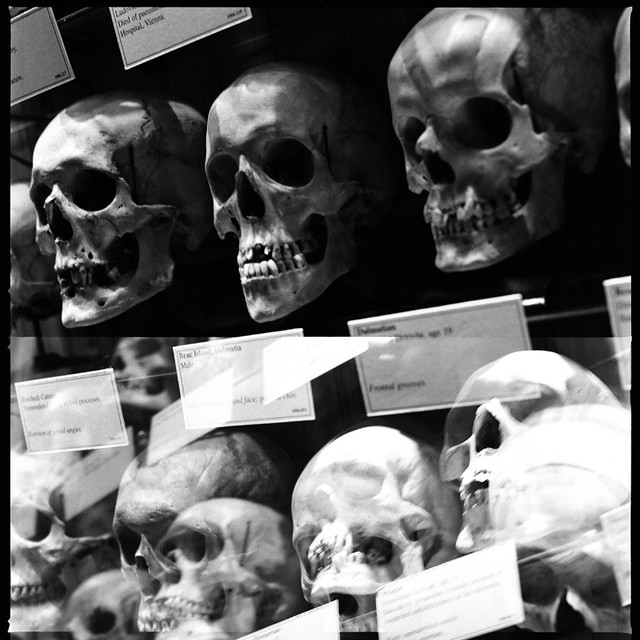
SOS = Save Our Skulls,Hyrtl Skull Collection, Mutter Museum, Philadelphia PA


Save Our Skulls 
A campaign to restore the Hyrtl Skull Collection at the Mütter Museum 
After more than 100 years, everybody needs a little repair! 

ROW ONE (22 Skulls): 


Name, age: unknown 
Gender: Male 
Nationality/Place of Origin: Amsterdam 
Accession #: 1006.009 
Cause of Death: Suicide 
Description: Turned-up nasal bones. 


Name, age: unknown 
Gender: Female 
Nationality/Place of Origin: Amsterdam 
Accession #: 1006.010 
Cause of Death: Suicide; persistent frontal suture. 
Description: Metopic suture; nasal crest; low cranial vault. 

photo

Monday, April 8, 2013

Did John Wilkes Booth Escape? Was He Really Killed? Army Thwarts DNA Investigation


Booth mystery must remain so - for now

Descendants of Abraham Lincoln's assassin want to knowif he escaped.
Descendants of Abraham Lincoln's assassin want to knowif he escaped. (LIBRARY OF CONGRESS)
Descendants of Abraham Lincoln's assassin want to knowif he escaped.


POSTED: March 30, 2013


The drama is clearly the longest running of any that John Wilkes Booth played during his acting career.
Was Booth, the assassin of Abraham Lincoln, killed by a soldier at a tobacco barn near Port Royal, Va., on April 26, 1865, as history books and government accounts record?
Or was someone else shot through the neck and declared to be Booth as a way of putting an end to the national tragedy? Did the president's killer actually escape?
Though those questions are settled in the minds of most scholars, they have intrigued and frustrated some historians and Booth family members, including some locally, who hoped to finally find answers.
But this month, just two weeks before the assassination anniversary, they were disappointed when the Army thwarted an effort to compare the DNA from the man in the barn with that of Booth's more famous thespian brother, Edwin.
Their request for access to an alleged Booth specimen - three cervical vertebrae in the collection of the National Museum of Health and Medicine in Washington - was rejected.
"Although the results might be intriguing, and the temptation to exploit emerging technologies is strong, the need to preserve these bones for future generations compels us to decline the destructive test," wrote Carol Robinson, the Army's congressional actions manager for the U.S. Army Medical Command, which oversees the museum. "The three vertebrae that were removed during an 1865 autopsy, believed to be [of] John Wilkes Booth, are unique and DNA testing may or may not yield the information desired," said the letter to U.S. Rep. Chris Van Hollen (D., Md.), who helped submit the request.
The answer is "beyond disappointing. . . . I'm angry," said Joanne Hulme, a Booth family descendant who lives in Philadelphia's Kensington section. "I would like to know who's buried in the family plot" in Baltimore's Green Mount Cemetery, where the assassin is allegedly interred.
"This never ends," she said Friday. "I may take this to my grave, but I will take it kicking and screaming."
Hulme's family and others - including Maryland educator and historian Nate Orlowek - sought permission in 1995 to open the grave believed to be Booth's but were thwarted by a judge who concluded its location could not be conclusively determined. Some reports had placed it at an undisclosed site in the cemetery.
That left the cervical specimen as the next best way to determine whether Booth or someone else was killed.
Its DNA could be compared with Edwin Booth's DNA retrieved from his grave in Cambridge, Mass., the family has said.
Philadelphia's Mutter Museum has cervical tissue of the man in the barn, but its DNA has been degraded by storage in formaldehyde and alcohol.
"We, the American people, own" the National Museum of Health and Medicine, said Orlowek, who has researched questions surrounding Booth's death for 40 years. "Why on earth should we spend millions of dollars to maintain a museum that withholds the decisive piece of evidence that would solve the greatest crime in American history?
"The American people should demand that they stop holding history hostage," he said Friday. The search for the truth "is only over if the American people allow this museum to stiff-arm history."
The testing of the specimen would not have seriously damaged it, said Krista Latham, director of the University of Indianapolis Molecular Anthropology Laboratory, and an assistant professor of biology and anthropology who would have performed the DNA test.
"We would have only needed 2 grams of bone," she said Friday. "That's a small amount, and it would have been minimally destructive.
"This is frustrating. This is a very important issue, and the worst thing we could do is give up."
For those questioning accepted history, the crucial days of April 1865 play over and over.
At 9 p.m. on the 14th of that month, Booth walked into Taltavull's Star Saloon next to Ford's Theatre and asked for a bottle of whiskey and some water.
"You'll never be the actor your father was," a customer reportedly told him.
"When I leave the stage, I will be the most famous man in America," Booth fired back, according to accounts.
An hour and a half later, the dark-haired actor - matinee idol of his time - shot Lincoln in the State Box at Ford's and dropped about 11 feet to the stage, breaking his left leg.
History says Booth was cornered 12 days later by detectives and Union soldiers in the barn in Port Royal. Shortly after 2 a.m. on a cool and cloudy Wednesday, he was mortally wounded in the neck.
Or was he?
From the beginning, several people who saw the body questioned the official account. The dead man didn't resemble the fair, raven-haired Booth. He had red hair, was freckled, and had a leg injury inconsistent with the assassin's. The questions will linger "as long as the demands of the American people for the truth are ignored," Orlowek said. "They have to let their voices be heard."

Contact Edward Colimore at 856-779-3833 or ecolimore@phillynews.com