Showing posts with label germantown historical society. Show all posts

Friday, September 5, 2014

"Graveyard Voices"-Death-Defying Poetry in Graveyard

Chestnut Hill Local, Thursday, September 4, 2014, Page 21:


‘Edgy,’ death-defying poetry performance in graveyard

Local Life September 5, 2014 0 Comments
Getting in the "spirit" for their Fringe Festival performance, "Graveyard Voices," are (l to r) 34th Street Poets Deidra Greenleaf Allan, Cindy Savett and Sandra Chaff, of Germantown, joined by poetic muse Yoricka (the skeleton). Other 34th Street Poets performing in Voices will be Alyson Adler, Barb Daniels and B.E. Kahn. Joining the group for the event will be Pew Fellow in the Arts J.C. Todd and David Daniels.
Getting in the “spirit” for their Fringe Festival performance, “Graveyard Voices,” are (l to r) 34th Street Poets Deidra Greenleaf Allan, Cindy Savett and Sandra Chaff, of Germantown, joined by poetic muse Yoricka (the skeleton). Other 34th Street Poets performing in Voices will be Alyson Adler, Barb Daniels and B.E. Kahn. Joining the group for the event will be Pew Fellow in the Arts J.C. Todd and David Daniels.
by Constance Garcia-Barrio
The adventurous 34th Street Poets will transform the gates of St. Peter’s Churchyard, 313 Pine St., Old City, into a portal between worlds this coming Saturday night. The poets will invite guests to enter the land of shades, or at least touch its boundaries, with “Graveyard Voices: a death-defying poetry performance with musings on aging, loss, death and what lies beyond.”
“This is not your mother’s bookstore reading,” said Germantowner Sandra Chaff, of this Fringe Festival event. “It’s a little edgy.”
Mortality-themed drinks before the show may help guests settle in, but “Graveyard Voices” promises a salutary shake-up. “Reflecting on mortality can create satisfying mindfulness that makes you feel more alive,” said Chaff, who co-founded 34th Street Poets, one of the city’s oldest continuously running poetry groups, in 1992.
Other members include Alyson Adler, Barb Daniels, B. E. Kahn, Cindy Savett and Deidra Lyngard, who writes under the name Deidra Greenleaf Allan. Joining the poets for this performance will be David Daniels and J.C. Todd, a 2014 Pew Fellow in the Arts. R. G. Evans will provide original music.
The poets, who have published books and chapbooks and received numerous awards, represent a range of voices. Add to that variety a disembodied voice that will come “through the ether” and put in its two cents with snippets and lines of poetry during the one-hour program.
Yoricka, the fictional sister of Yorick, whose skull Hamlet so famously addressed, will appear as the event’s official muse. Two poets from the Northwest will offer honest, compassionate and sometimes-odd views of death. Deidra Lyngard, of Flourtown, notes that death may be a tough sell in a culture that aims to nip, tuck and Botox its way to immortality.
“The thought of death can make people uncomfortable, but I find it easier with passing years,” said Lyngard, 67, director of publications at Springside/Chestnut Hill Academy. Originally from Washington, D.C, she likes living near Whitemarsh Farm. “There’s a distilling and condensing of life with age, a deeper appreciation of little things.”
Lyngard has written poetry since childhood. “I was 8 years old when I wrote a ballad about a frog,” she said. “I was so proud of myself. I remember standing in front of my Brownie troop and having everyone listen.”
In college and while launching a career in communications, Lyngard poured energy into other activities, but in 1997 she returned to poetry. Three years later, during a sabbatical from work, she attended the MFA program at Vermont College. It bore fruit. She was named Montgomery County Poet Laureate in 2001, the same year she won a Leeway Foundation Award.
“I write poems that explore the nature of our human boundaries, those troublesome and mysterious divides by which we define life, death and what is other than us. I’ve tried to pick a range of themes for this Saturday. There’s more than doom and gloom.”
Sandra Chaff, 68, born in northeastern Ohio, finds herself in her element in Germantown. “I’m energized by Germantown’s diversity — of architecture, religions and ethnic groups, you name it,” said Chaff, a lawyer and archivist who’s lived in the area almost 40 years.
“At the same time I’m enchanted by the history. There are so many Germantown stories that are part of the larger story of the country’s founding,” said Chaff, who’s been writing for as long as she can remember. “Take Philadelphia’s 1793 Yellow Fever epidemic. President George Washington, who was living in the city, the nation’s temporary capital, fled to Germantown and governed from here with his cabinet.”
Chaff unearthed lots of interesting and often little-known historical facts while she worked as the archivist and librarian at the Germantown Historical Society from 2008 to 2010. She also noted that Germantown is “awash in cemeteries.” “There’s the Upper Burial Ground (created in 1692) next to the Concord School on Germantown Avenue.
“Then we have the Lower Burial Ground, now named Hood Cemetery, and many, many churchyards, literally, cemeteries associated with churches. I enjoy trying to figure out the lives of the people by names and dates on their tombstone and the names and dates of those buried close to them.”
For Chaff, who’ll present a poem about a cemetery from the viewpoint of feral cats, “Graveyard Voices” provides a unique opportunity. “It’s not often that we can reflect on death in a public forum without the media blitz that surrounds the demise of celebrities. It’s good to do what we can to be aware at the moment of death because it’s got to be one of the most significant and interesting moments of our lives.”
The peace and beauty of St. Peter’s Churchyard — with its sycamores, London plane trees and seven Osage oranges linked to the Lewis and Clark expedition of 1804-1806, beckon. “Let ‘Graveyard Voices’ be the first event you attend Saturday evening,” Chaff said. “Your enjoyment of dinner and later shows will be all the sharper for reflecting on mortality.”
“Graveyard Voices” will be held Saturday, September 6, 6 p.m.-7 p.m. at St. Peter’s Cemetery, 313 Pine St. Come early to enjoy mortality-themed drinks before the show. Gates open at 5:30. Tickets may be purchased at the gate. $15 for general admission. More information at www.fringearts.com.

Friday, February 28, 2014

1874 "JonBenet"Case of its Time=1st Kidnapping for Ransom in America Which Received Nationwide Media Attention

Philadelphia Inquirer, Friday, February 28, 2014, Front Page, Page A1:


'JonBenet' case of its time - in 1874- at Germantown exhibit

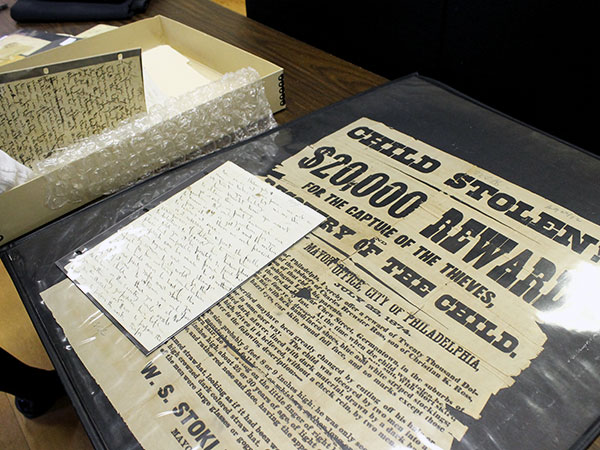
Documents will be featured in the Charley Ross exhibition at Historic Germantown, in Philadelphia, on Thursday, February 27, 2014. ( COURTNEY MARABELLA / Staff Photographer)
Documents will be featured in the Charley Ross exhibition at Historic Germantown, in Philadelphia, on Thursday, February 27, 2014. ( COURTNEY MARABELLA / Staff Photographer)GALLERY: 'JonBenet' case of its time - in 1874- at Germantown exhibit

The kidnappers wouldn't stop writing.
They didn't send just one ransom note. Or two. Or 10. They sent 23, a veritable War and Peace of demands.
But no money was paid. And the little boy they took was never seen again.
The case described as America's first recorded kidnapping for ransom took place in Philadelphia - the daylight abduction of 4-year-old Charley Ross from the front yard of his Germantown home in 1874. The quiet, shy boy was lured into the clutches of strangers by an offer of sweets, his fate believed to have given rise to the warning, "Never take candy from strangers."
MORE COVERAGE

  • Monticello slavery focus of NCC exhibit
  • Graceland exhibit gives glimpse into young Elvis
  • Friday night, a reception at the Germantown Historical Society opens a two-month-long exhibit on the case, tied to the recent surprising discovery of the ransom notes in the basement of a Mount Airy home.
    The exhibit includes photos of the main actors, newspaper stories of the day, a missing-child poster, and more to fuel theories on the nature of a dark crime.
    "It was the JonBenet Ramsey case of its time," said Barbara Hogue, executive director of Historic Germantown, an alliance of area museums.
    And not just because it went unsolved.
    News coverage of the kidnapping was sensational and national, torment to a city government preparing to host the Centennial International Exhibition of 1876 and urging people to open spare rooms to visitors.
    The criminals struck upon a simple idea: Don't take people's property, take people. And get their families to pay for their return. It proved an enduring and replicable crime.
    Kidnappers took and killed the infant son of aviator Charles Lindbergh in 1932, a case that journalist H.L. Mencken called "the biggest story since the Resurrection." Frank Sinatra Jr. was kidnapped from Harrah's Lake Tahoe in 1963, released when his father paid $240,000. John Paul Getty III was snatched in 1973 by kidnappers who demanded $17 million - and sent his severed ear to a newspaper when the family was slow to pay.
    The Ramsey saga began the day after Christmas 1996, when mother Patsy found a ransom note on a staircase of the family home. The body of the 6-year-old beauty queen was discovered hours later in the basement.
    As for the Charley Ross case, it began July 1, 1874, as the boy and his nearly 6-year-old brother, Walter, played outside.
    A horse-drawn carriage pulled up, and two men inside offered to buy candy and fireworks if the boys would go for a ride. All four traveled to a store in Kensington, where Walter was given money and sent inside. The carriage then left without him.
    Three days later, a letter demanding $20,000 reached the boys' father, a dry goods merchant, Christian Ross. That sum was a fortune at the time, the equivalent of more than $400,000 today.
    "Mr Ros, be not uneasy, you son charley bruster be all writ we is got him and no powers on earth can deliver out of our hand," the kidnappers wrote.
    On that July 4, as news of the crime spread, Mayor William Strumberg Stokley laid the cornerstone of the new City Hall in what was then Center Square, and officially broke ground for the centennial celebration in Fairmount Park. The Philadelphia Zoo had opened for the first time only three days earlier.
    Detective work was relatively new. The Philadelphia Police Department was less than 40 years old, and the Pinkerton Detective Agency, which became involved in the search for the boy, had been formed less than 25 years earlier.
    All during July, a frightened public demanded answers. The mayor offered a city reward of $20,000 - the same amount sought by the kidnappers. The Inquirer offered a reward, too. Children sent coins to help save the lost Charley.
    The early ransom notes gave instructions for how Christian Ross should reply in the personal ads of local newspapers. Later, the kidnappers discussed the news coverage, attempting to justify their actions in increasingly desperate tones.
    "I really do think they intended to give the child back once they got the money," said Carrie Hagen, author of We Is Got Him: The Kidnapping That Changed America and a speaker at Friday night's reception. "I don't think they had any clue this would blow up like it did."
    Police told Christian Ross not to pay the ransom, because they feared a wave of copycat crimes. Ross took the advice. He never saw his child again.
    The letters stopped in November, after a series of arranged meetings fell through.
    Authorities identified two suspects, career criminals Bill Mosher and Joe Douglas. In December the two were met by armed neighbors when they tried to rob a Brooklyn, N.Y., home. Mosher was killed in the shoot-out, but Douglas lingered for an hour, during which witnesses said he confessed, telling them, "I helped to steal Charley Ross. . . ."
    The next year a suspected accomplice, a friend of Mosher's and a former Philadelphia police officer named William Westervelt, went on trial for kidnapping. Convicted of the lesser offense of conspiracy, he served seven years, then disappeared from history.
    Charley's body was never found. One explanation? Maybe he wasn't killed, but placed in a different family, where he grew up unaware of his true identity. At the time, scores of "Orphan Trains" were headed west, taking neglected children in New York to new homes elsewhere. A child could easily have been slipped aboard.
    "It's a sad story," Hagen said, "but one of the things about it, a positive outcome, was, a lot of children who were taken were found. You had people coming forward saying, 'My neighbor has a kid, and I don't know where the kid came from.'"
    For decades after the crime, people stepped forward, hundreds of them, claiming to be Charley Ross. In the 1930s, a carpenter in his 60s named Gustave Blair persuaded an Arizona court that he was Charley Ross, successfully changing his name to that of the child. The Ross family dismissed his claims.
    Today the case is largely forgotten, and the ransom notes thought lost - until March, when a Germantown Academy librarian found them in the basement of her Mount Airy home.
    Bridget Flynn and a daughter were searching through boxes of family photos and letters, looking for a drawing that could appear on a bridal-shower invitation. As they rummaged, Flynn found a stack of small envelopes tied with a black shoelace.
    "I thought they were love letters between my grandmother and my grandfather," Flynn said.
    They weren't. But how the letters came to her home is a mystery. While her family has been in Philadelphia since the 1600s, there's no obvious connection to the Ross family or the case, Flynn said.
    In November the notes were bought at auction by an anonymous benefactor, who then loaned them to Historic Germantown. The sale price was $20,000, the same as the ransom.
    Texts of the letters have been available from newspapers and books of the era, but the exhibit marks the first time all 23 can be seen in public.
    "There's still a lot of questions," Hogue said. "It's still not solved."


    jgammage@phillynews.com 215-854-4906
    @JeffGammage

    Read more at http://www.philly.com/philly/news/20140228_Ransom_notes_from_nation_s_first_ransom_kidnapping_on_exhibit_in_Germantown.html#jcbjPmGvboRzhg6Q.99