Deathternity talks about all things death related. There are 1 million+ owned graves in cemeteries in America that people will not use. Cemeteries do not buy graves back. I would encourage people to begin thinking about either selling or buying these graves at a deep discount to what your cemetery charges. Or you can donate unused graves for a tax deduction. If I can help you with this please contact me here, email me at deathternity@gmail.com, or call me at 215-341-8745. My fees vary.
Is celebrating the life, or remembering the dead the right thing for a funeral?
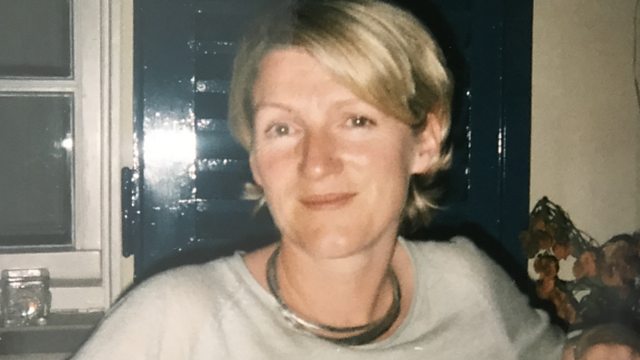
When Colin Brazier lost his wife Jo to cancer last summer, he felt pressure to put his grief on show, to make her funeral a celebration.
Friends expected him to give the eulogy at her funeral, and some wanted to wear bright colours to celebrate her life. But that felt completely wrong, and though one mourner turned up in shorts and flip flops, the service was a traditional one with hymns and mourners dressed in black. As a Catholic, the ritual of the Requiem Mass felt cleansing and appropriate.
As much of Europe and the US becomes more secular, Colin explores the modern funeral and the growth of the personalised, celebratory service, in contrast to the service he organised for Jo. With pall bearers dressed as super-heroes and wakes at McDonalds, is death being given its true state, and should it be a time to celebrate?
In a highly personal programme, Colin talks to non-believers too, and asks how they navigate death without the framework of religion to guide them.
Presenter: Colin Brazier Producer: Henrietta Harrison
Picture: Jo Brazier. Credit: Colin Brazier
On Sunday, California Governor Jerry Brown passed AB 967, an innocuously named bill for a not-so-innocuous law. The bill, proposed by assembly member Todd Gloria, a San Diego democrat, will make it legal for Californians to liquefy their corpses after death in a bath of caustic juice.
The process, referred to as water cremation (or aquamation, resomation, bio-cremation, or flameless cremation), has been proposed as a much more environmentally friendly way to dispose of a body after death. The bill is sponsored by Qico, Inc., a “sustainable cremation” company that specializes in this form of corpse disposal, and it will go into effect by at least July 1, 2020.
“A lot of people view water creation as a more respectful option and we’re glad a lot of people will be able to have it,” Jack Ingraham, the CEO of Qico, tells Inverse. “We think this is a trend for the future. I think within 10 years to 20 years, cremation will be thought of as a water-based process, and the entire flame process will be replaced.”
Unfortunately, no actual liquid is returned to the survivors, only the remaining calcium, or the bones. “These are crushed into the ashes returned to the family,” Ingraham says, who adds that the process also results in about 20-30 percent more “ashes” being returned to the family. So while you can’t drink Uncle Frank, you will get more of his ashes.
These days, the only mainstream options available are burial or cremation, both of which aren’t especially green; coffins take up a lot of valuable space and are made of slowly biodegrading wood, and cremation requires reaching temperatures of up to 1800 degrees Fahrenheit, which isn’t exactly energy efficient. Then there’s the option of sending a dead body to space in a rocket, which is not green, for obvious reasons.
Aquamation, in contrast, dissolves a body, DNA and all, in a vat of liquid into a relatively unharmful solution of slightly alkaline water that can be neutralized and returned to the Earth. California is the latest state to make the procedure legal, joining 14 others.
The chemical process behind aquamation is called alkaline hydrolysis, which involves sticking a body into a solution of potassium hydroxide and water that’s heated to about 200 degrees Fahrenheit, a slightly lower temperature than boiling and waiting for it to dissolve.
Potassium hydroxide, often referred to as potash or lye, is a common chemical used in manufacturing soft soap and biodiesel. Its defining quality is that it’s chemically alkaline, which means that it’s packed with oxygen-hydrogen pairs known as hydroxide groups. In strong enough concentrations, hydroxides can dissolve organic solids into liquids; it’s essentially the same process that happens when you pour Drano into a sink clogged with fat or hair.
In aquamation, raising the temperature and pressure helps the process move along faster. Usually, it takes about four hours to dissolve a skeleton. By the end of the process, the only solid thing that’s left is a pile of soft bones (potassium hydroxide won’t eat through calcium phosphate) that gets crushed into a sterile powder for family members of the deceased to take home.
As for the flesh, blood, and guts? Everything else gets dissolved into a green-brown liquid that’s slightly less basic than it was at the start of the process. What starts as a solution with a very strongly alkaline pH of 14 (the most basic possible) ends up somewhere around pH 11. Truly neutral water has a pH of about 7, so technicians sometimes add an acidic substance, like vinegar, to balance out all the excess hydroxides floating around.
It’s “what happens in a natural burial in the ground, just in a faster time frame,” Ingraham says.
The process is already a popular way to dispose of a dead pet’s body; not only is it less energy-intensive than other methods, but it also kills potentially life-threatening pathogens, like viruses, bacteria, and prions that cause transmissible spongiform encephalopathy (the type that cause mad cow disease), which aren’t always inactivated by heat.
The thought of liquefying a body is pretty weird, but California is not the first state to make it legal: Oregon, Minnesota, Maryland, Maine, Kansas, Illinois, Florida, Colorado, Georgia, Wyoming, Idaho, and Nevada have already joined the ranks of the corpse dissolution supporters. It’s something we’d better get used to in the long run. The world is running out of space, both for living and dead bodies, so it’s in our best interest to figure out what to do with all of our future corpses. Besides, if humans aren’t going to do anything good for the Earth while we’re alive, we might as well find a way to do so in death.
What’s next for aquamation in California? Ingraham says his two-year-old company expects to have their technology ready by 2019 and to be in agreement with state regulators by then as well. Meanwhile, he’s hopeful that demand will grow for this new technology that he expects will cost a little more than traditional cremation but ultimately will be set by funeral homes.
While you can’t scatter traditional ashes at Venice Beach because they’re relatively toxic — they’re ashes, after all — you won’t have those restrictions with the result of a water cremation, Ingraham says.
“When people hear about it they tend to prefer it,” he says, noting that the white “ashes” from water-based cremation can be scattered in more places.
As Washington State considers legalizing human composting, advocate Katrina Spade explains the process as a needed alternative to standard burial and cremation.
Last month, Washington State Senator Jamie Pedersen pre-filed a bill to legalize human composting, also known as “recomposition.” If it passes, Washington would be the first state in the U.S. to allow the practice. (The bill would also legalize alkaline hydrolysis, the dissolving of bodies in a pressurized vessel with water and potassium hydroxide, or lye; it is already legal in 16 states.) Pedersen introduced a bill to legalize alkaline hydrolysis in 2017 but without success.
The fact that human composting is on the legislative agenda is largely thanks to designer and entrepreneur Katrina Spade. Spade is the founder and CEO of Recompose, a human-composting company, and she has spent years promoting it as a greener alternative to standard death practices. In the process that Recompose has devised, the body is placed in a vessel with wood chips, alfalfa, and straw, which work to decompose the body. The company co-sponsored a recent trial at Washington State University that determined recomposition is safe and effective, and Spade and her team say it uses only one-eighth the energy of cremation.
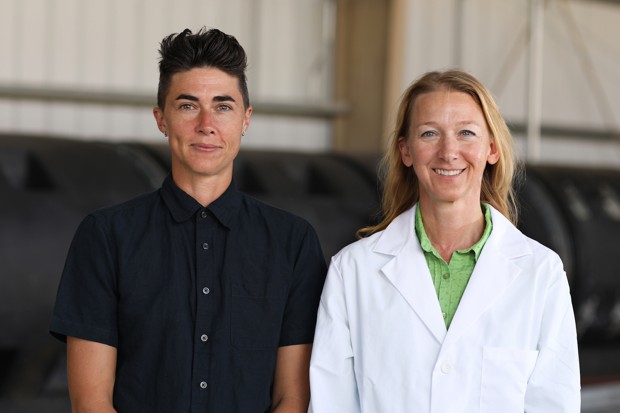
Katrina Spade (left) with Lynne Carpenter-Boggs, a soil scientist and research advisor for Recompose. (WSU Communications)Spade wants to build a fully functioning human-composting facility in Seattle when the practice becomes legal. This would not simply offer a new way to dispose of remains, but be a place of comfort for relatives and friends of the deceased, with gardens and events like poetry readings. CityLab caught up with Spade to find out more about human composting and her vision for this state-of-the-art facility. The interview that follows has been lightly edited for length and clarity.
Tell me about how you first became interested in this idea of human composting.
I was in graduate school for architecture, and I began thinking about what would happen to my body after I died. And then I got a little obsessed with the funeral industry and the options we have. And then a friend of mine told me about this practice that farmers and agricultural institutions have been using for decades now to recycle animals back to the land. It was like a light bulb went off, and I decided to make it my mission to apply those principles to humans and create a new option for human disposition. Once you had this idea, where did you go from there?
I had the luxury of being in graduate school, so it became my thesis project. I was at my desk many, many hours a day at the University of Massachusetts, Amherst in the architecture department, just kind of imagining what would be meaningful and thinking a lot about what the space would look like and feel like.
In 2014, I got this fellowship called Echoing Green. It was really surprising to me that this wasn’t just an idea for my friends and family, but it was something that the broader community was really interested in. That fellowship came with seed funding and allowed me to quit my day job and just work on the project full time. I was then able to start a nonprofit called the Urban Death Project. We did a lot of the initial research into the work and also started to build a community around the idea.
In 2017, we closed the nonprofit and started Recompose, which is a public-benefit corporation. Most of our focus has been on co-sponsoring research with Washington State University. We’re also working with the Washington state legislature to try to pass proposed legislation that would allow recomposition for public use. And then we’re always working toward designing and developing Recompose Seattle, which hopefully will be the first place in the world where recomposition is offered.
What’s your vision for this facility?
We will probably lease a warehouse base. Ideally, it will have character. And then we’ll fit it out to make sure that there’s natural light and interior gardens, and mostly just make a space that feels really comfortable and really comforting to people. And then we would implement our recomposition system in the building itself, so families can come and have a memorial service, spend time together, and also start their loved one’s body on this journey of transformation from human to soil.
Tell me more about the recomposition process. Besides putting a body in a vessel with materials used to break down the remains, what else is involved?
With the aerated process, oxygen is a really important piece, because essentially what we’re doing is creating the right environment for microbes to do their job. [It] requires oxygen, nitrogen, and carbon, and then the microbes really do a beautiful job of breaking everything down on a molecular level and creating this beautiful, usable soil.
Could the process work for everyone?
The process is good for just about everyone. I think the only exception would be if you have a disease where you’re quarantined. That wouldn’t be a fit. But those are exceedingly rare [cases]. One of the reasons you argue for recomposition is the positive environmental impact it could have. Can you say more?
One of the reasons I started developing the concept was because I found out that both cremation and conventional burial have a significant carbon footprint. Thanks in part to sequestration of carbon that occurs during the process, it has been estimated that recomposition will save just over a metric ton. That means that for every person that chooses to be recomposed instead of cremated or buried, it will save just over a metric ton of carbon, which is pretty significant.
I think one of the things for me, in addition to that carbon savings, is just having a way to create usable soil. Something that you can go grow a tree with and have sort of this ritual around that feels meaningful.
Can recomposition help in large, dense cities where cemetery plots are limited?
My vision has always been that conventional burial—giving everyone their own spot in this city—probably isn’t very sustainable in the long term. So what’s a process that works for our urban population? And I think recomposition really fits that. [In] a lot of cities, people are concerned about land use. And cemeteries are filling up, so one of the things recomposition does is solve for that problem.
Are there psychological benefits to human composting?
I think in general, death is a really personal thing. And people experience death of a loved one in so many ways. So our goal with recomposition is just to add more choice when it comes to death of a loved one, so that it’s still really personal.
In my vision, we have a dozen options for disposition in the next 10 years or so, because I think that’s really what we as a diverse and creative society deserve. But for now, we’d like to add recomposition to the list.
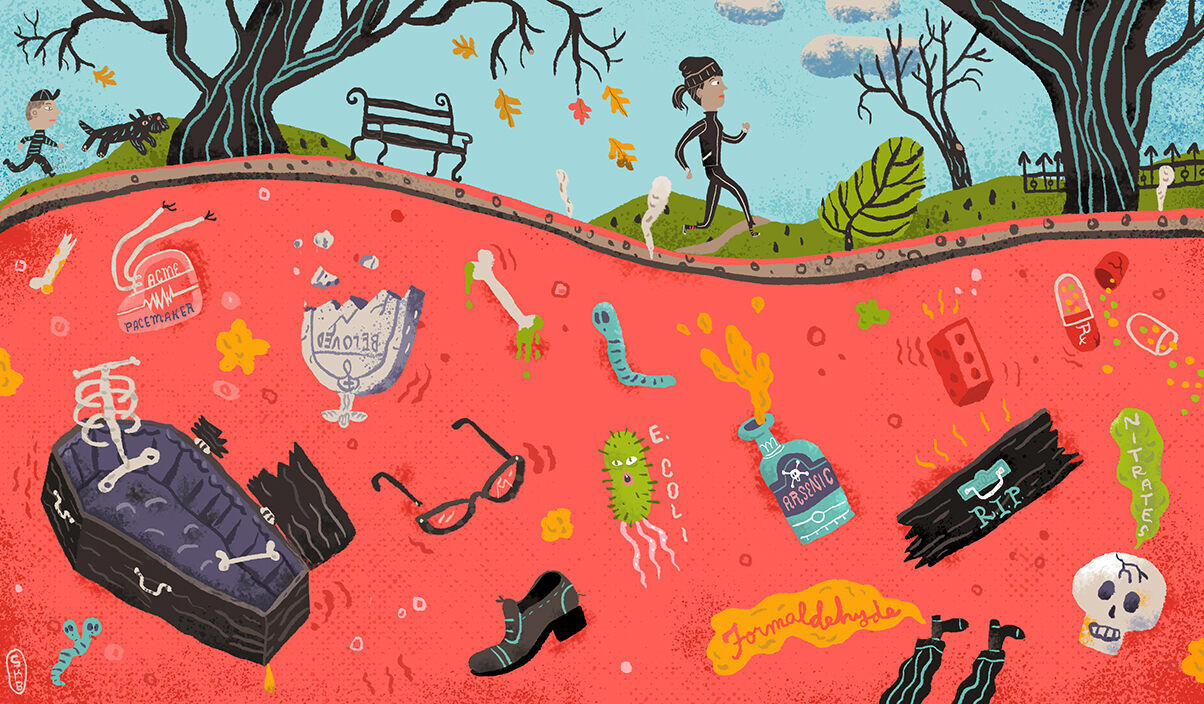
Cemeteries are landfills, and can contain all sorts of pollutants. Stephanie Birdsong
4,374
In the central cemetery of Marau, a small city in southern Brazil, squat mausoleums are crowded together like a mess of toy blocks. From the cobbled walks, the cemetery looks clean and well kept. But a couple of years ago, when a team of researchers visited, they noticed a crack in the wall of one of the tombs. Inside was a relatively new corpse, and it was leaking.
A human body is made mostly of water, carbon, and salts, containing calcium, potassium, iron, and other compounds familiar from the back of a vitamin bottle. When a person dies and their body starts to decompose, it transforms into a salty liquid—known as “necroleachate”—made up of about three-fifths water and two-fifths salts and organic compounds. Every 15 or 16 pounds of body weight produces a gallon of leachate, which has a distinct, fishy smell.
In cemeteries, this liquid of decomposition seeps into the ground and, especially in sandy or gravelly soil, can mix with the groundwater below. In Brazil, where it’s hot and humid and torrential, the risks of this happening are particularly high. “I consider cemeteries one of the biggest contamination problems,” says Alcindo Neckel, a geographer at Brazil’s Faculdade Meridional, who led the study of the Marau cemetery.
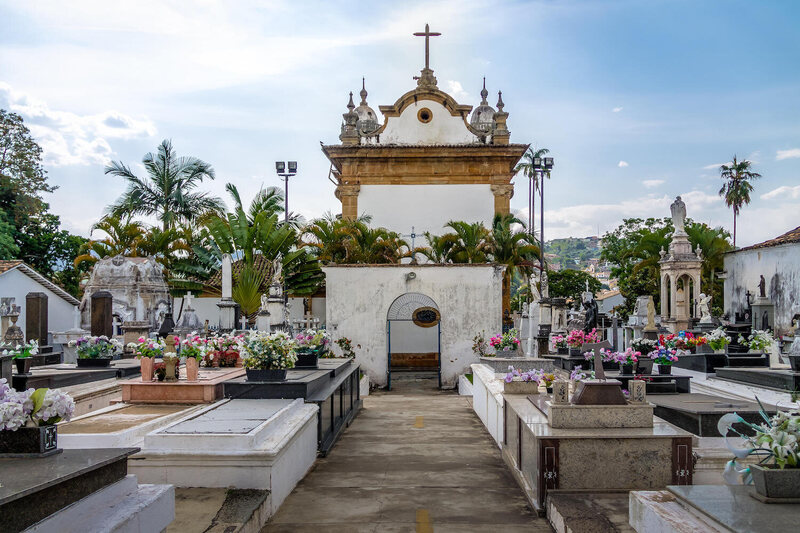
Some cemeteries, such as this one in São João del Rei, Brazil, can pose health risks. Diego Grandi/Alamy
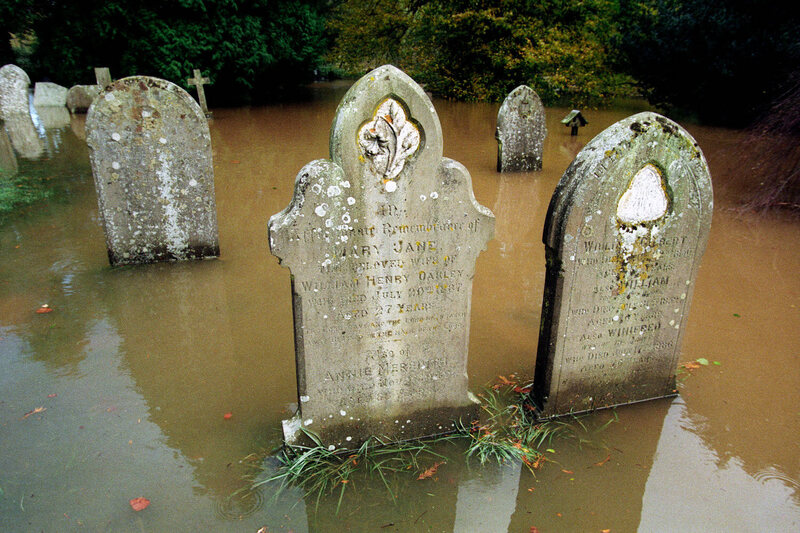
For millennia, groups of people have set aside special places to inter their dead, but as the world’s population has grown, so have the problems with concentrating dead bodies in this way. “Cemeteries can be regarded as special kinds of landfills,” the World Health Organization wrote in a 1998 report, and, like any landfill, they come with pollution risks. There have been few comprehensive studies of their environmental hazards, but in some cases—a cemetery that keeps flooding, for instance—the dangers of contamination are clear. With cemeteries sometimes converted into parks and playgrounds, or surrounded by dense development, environmental scientists are increasingly trying to understand the real dangers hidden in cemetery grounds.
In any place where we bury bodies, the soil will be different from the surrounding land, and those underground signatures can last for hundreds, even thousands, of years. Some researchers have a name for cemetery soils—“necrosols”—and they can carry higher concentrations of nutrients than the surrounding areas. Far more alarming are the microbes that soil can contain.
Back in the 19th century, there were at least a few documented cases of cemeteries contaminating urban water supplies. Cholera often slipped from dead bodies into drinking water, and in Berlin in the 1860s, people who lived near cemeteries were at higher risk of contracting typhoid fever. In Paris, the water near cemeteries might have tasted sweet and had that fishy, infected smell.
Modern cemeteries are full of all sorts of other potential contaminants. Every year in the United States, more than 100,000 tons of steel—“enough to rebuild the Golden Gate Bridge,” as a reporter for Modern Farmer noted—are buried in cemeteries, along with wood preservatives, paints, medical devices with radioactive components, zinc, silver, bronze, hip replacements, breast implants, and all the other detritus of human life that we take with us to the grave. Embalming fluids, which once included arsenic, are gradually mixed into the dirt. The formaldehyde used today is a carcinogen. Corpses secrete toxic compounds called putrescine and cadaverine, which are responsible for the off-putting smell of decomposition. Cemeteries are heavily landscaped, too, which means a lot of fertilizer. The varnishes of coffins, the clothing people are buried in, the make-up on their faces—it’s all filled with compounds that, concentrated heavily in one place, can become a hazard.
While human bodies decompose in about a decade, some of these pollutants linger for much longer. Traces of metals, for instance, can persist for many years. “It dilutes over time,” says Matthys Dippenaar, a hydrogeologist at the University of Pretoria, who has been leading a project on the environmental hazards of cemeteries. “But it never disappears.”
Flooding, seen here in Wales, can exacerbate pollution problems in cemeteries. Jeff Morgan 04/Alamy
The way that cemeteries are sited and designed can exacerbate these issues, his project found. Graves can act like a sieve, providing channels for rain or floodwater to flow into the ground, directly through the highest concentrations of contaminants. Or the presence of a cemetery can lead to erosion, which sloughs the buried pollutants off into nearby water sources. Often cemeteries are located in flood-prone areas, close to wells, or in sensitive places, because as a form land use and compared to activities like housing and industry, Dippenaar says, “a cemetery is often wrongly considered to be the lowest risk.”
From a public health perspective, the contamination that poses the highest risk is the pathogens. “Historically, people have assumed if you put formaldehyde in the body, then you know the pathogens would die off,” says microbiologist Eunice Ubomba-Jaswa, a water resources quality manager at the South African Water Research Commission, and one of Dippenaar’s collaborators. But studies have found all sorts of microbes thriving in cemetery soil: E. coli, salmonella, C. perfringens (a common cause of foodborne illness), and B. anthracis (which, as its name suggests, carries anthrax). In laboratory simulations of cemetery conditions, Ubomba-Jaswa was surprised to find that E. coli survived the biocide that was supposed to kill them off. In one study, their team found E. coli, including the more dangerous, drug-resistant strains, in water samples from three different cemeteries.
Before we panic about the toxic waste sites in our midst, it’s important to remember that in most cases, there is no immediate danger or cause for alarm. But this research shows that cemeteries can be reservoirs for many things that we don’t want to live around. And the problem could get worse in the case of a serious disease outbreak, in which the infectious agents could simply cycle through cemeteries and back into the living population.
“It’s a very low probability of a very high risk,” says Dippenaar.
Researchers who study these issues, including Neckel, Dippenaar, and Ubomba-Jaswa, often come to the conclusion that burial is simply an unsustainable way to deal with dead bodies, in the long term. For a cemetery to be naturally secure, “you need the prime land, not the worst land,” says Dippenaar.
It’s not totally obvious what the best alternative is for an environmentally conscious death. Cremation, for instance, has its own environmental impact. But there are plenty of ideas floating around—from vertical cemeteries to mushroom death suits to freezing a body and shaking it to dust.
“The way we live has changed so rapidly, but how we die and how we look at burial has remained quite static over a long period of time,” says Ubomba-Jaswa. “We are changing our lifestyles, with respect to how we live, and that should keep up with how we die.”
In his new collection, “Be With,” the poet yearns, endures, and tries to spin the inchoate into words.
By Dan Chiasson
The elegies in “Be With” chart the addled chronology of loss.Illustration by Tom Bachtell
The title of Forrest Gander’s latest book of poems, “Be With” (New Directions), is a blurted command welling up from yearnings not quite expressible in language. Gander’s partner of more than thirty years, the poet C. D. Wright, died unexpectedly in her sleep in 2016. Later that year, a new volume by Wright, “ShallCross,” was published posthumously, with a dedication to Gander: “for Forrest / line, lank and long, / be with.” Gander borrows his title from that dedication, which reads like a message from beyond the grave. This collection of elegies for Wright confirms receipt of the message and returns it. Poetry often creates a supernatural-seeming rapport with the dead, but rarely has the communication between worlds felt so eerily reciprocal.
Gander, who teaches at Brown, is the author of eleven books of poems and two novels, plus multimedia collaborations and distinguished translations. In “Be With,” he is at once adamant about the ineffability of grief and committed to getting his inchoate “grief-sounds” somehow into words. The book’s sputtering, flinching style, with its syntactical dead ends and missed connections, feels like both an accommodation to the necessity of language and proof of its inadequacy. “Beckoned” is a poem about finding the words. The parallel structure of its sentences suggests hasty bulletins delivered in a narrowing span of consciousness. It begins abruptly, in the middle of some story we haven’t read, capturing the sudden, repeated shock of Wright’s death:
At which point my grief-sounds ricocheted outside of language.
Something like a drifting swarm of bees.
At which point in the tetric silence that followed
I was swarmed by those bees and lost consciousness.
At which point there was no way out for me either.
The heavy silences between these single-line stanzas suggest a blackout or a seizure, something more dire than a break for thought. Grief takes us back to the same “point” in time, again and again, even as the clock—and the book itself—moves forward. Coming to in this interstitial state, Gander finds himself suspended in a “semi-coma, dreaming I was awake,” where actions and symbols share a single plane:
At which point I grew old and it was like ripping open the beehive with my hands again.
At which point I conceived a realm more real than life.
At which point there was at least some possibility.
Some possibility, in which I didn’t believe, of being with her once more.
The distant future gets the past tense: even the unknown trajectory of Gander’s emotional life is described as fixed, and finished. There’s nothing ahead for him except grieving. The “possibility” that he constructs contains both supreme hopefulness and self-cancelling disbelief. “I outlived my life,” he writes.
The book’s title gives away its most tragic insight. “Be with”: the phrase is stripped of its object; the beloved has been ripped from the world. Reciprocity is suddenly broken, as though one player in a game had walked off the court mid-volley. “Who was ever only themselves?” Gander asks in “Son,” a poem addressed to his and Wright’s “one arterial child.” In “Epitaph,” another jarring phrase substitutes for more mellifluous expressions:
Advertisement
To write You existed me would not be merely a deaf translation.
For there is no sequel to the passage when I saw—as you would never again be revealed—you see me as I would never again be revealed.
The line breaks scramble and reframe the memory of when the two parties, by seeing the other see, brought each other into existence. Because “there is no / sequel to the passage,” Gander is compelled to continue revisiting it. Birth and death are all there in that first glance: “never again” conveys irrevocable loss. The line break in the second instance—“never / again”—suggests that, for the living, the full emotional weight of eternity must “be revealed,” and endured, again and again.
To write about profound loss, you step inside a genre, elegy, that is full of haunting echoes. Gander’s poems call to mind those Thomas Hardy wrote after the sudden death of his wife, Emma. Hardy’s verse skips over his immediate, painful past to a moment “when our day was fair,” dwelling on the uncanny traces his wife left behind in “a room on returning thence.” Gander shares the intensity of Hardy’s grief—his morose fixation on moments squandered. The poems in “Be With” recall the happy parallel paths in life and in art that he and Wright followed—always within a holler of each other. After Wright’s death, Gander’s memories revolve around objects, landscapes, work, and routines—symbols that become nearly sentient in their embodiment of his pain:
The cabinet door’s squeaky dactylic remark: Hap-pi-ness?
What Gander calls the “spectacularization / of the trivial” occurs when the everyday—an ordinary cabinet, a mundane memory—“means just / what it feels like / it means.” We teach our objects how to speak our language. This poet’s cabinet even talks in meter.
“Be With” charts the addled chronology of personal loss. The linear march of time is scattered with vignettes from Gander and Wright’s life together, often out of order, often repeated. Early on, she candled eggs for a poultry farm while he played “frisbee on the green.” One night, instead of making love Wright takes a bath, her knees poking up “through the soap bubbles,” while Gander stargazes under the “Prawn Nebula.” Loss is what makes these memories visible; without it, what you have is just another evening of slightly divergent marital priorities. A more recent, more painful memory captures the contesting imperatives of finality and delay:
“If you want to throw in some dirt,” the priest addressed the widower and his child generally but did not complete the sentence.
The priest doesn’t finish the sentence, but Gander must.
Meanwhile, the world proposes alternative measurements of time and loss. One day, Gander discovers that “the spider / vibrating on its long legs in the ceiling corner / over my desk doesn’t exist now.” The spider’s work, so deeply associated with writing poetry, has been cut short. In an interview, Gander has said that one poem in the collection, a loose translation of the first ballad of St. John of the Cross, was literally interrupted by Wright’s death. This breach is honored in real time: the poem suddenly veers off in a personal direction. The book as a whole replicates this effect: it is a self-suturing wound, equal parts bridge and void.
Advertisement
The fleeting moments that Gander assembles seek an order that is not merely chronological. He remembers a question from Wright: “If it’s not all juxtaposition, she asked, what is the binding agent?” The most obvious answer is language, though, as Gander discovers, language often fails. “Creepy,” he writes, “always to want to pin words on ‘the emotional experience.’ ” Sometimes he gets rid of the binding agents altogether, as in “Deadout,” a two-part poem that arranges fourteen sentence fragments into intelligible couplets, then scrambles them into dreamlike illogic. The result isn’t nonsense; it’s a haunting near-sense made by foiling cause and effect.
Gander has a degree in geology and is the author, with John Kinsella, of “Redstart,” a pioneering hybrid treatise on ecopoetics, a movement in contemporary poetry that, according to Gander, explores “the economy of interrelationship between human and non-human realms.” In the same way that the vocabulary of faith might aid a religious poet in a time of crisis, Gander’s deep affinity for the natural world provides a kind of solace. There phenomena “rarely have discreet beginnings or endings” and instead reveal “layers, duration, and transitions.” The impulse to go very small or very big, from the microscopic to the cosmic, is evident in the opening poem. “You lug a bacterial swarm / in the crook of your knee,” Gander writes, while “through my guts / writhe helminth parasites.”
The book’s final section is titled “Littoral Zone”—the part of a body of water, usually near the shore, where enough light passes through for plants to grow. My Google search tells me that by the time sunlight reaches the bottom of the littoral zone it is usually one per cent or less of its surface strength. That’s about as much comfort as arrives in this harrowing, sometimes despairing book. But even in near-darkness there’s light enough for a new, strange kind of love poem:
. . . From afar, do you see me now briefly here in this phantasmic standoff riding pain’s whirlforms?
The phrase “phantasmic standoff” is lifted directly from “Redstart,” where it refers not to humans but to strange “nocturnal / pods,” surging in the dark water. It was Nietzsche who defined human beings as “hybrids of plants and ghosts.” The comfort of the littoral is, I take it, entirely figurative. ♦︎2