Deathternity talks about all things death related. There are 1 million+ owned graves in cemeteries in America that people will not use. Cemeteries do not buy graves back. I would encourage people to begin thinking about either selling or buying these graves at a deep discount to what your cemetery charges. Or you can donate unused graves for a tax deduction. If I can help you with this please contact me here, email me at deathternity@gmail.com, or call me at 215-341-8745. My fees vary.
On Sunday, California Governor Jerry Brown passed AB 967, an innocuously named bill for a not-so-innocuous law. The bill, proposed by assembly member Todd Gloria, a San Diego democrat, will make it legal for Californians to liquefy their corpses after death in a bath of caustic juice.
The process, referred to as water cremation (or aquamation, resomation, bio-cremation, or flameless cremation), has been proposed as a much more environmentally friendly way to dispose of a body after death. The bill is sponsored by Qico, Inc., a “sustainable cremation” company that specializes in this form of corpse disposal, and it will go into effect by at least July 1, 2020.
“A lot of people view water creation as a more respectful option and we’re glad a lot of people will be able to have it,” Jack Ingraham, the CEO of Qico, tells Inverse. “We think this is a trend for the future. I think within 10 years to 20 years, cremation will be thought of as a water-based process, and the entire flame process will be replaced.”
Unfortunately, no actual liquid is returned to the survivors, only the remaining calcium, or the bones. “These are crushed into the ashes returned to the family,” Ingraham says, who adds that the process also results in about 20-30 percent more “ashes” being returned to the family. So while you can’t drink Uncle Frank, you will get more of his ashes.
These days, the only mainstream options available are burial or cremation, both of which aren’t especially green; coffins take up a lot of valuable space and are made of slowly biodegrading wood, and cremation requires reaching temperatures of up to 1800 degrees Fahrenheit, which isn’t exactly energy efficient. Then there’s the option of sending a dead body to space in a rocket, which is not green, for obvious reasons.
Aquamation, in contrast, dissolves a body, DNA and all, in a vat of liquid into a relatively unharmful solution of slightly alkaline water that can be neutralized and returned to the Earth. California is the latest state to make the procedure legal, joining 14 others.
The chemical process behind aquamation is called alkaline hydrolysis, which involves sticking a body into a solution of potassium hydroxide and water that’s heated to about 200 degrees Fahrenheit, a slightly lower temperature than boiling and waiting for it to dissolve.
Potassium hydroxide, often referred to as potash or lye, is a common chemical used in manufacturing soft soap and biodiesel. Its defining quality is that it’s chemically alkaline, which means that it’s packed with oxygen-hydrogen pairs known as hydroxide groups. In strong enough concentrations, hydroxides can dissolve organic solids into liquids; it’s essentially the same process that happens when you pour Drano into a sink clogged with fat or hair.
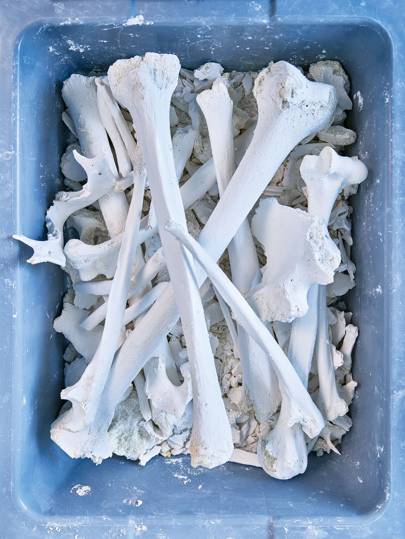
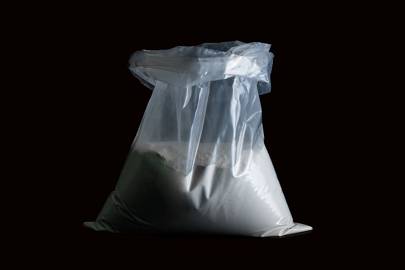
In aquamation, raising the temperature and pressure helps the process move along faster. Usually, it takes about four hours to dissolve a skeleton. By the end of the process, the only solid thing that’s left is a pile of soft bones (potassium hydroxide won’t eat through calcium phosphate) that gets crushed into a sterile powder for family members of the deceased to take home.
As for the flesh, blood, and guts? Everything else gets dissolved into a green-brown liquid that’s slightly less basic than it was at the start of the process. What starts as a solution with a very strongly alkaline pH of 14 (the most basic possible) ends up somewhere around pH 11. Truly neutral water has a pH of about 7, so technicians sometimes add an acidic substance, like vinegar, to balance out all the excess hydroxides floating around.
It’s “what happens in a natural burial in the ground, just in a faster time frame,” Ingraham says.
The process is already a popular way to dispose of a dead pet’s body; not only is it less energy-intensive than other methods, but it also kills potentially life-threatening pathogens, like viruses, bacteria, and prions that cause transmissible spongiform encephalopathy (the type that cause mad cow disease), which aren’t always inactivated by heat.
The thought of liquefying a body is pretty weird, but California is not the first state to make it legal: Oregon, Minnesota, Maryland, Maine, Kansas, Illinois, Florida, Colorado, Georgia, Wyoming, Idaho, and Nevada have already joined the ranks of the corpse dissolution supporters. It’s something we’d better get used to in the long run. The world is running out of space, both for living and dead bodies, so it’s in our best interest to figure out what to do with all of our future corpses. Besides, if humans aren’t going to do anything good for the Earth while we’re alive, we might as well find a way to do so in death.
What’s next for aquamation in California? Ingraham says his two-year-old company expects to have their technology ready by 2019 and to be in agreement with state regulators by then as well. Meanwhile, he’s hopeful that demand will grow for this new technology that he expects will cost a little more than traditional cremation but ultimately will be set by funeral homes.
While you can’t scatter traditional ashes at Venice Beach because they’re relatively toxic — they’re ashes, after all — you won’t have those restrictions with the result of a water cremation, Ingraham says.
“When people hear about it they tend to prefer it,” he says, noting that the white “ashes” from water-based cremation can be scattered in more places.
In the future, your body won’t be buried... you’ll dissolve
For centuries, humanity's dead bodies
have been either buried or cremated. Now, a growing movement is
advocating for a cleaner, more sensitive alternative
Spencer Lowell
The
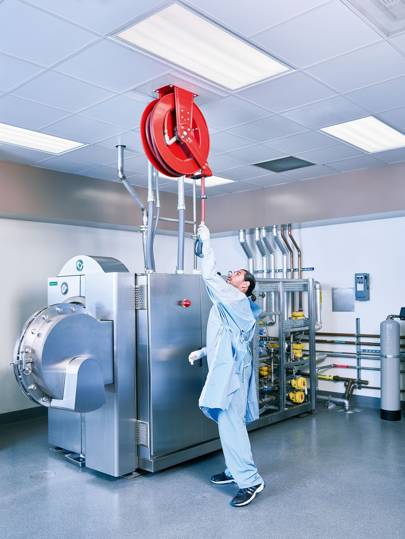
Resomator stands monolithic in the corner of a room in the bowels of
the University of California, Los Angeles (UCLA). It's as sterile as a
hospital here, but every patient is already dead. This is the
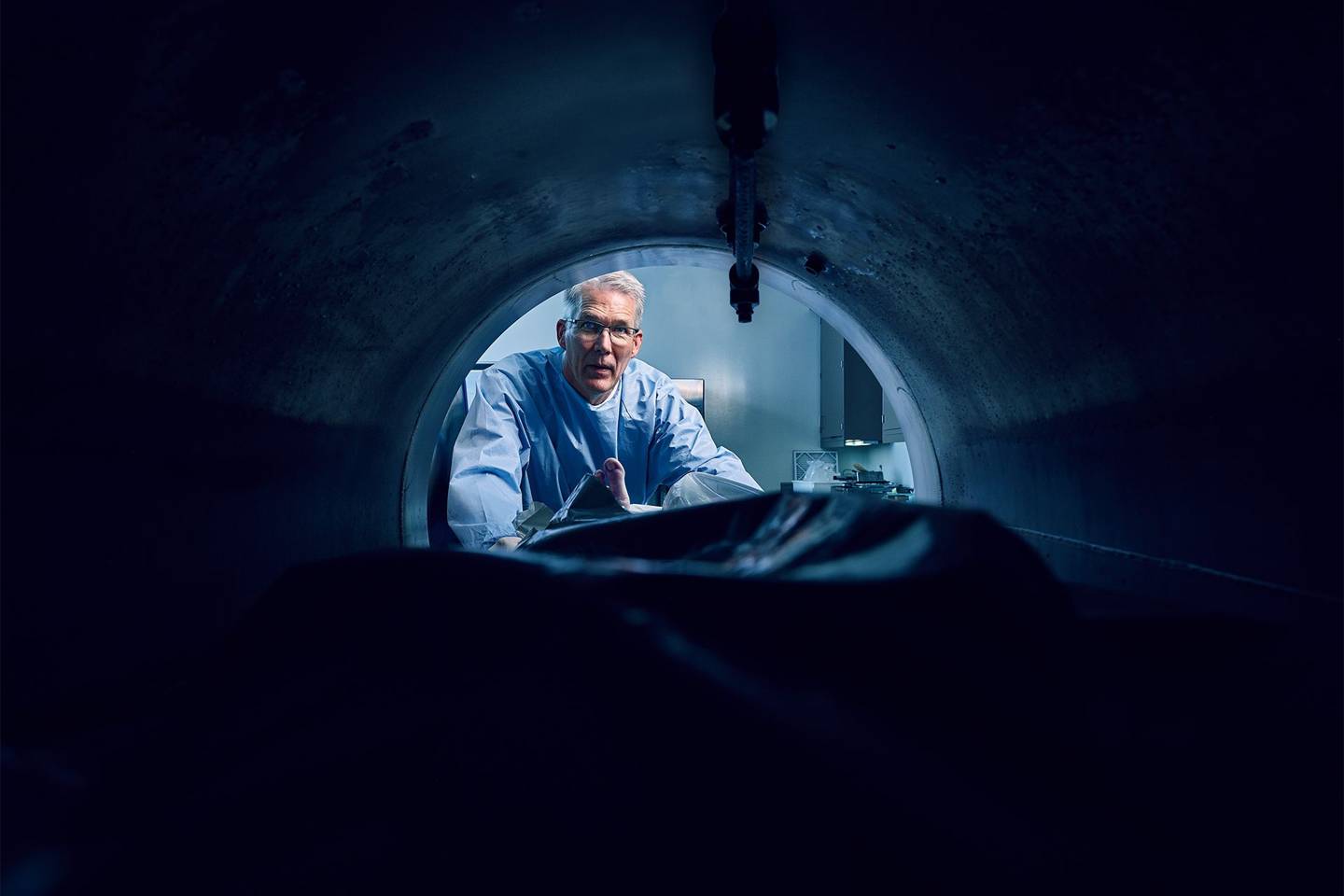
penultimate stage of their time under the care of Dean Fisher, director
of the Donated Body Program at the David Geffen School of Medicine.
Bodies are wheeled in under crisp sheets for disposal in Fisher's
alkaline hydrolysis machine, which turns them into liquid and pure white
bone. Their bones will be pulverised and scattered off the coast by
nearby Camp Pendleton, the Marine Corps Base, where they will float and
then disperse, because pure calcium phosphate will not sink. From the
coastguard's helicopter it looks like drug lords flushing their stash.
The
machine emits a low hum, like a lawnmower several gardens away. The
cadavers awaiting grinding sit in blue plastic containers at the back of
the room, identities anonymised by numbers and dog tags. The chalky
bones are soft enough to destroy by hand: touch a femur and it falls
apart.
Fisher has been running this model since March
2012 and he still can't believe it, he's gushing like it's a car on a
game show. It is one of only three in the United States, and not
commercially legal in California. He's removed the stainless- steel
panels to reveal the inner workings, all the pipes and machinery that
are neatly tucked away. Bodies go in through the same circular steel
door that the British Ministry of Defence uses on its nuclear-class
submarines. "It's great, isn't it?" he says, beaming behind his glasses.
"Oh man, it's just the best!" Fisher has the kind of personality you
can't help feeling is wasted on the dead.
The machine is mid-cycle.
Fisher, grey-haired and tall in light green scrubs, explains what's
happening inside the high-pressure chamber: potassium hydroxide is being
mixed with water heated to 150°C. A biochemical reaction is taking
place and the flesh is melting off the bones. Over the course of up to
four hours, the strong alkaline base causes everything but the skeleton
to break down to the original components that built it: sugar, salt,
peptides and amino acids; DNA unzips into its nucleobases, cytosine,
guanine, adenine, thymine. The body becomes fertiliser and soap, a
sterile watery liquid that looks like weak tea. The liquid shoots
through a pipe into a holding tank in the opposite corner of the room
where it will cool down, be brought down to an acceptable pH for the
water treatment plant, and be released down the drain.
Fisher says
I can step outside if it all gets too much, but it's not actually that
terrible. The human body, liquefied, smells like steamed clams.
This, Fisher explains, is the future of death. Dean Fisher, director of the UCLA Donated Body Program, in front of the Resomator
Spencer Lowell
The GeoCities fansites of the 90s have been outmoded in every industry but death.
There are sites that automatically play MIDI tracks when you arrive at
them, cursor heads that turn into trailing doves when they move. Above
them sit cheap stock images of old couples smiling. These are not the
websites of an industry that likes change.
Burial and cremation,
the most common ways that bodies are processed after death, haven't
fundamentally changed in centuries. The modern act of embalming,
popularised during the American Civil War, is a physically violent one
in which blood goes down the drain, untreated, after being pushed out by
embalming fluid pumped through the vascular system. Full of nine litres
of dyed-pink, carcinogenic formaldehyde and various other chemicals,
the body is put in the ground, where its decomposition is delayed but
not entirely so. In the first year, approximately half of the chemicals
will seep out into the surrounding soil as the body putrefies, along
with any chemotherapeutic drugs present in the body at the time of death.
In 2015, flooded cemeteries in
Northern Ireland were reported to be leaching chemicals out of bodies
and into the groundwater, posing a threat to the living nearby. In the
US alone, more than three million litres of embalming fluid are buried
every year. Lead coffins may stop chemicals seeping out, but the lack of
oxygen turns the body into a black soup; old London cemeteries such as
Highgate ask tourists not to lean on coffins in the catacombs in case
they upset the structural integrity of the box and the soup pours out.
Seventy-five
per cent of people in the UK are cremated, but few ask what it entails.
They don't know that halfway through the process a crematory operator
will open the door and use a rake to hook the skeleton by the ribs and
move it around to ensure the whole body is touched by flame. They don't
know that, despite the best efforts of crematory operators, bone dust
catches in the bricks of the retort (the chamber in which the deceased
is burned). Cross-contamination of bodies is inevitable.
Caitlin Doughty runs
Undertaking LA, a nonprofit funeral home on Santa Monica Boulevard, and
wrote about her time working in crematoria in her memoir Smoke Gets in Your Eyes. She wages a gentle war on the industry through her YouTube series Ask a Mortician
and a TED talk, trying to get us closer to our dead and, by extension,
our mortality. After years spent dealing with bodies, she believes
cremation is not the way to do it. "We're sending our families into
these intimidating industrial warehouses with behemoth fire machines
belching natural gas," she says. "It's almost cruel."
Doughty told
me that if there's a future for death beyond burial and cremation, it's
alkaline hydrolysis. It's legal in the UK but, despite lobbying from
advocates in the funeral industry who argue the process is more
efficient and better for the environment, is currently only legal in 14 US states and three Canadian provinces.
Doughty
says machines like the Resomator will make a huge difference to our
experience of death. They can be installed in clean, bright,
well-designed spaces without all the heat and noise of a crematory. "We
have to do so much better in designing our death spaces," she says.
Human bones that have been processed by alkaline hydrolysis crumble and fall apart to the touch
Spencer Lowell
Sandy Sullivan is sitting in a desolate London pub
on a Tuesday afternoon explaining how his quest to change the funeral
industry happened through the medium of mad cows. Just off the plane
from Glasgow, Sullivan's not-quite-ginger stubble shows flecks of grey
in the sunlight. An hour from now, he'll swap his dark jeans for a suit
and head to the Cremation Society's annual dinner, an invitation which
he says proves that people are starting to take him seriously. Sullivan
doesn't like to tell people on planes what he does for a living; say you
dissolve human bodies and you end up answering questions for the rest
of the flight.
The British BSE epidemic saw 4.4 million cattle
slaughtered between 1988 and 1998. The culled animals were burned in
mass pyres, corpses heaped in the middle of the fields they once grazed.
If you lived near enough, you could smell the smoke in your house. The
flames charred the bones and rendered the remains safe enough to put in
landfill, but failed to destroy the prions - the misfolded protein that
causes the brain degeneration. As a result, in 2006 the European
Parliament approved a new method of animal disposal: alkaline
hydrolysis. You can now send your loved one's ashes into orbit on a SpaceX rocket
You can now send your loved one's ashes into orbit on a SpaceX rocket
At the time, Sullivan was working for a company called
WR² (The "wr" stands for waste reduction), selling the machines that
melted cows. The company had been founded in the mid-90s by two
professors at Albany Medical College, who had patented the technique to
dispose of contaminated animals - namely, radioactive rabbits. Gordon
Kaye, who was working on cancer research, was frustrated at paying $300
(£235) to dispose of each rabbit. A colleague, Peter Weber, provided a
solution.
Biochemists like Weber
hydrolysed proteins all the time for amino acid analysis, but one of the
ways of doing it - alkaline hydrolysis, using potassium hydroxide or
sodium hydroxide, otherwise known as lye - was rarely used because it
was so destructive it tore apart the very amino acids the scientists
were trying to analyse.
Kaye and Weber began to experiment,
co-opting the university kitchen's old soup kettle. They once stuffed a
whole sheep into the pot, filled it with water and potassium hydroxide,
and set it to boil. But fat plus lye makes soap, so as the sheep boiled,
it foamed suds all over the laboratory floor.
By 1994, the
professors had a patent, and a company, to manufacture huge
stainless-steel pressure containers as big as the back of a
double-decker bus into which numerous cattle could be wedged and
dissolved cleanly and efficiently.
At WR², Sullivan pushed for the
company to expand into machines for humans. In 1995 the company had
built and sold one machine, by request, to the Shands Hospital at the
University of Florida in Gainesville, for the disposal of several
medical cadavers in one cycle. In 1998, Joe Wilson, their newly
appointed company president and CEO, had built a singular human machine
but it was considered too radical an idea for the funeral industry, so
it remained under a tarpaulin in the factory. There's a photo of Wilson
smiling inside it, wearing a baseball cap and a plaid shirt, testing the
fit of the steel coffin. To photograph the future of death, you've gotta feel dead
To photograph the future of death, you've gotta feel dead
WIRED Photo
"I started going to cremation meetings and did a little
bit of market research," says Sullivan. "Because of the inherent
environmental benefits and low running costs from an energy perspective,
it seemed an obvious fit [for the funeral industry]."
In the mid
aughts, the company got a call from Dean Fisher, then director of
anatomical bequests, Department of Anatomy, at the Mayo Clinic in
Minnesota, asking for a machine suitable to process an individual human.
They built him one from scratch according to his specifications.
Seventeen days after they delivered the machine, WR² went bankrupt and
stopped answering calls.
WR² hadn't failed because of any lack of
demand for the machines. Kaye and Weber, the scientists who founded the
company, both agreed they were lousy businessmen and returned to their
laboratories. Wilson decided to launch his own company, selling the
machines to the livestock and veterinary industries.
By now it was late 2006. The Mayo had a machine to dissolve bodies, but no instructions. Sullivan saw an opportunity. The Resomator's chamber is cleaned to a high level of sterility by Alex Rodriguez, Dean Fisher's assistant
Spencer Lowell
"It was a freaking mess. It was $380,000 just sitting there."
The
machine was not the dream Fisher thought it would be. He and a
colleague had attended a national Anatomical Board meeting in
Gainesville, Florida, and were given a tour of the university lab. They
were taken to a room off the loading dock and shown Shands' enormous WR²
machine. Staff would stuff the bodies into nylon bags, hang them off
ropes from the side, and dissolve five at a time. The bone was kept
separate, but the fluid was sloshing around between them. "We thought it
was kind of gross," says Fisher. "And then we saw the finished
product." It was not the grey cat-litter bone grit that came from the
crematorium.
Fisher
had asked WR² to make him one for individual humans: to turn the
chamber horizontal and to include a tray in the middle that the body
could lie on, alone.
But when his WR² machine arrived, he couldn't
get it to work. "We'd run it, open up the door and it'd be a half-baked
body." He shields his eyes with his hands, mimes slamming the door in
disgust. "You'd see flesh still on the body, some of the bones were free
but most of it was just so gross and so bad. We'd have to run it three
times. And this went on for about a month. We could not get it right at
all. We had the crematoria cremating them again." Even now he sounds
genuinely heartbroken by the disappointment. It's the only time when
he's talking about the machine that Dean Fisher is not smiling.
He
was sitting in a sporting goods store soon after when Sullivan called
him on his mobile. Fisher heard Sullivan's Glaswegian accent, didn't
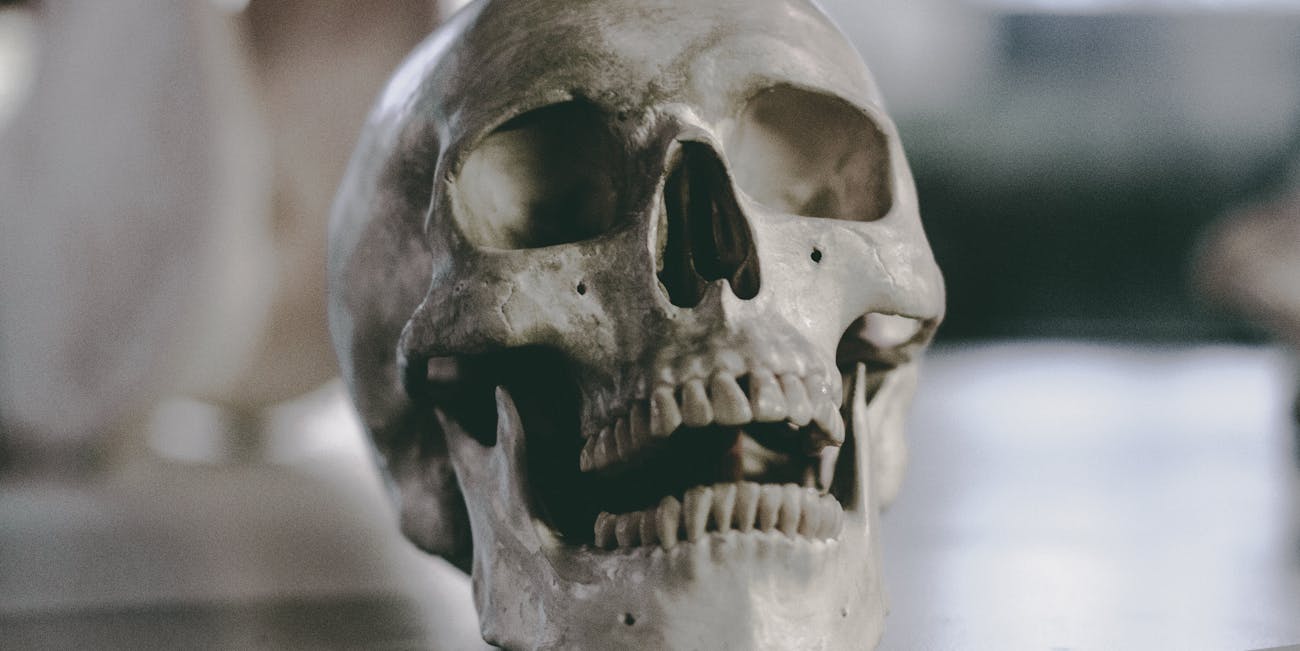
understand a word of it, and immediately hung up. The skull's job is to protect the brain, making it the hardest body part to deal with
Spencer Lowell
In death, the skull presents an issue. The structure
evolved to protect the brain and is extremely good at its job: aside
from the eye sockets and the underneath of the skull, flames have no way
of getting inside, and neither does liquid. In a crematory retort, the
flames shoot down from the ceiling and the skull is cracked and blown
open violently, or helped along by a crematory operator with a
long-handled rake. But towards the end of an alkaline hydrolysis cycle,
when all flesh has dissolved off the skeleton and the bones begin to move around the machine, the skull bobs along the top with the brain still inside it.
This
was not a big deal at Mayo where the majority of cadavers had had their
skull caps removed for educational purposes anyway, but if Sullivan was
going to transform the industry, he couldn't go asking funeral
directors to slice the deceased's head open. When he finally got Fisher
on the phone long enough to explain that he had worked at WR² and wanted
to commercialise the idea for humans, Sullivan promised to fix the
machine gathering dust in Fisher's lab. Then they would experiment with
it, fix the problem of the skull, try ways of taking alkaline hydrolysis
to the commercial market.
Together, they devised a cage that
holds the head in place so the eddy of liquid puts pressure on the skull
and breaks it open like an egg. It was the most dignified way of doing
it, and for Sullivan, dignity is important. He says this not in the
euphemistic way the funeral industry speaks ("interment space" instead
of "grave"), but because he genuinely means it. Sullivan worries about
rival companies doing it badly, unsafely. He worries that their work
will be lumped in with his own and put the technology back decades.
He's
referring, specifically, to Bio-Response Solutions in Danville,
Indiana, the company his former colleague Joe Wilson started after the
implosion of WR². After two years of manufacturing machines for animals,
Wilson decided to follow Sullivan's lead and revisit his idea from 1998
- a machine for an individual human.Bio-Response solved the skull issue
by putting the bodies in head first, tilting the tank with a crank, and
letting the weight of the body force the skull on to a spike, not
unlike that which pierces the seal on a tube of antiseptic cream. As the
head is crushed and the body dissolves, the feet slide into the liquid,
but you can never be sure when they enter the water, whether they had
enough time in there to disappear.
Bio-Response Solutions have
sold nearly 100 alkaline hydrolysis machines - to veterinary colleges
and pet cremation companies. Its human machines outsell Resomation's by
five to one. Wilson says he only went into the human side of the
industry after Sullivan refused to do a low-end, low-pressure machine
that family-run funeral homes could afford. He calls his company "the
Ford of the industry. [Sullivan] has built a BMW. I would not have
gotten into it if he built a machine for the average guy."
Sullivan
doesn't like the skull spike, or the fact that Wilson is selling
machines that cost a third of the price and take 14 hours to complete a
cycle instead of four. "It's disrespectful, it's not dignified, it's not
Resomation," he says. At an alkaline hydrolysis symposium in February
2017, the pair got into an argument, shouting over the heads of the
crowd.
The collective failure to settle on a marketable name for
alkaline hydrolysis is indicative of a fractured movement. Sullivan
refers to a body being "resomated" but the term is a registered
trademark, so no one else can use it. On its website, Bio-Response
Solutions leaps through linguistic hoops to avoid calling it anything at
all, using phrases like "this form of disposition". Qico, another
California-based alkaline hydrolysis startup, prefers "water cremation".
The Resomator's chamber is cleaned to a high level of sterility by Alex Rodriguez, Dean Fisher's assistant
The
lack of clarity has caused a confusion on a legal level about whether
alkaline hydrolysis is simply a different form of cremation or an
entirely new disposal method. In 2010, the Cremation Association of
North America changed its definition of cremation to include alkaline
hydrolysis, which doesn't make it legal but identifies it as a variant
of a process that already exists: you're still reducing the body to bone
fragments that can be returned to the family as ashes. Some states
recognise it as a third method; in Oregon, where it's legal, it's
"dissolution".
Convincing the public is not the issue. "Every
family that I explained the process to wanted it for their loved one,"
says Jeff Edwards, a funeral director in Ohio who purchased a machine
from Bio-Response Solutions in 2011. "The public is far from stupid."
But, while the cost of running the machine is cheaper for the operator,
Edwards charges a premium price because the bodies have to be
transported out of the state to do it. Bones from a resomated body are processed and scattered in the ocean
Spencer Lowell
As Jessica Mitford wrote in The American Way of Death, her 1963 treatise on the commercialisation of the funeral industry: it's all about money.
"It's
always money," says Fisher, standing by his Resomator at UCLA. "The big
corporations - here in America, it's Service Corporation International,
it's Carriage, it's Stewart Enterprises - set up billion-dollar models
to sell you a casket, to give you a ride to the cemetery in that hearse,
to sell you the cemetery plot, to put up the marker. And they don't
want to compete against something that costs $45 a cycle."
The
people who stand to lose out financially are the ones blocking the way,
Fisher claims: if alkaline hydrolysis overtook burial and cremation,
casket manufacturers would be rendered irrelevant. The cremationists
would not be able to take on as many bodies as they would ordinarily do,
because the process is slower. The Catholic Church, he alleges, is
against alkaline hydrolysis not on religious grounds, but because they
own a lot of cemetaries and they would lose money on the unsold plots.
(In 2007, Fisher demonstrated the machine for Sister Renée Mirkes,
director of the Center for NaProEthics, who declared the process
"morally neutral" in The National Catholic Bioethics Quarterly.) Decomposition, decay and the 'future of death': what really happens when we die
Decomposition, decay and the 'future of death': what really happens when we die
Death
Progressive independent funeral homes are slowly
adopting alkaline hydrolysis - two in Florida and Minnesota have
Resomators, more than a dozen have cheaper ones by Bio-Response
Solutions - but while it's less expensive in the long run to operate,
family-run funeral homes will take years to make up the Resomator's
£330,000 cost. For the process to take off commercially, the
corporations need to back it. Sullivan has just installed a Resomator in
Rowley Regis, near Birmingham, his first sale in the UK after a decade
of trying. It made the local papers.
But there is money to be
made. "The current installations are seeing an 80 per cent acceptance
rate," says Jevon Truesdale, founder of Qico. "We want to make it 100
per cent. Get rid of [cremation] altogether."
I meet Truesdale and
Qico's CEO, Jack Ingraham, at a rooftop bar in downtown San Diego.
Ingraham has a few shirt buttons undone, his hair slicked back, says
he's a sucker for a restaurant with a view. Their machines are
theoretical at this point; they have nothing to show in their office in
Ocean Beach. But they have nice suits and they have mock-ups: the
futuristic MZ-1 is white like an old iPod and shaped like a nautilus
shell. It doesn't look medical and it doesn't look like anything related
to death: thisis how they plan to differentiate themselves from the
competition. They picture a machine that can do everything inside its
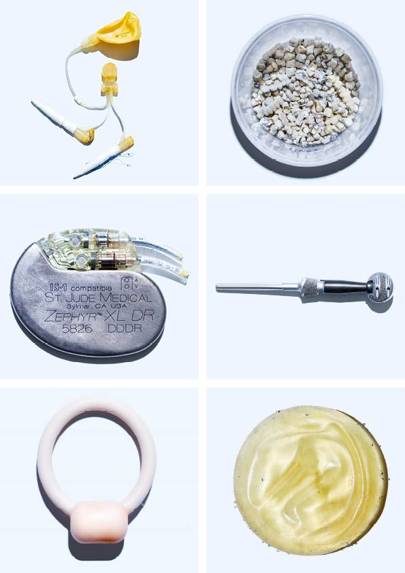
shell. At no point does anyone have to come in contact with a bone. From left to right: penile implant, teeth and fillings, pacemaker, titanium hip joint, bladder implant, breast implant
Spencer Lowell
Qico
is here because the cremation rate in Japan is 99.97 per cent and if
they replace every crematory retort with a shiny white MZ-1 they would
quickly become millionaires. Its machine looks the way it does because
Truesdale has already pictured it on the cover of Time. He doesn't want
to be photographed beside something that "looks like it belongs in a
basement". Ingraham has never seen a dead body but is trying to sell a
machine that dissolves them.Truesdale and Ingraham pose a threat to
Sullivan and his machine at UCLA, but Sullivan's not worried. "These are
wide boys as far as I'm concerned," he says. "Truesdale's selling a
concept. What he's saying it can do, it can never do."
Wilson agrees. "[Qico] don't have anything. They have a picture of an egg."
It's
possible that Qico will amount to nothing, but the alkaline hydrolysis
movement is so small that each company could be tainted by anything the
other does. As they travel the country explaining the process to funeral
directors and helping to push bills through the courts, Qico doesn't
see legality or engineering an impossible machine as the thing standing
between them and that magazine cover: they see a whole stubborn industry
of businessmen just like them.
As Sullivan leaves to attend the
Cremation Society dinner, he stands up and hands me his business card.
"Be positive," he says, putting his wallet back in his pocket. "I
believe it's good for society, it's good for the environment, and the
quicker the backward ideas of the industry are resolved, the better."
Back
at UCLA, Fisher shrugs. For years he's been arguing with this industry,
mired as it is in financial motivation parading as tradition. They
don't care that this machine, with its diminished environmental,
emotional and financial impacts, could save the world - or at least
delay its demise, one body at a time. Amuffled dual-tone alarm sounds in a cupboard.
Fisher opens it to show me a tiny implantable
cardioverter-defibrillator, the batteries of which have been slowly
running down for years. "It's been through the machine and the battery's
still working. Crazy, isn't it?"
On a small blue hand towel,
below the buckets of teeth and fillings (teeth are separated from bones -
metal fillings could break the cremulator in which the bones are ground
into a powder), is a collection of metal hip joints, valves, stents
that propped open the chambers of hearts, pins, plates; things that have
washed up on the tray after the people around them have disappeared.
The process is gentle enough to render a hernia mesh as new as the day
the surgeon implanted it, but strong enough to bleach the colour out of
glass eyes and fake fingernails.
Fisher motions to the array of
pacemakers he's collected. Aside from these few he's saved, he has all
of the metal recycled. The money he makes from the refiners goes toward
the servicing of the machine; he says it ends up paying for itself. He
flips over a pacemaker and holds it in front of my face. "If you look at
all this, you can still read the label. You can't put these in a
crematory. You have to cut them out." In the crematory retort, prosthetics melt or burn or,
in case of a pacemaker's lithium-ion battery, they explode. The titanium
ball-and-socket hip joints don't come out polished like a pristine
mirror like in Fisher's cupboard, they come out battered with carbon.
The silicon breast implant that Fisher jiggles in his hand ("we call
them jellyfish") has already spent a good few years inside a woman and
four hours inside the machine, but would melt like gum in a crematory
and need to be chiselled off the floor of the retort by hand. Other
implants, like plastic urinary pessaries or penile pumps, would never
even be seen by a crematory worker. They melt and escape into the
atmosphere through the chimney along with all of the mercury in your
teeth.
In the corner of the room the Resomator's cycle is nearing
its end. The noise is more intense; the pump beats like a straining
heart. Fisher lets me press the red button to stop it and Alex
Rodriguez, Fisher's right-hand man, swings open the door. There on the
tray, amid steam, lays the skeleton of a 90-year-old woman who donated
her body to the medical school. Rodriguez delicately picks up the larger
bones and places them in a tray. As he does so, he tells me what he
knows about her from her bones alone: that she had no teeth when she
died, because there are none here. That she had osteoporosis, which
turns your bones to dust before the cremulator. That she was small.
In
the 80s, before Fisher worked at the Mayo Clinic, he was a funeral
director in Minnesota. He knows where the money goes, and he knows when
to be frank. He also knows how to comfort the bereaved. When he's
notified about the death of a donor, he calls up their family, thanks
them for their generosity and assures them that he will take care of
their loved one. He explains exactly what will happen to the body: that
after the students have learned everything they can, their ashes will be
scattered in the Pacific Ocean and a memorial service will be held in
their memory.
If you're interested in donating your body one
day, Fisher will explain all this to you personally. He'll stand you in
front of this huge, silver machine and explain exactly how it works. And
later, after your remains have helped to teach the surgeons of the
future, Fisher will slide you in, quickly and quietly turning your body
back into the biological blocks that built you.
Hayley Campbell is a freelance journalist and the author of The Art of Neil Gaiman
Just past the perimeter of Joshua Tree Memorial Park’s manicured green lawns sit acres and acres of undeveloped desert. Joshua trees, so named by Mormon settlers for their purported resemblance to the biblical Joshua—his hands reaching toward the heavens in prayer—dot the rugged landscape, but a few hundred feet to the east stands a simple rectangular fence, marking off what, from a distance, looks like nothing at all.
Even upon closer inspection, the fence’s precise function is unclear. It corrals the same rocks and ground that extend for miles in every direction. And then I notice small, stainless steel pins in the ground, marking out 66 plots in what I soon will learn is the Joshua Tree Memorial Park’s natural burial section.
“The county requires that we put them in,” says Keith Yoder, the park’s superintendent, of the shiny, nonbiodegradable interlopers.
Unlike traditional burial, natural burial (also referred to as green burial) doesn’t seek to fight the effects of decomposition, but to harmonize with them by burying the body in a way that quickly recycles it into the ecosystem. Grave openings are prepared without the concrete vaults required for reinforcing standard graves, so the only thing in between the unpreserved body and soil is an organic fabric burial shroud or casket made from Earth-friendly material like wicker, cardboard, or bamboo. The graves themselves are dug by hand, and it can take a team of workers two to three days to do so—as opposed to the two to three hours it takes to dig a grave with heavy machinery.
“It gets very hot, and it’s hard work, but it’s more rewarding,” says Yoder.
Born from a conversation within the environmental movement of the mid-1990s, natural burial has been gaining popularity ever since, particularly in the last few years, and is part of a larger trend, paradoxical to some: the effort to make human death itself more sustainable. It is being engineered by social innovators all over the world who believe end-of-life decisions that take into account the future well-being of the planet are part of this generation’s legacy of environmental stewardship.
Maggie Matthews, funeral director and general manager at the Joshua Tree Memorial Park, thinks it’s about time that the larger cultural conversation about personal impact has crept into her professional domain. “We know that the choices we make have consequences,” she says. “As the world trends toward people asking themselves, ‘How can I be more environmentally conscious in my life?’ and as they get older, ‘How can I be more environmentally conscious in my death?’ it makes sense that natural burial would be a solution for some.”
Rituals surrounding death, of course, aren’t just there to comfort the dying; they’re also there for the living, offering them a sense of order amid chaos. According to Matthews, a burial that considers the planet doesn’t reduce burial to a mere utilitarian act, devoid of meaning. “You don’t have to have a casket out there,” she tells me from her eclectic showroom, sprinkled with brochures about making glass sculptures out of cremated human remains and jewelry from thumbprints of the deceased. “We’ve had burials where the families are actually lowering a shrouded body into the grave, holding the strap, right there with us, and there’s just something totally different about that experience.”
In a world in which we’re increasingly conscientious about the most fleeting of day-to-day lifestyle choices—from the provenance of our slip-on shoes to the fair-trade nature of our caffeine habits—it’s peculiar that so little conversation up to this point has occurred around perhaps the least fleeting of occasions: our eventual demise. As a licensed mortician, natural burial advocate, and founder of the Order of the Good Death, a collective dedicated to staring down the death anxiety of modern culture, Caitlin Doughty concurs. She sees natural burial as part of a much larger trend and perhaps the beginning of a movement.
“There’s already a cultural shift. In the past few years there has been a radical uptick in the number of people wanting to be involved in changing the conversation about death,” she says.
In October, Doughty was one of the organizers behind Death Salon, a three-day event in Los Angeles (with one scheduled to take place in the United Kingdom in 2014 and one in Ohio in 2015) where academics, “death care” professionals, historians, and artists gathered to rethink our relationship with human expiration. Topics at the salon included bejeweled 16th-century skeletal art, the relationship between death and feminism, and the controversial Body Worldsdisplays of German anatomist Gunther von Hagens—as well as modern advocacy of natural burial practices. Strange as some of them may sound, Doughty doesn’t believe that these conversations do not belong merely to an eccentric fringe.
“The type of person who believes climate change is a serious threat to the environment is the type of person who is not going to want the dead body of a loved one to go into the ground pumped full of cancer-causing chemicals and locked in a metal casket in a big concrete vault,” she says. “It’s that kind of extreme consumption that got us into the trouble we are in environmentally.”
The trouble that Doughty is alluding to has relatively recent origins. While the roots of human burial date back to the Middle Paleolithic period approximately 200,000 years ago, the traditional lawn cemetery, with its flattened grass, concrete vaults, and metal plaques, originated late in the 19th century and has been a prominent human burial practice ever since.
In the 1960s, many championed cremation as a more ecologically responsible, trendy alternative to burial. This was partially due to the actions of the Catholic Church, which lifted a centuries-long ban on the practice in 1963. Cremation numbers in the Western world rose sharply; from around 4 percent in 1965, according to the Cremation Association of North American, to more than 40 percent at present, with projections toward 50 percent by 2018. Yet, despite its popularity, according to the Green Burial Council, an organization founded in Joshua Tree that calls for certifiable standards for sustainable burial, cremation only adds to a person’s final carbon footprint. It takes nearly 23 liters of fuel and up to four hours for a body to be fully incinerated, a process that emits noxious gases including dioxin, hydrochloric acid, sulfur dioxide, and carbon monoxide, as well as mercury and other toxic metals into the atmosphere.
Enter alkaline hydrolysis (also known as resomation, aquamation, or biocremation), a water-based chemical resolving process that uses an alkaline solution of potassium hydroxide combined with 300-degree Fahrenheit heat and 60 pounds of pressure per square inch to dissolve bodies in large stainless steel cylinders.
After two to three hours, the body is transformed into a sterile coffee-colored liquid the consistency of motor oil that can be safely poured down the drain, alongside a dry bone residue similar in appearance to cremated remains. According to Resomation Ltd., the U.K.-based manufacturer of biocremation equipment, substituting ordinary cremation with alkaline hydrolysis can reduce greenhouse gas output by up to 35 percent. It also removes the need for burial space, an important benefit, given the world’s rapidly increasing population and growing urbanization. To date, however, alkaline hydrolysis is only available in Australia and in the U.S.
If it’s hard to wrap your head around how a chemical lab right out of Breaking Bad could possibly make death more sustainable, a decomposition process called promession might seem less foreboding. Developed by Susanne Wiigh-Mäsak, a Swedish biologist and entrepreneur, this method utilizes freeze-drying to dispose of dead bodies. Doused in a bath of liquid nitrogen, a corpse is frozen to -148 degrees Fahrenheit, and, once brittle enough, is shattered via short, mechanical vibrations. The resulting compound is then placed in a vacuum chamber to remove all ice, leaving 55-66 pounds of powdered human “promains.” Mercury tooth fillings and any other metal implants are sieved out with an induced magnetic field, and the dry powder is placed into a cornstarch enclosure and interred into top layers of soil where microorganisms can fully incorporate it within a matter of months.
Wiigh-Mäsak spent more than 20 years developing promession as she built an organic produce business, only presenting her ideas to the public in 2001.“My passion for gardening and composting led me to wonder how we can take such good care of an organic garden, so that it produces mulch within weeks, and yet when it comes to dead human bodies, we treat them as if they were a waste problem,” Wiigh-Mäsak explains. “Promession basically looks upon the corpse as something that can contribute to new life. The body can be a ‘thank you’ to the environment for the life that we’ve lived, instead of being a burden on the planet. I think people love that vision of being a contribution to nature, even after they’re gone.”
Promession was legalized in the Channel Islands in 2013, and South Africa and Germany adopted legislation allowing the process to be offered commercially in 2005, but it has yet to come to market. Sweden, South Korea, and a handful of other countries are currently reviewing their laws to see how promession might be included, but Wiigh-Mäsak plays down these regulatory holdups, saying that “even armies cannot stop an idea [when its] time has come.”
But what if instead of trying to preserve nature we turned to it for help with our burial rituals? Artist and Massachusetts Institute of Technology research fellow, Jae Rhim Lee does just that with the Infinity Burial Project by imagining a very unique fate for the postmortem body: decomposition via mushroom.
Inspired by the mushroom’s natural ability to remediate toxins in its environment, Lee trained fungi to feed off of her own body so that when she dies, these same mushrooms will devour her completely. Cultivating oyster and shiitake mushrooms on clippings of her hair, nails, and skin, she picks the best feeders in what becomes a selective breeding process. The idea is that after her death, these mushrooms will recognize her decaying tissue as a food source and take on the job of turning her into mulch and establishing a biological infinity.
To these ends, Lee has developed a fitted organic cotton burial suit with crocheted netting and spore-infused threads, where her flesh-eating Infinity Mushrooms can grow. She’s also working on developing an Infinity Burial kit, complete with burial suit, a cocktail of minerals and spores that will activate decomposition from the inside, an open source burial container, and membership in a society dedicated to the promotion of death acceptance, as well as the practice of decompiculture (cultivation of decomposing organisms). If all of this sounds spectacular and provocative, that’s part of the intention. Lee is trying to start a conversation she feels is desperately needed.
“I think there is a bigger message here than merely that funerals have a negative environmental impact,” she tells me. “Denial of death is deeply ingrained in our culture, but I think that environmental stewardship begins with accepting that we are mortal, that we are physical beings who eat, breathe, shit, die, and decay, and are therefore intimately connected to the larger ecosystem. We care for the environment because we are a part of it and it is a part of us.”
Imaginative, sustainable ways to deal with burial continue to pop up all over the place these days. French designers Enzo Pascual and Pierre Rivière have developed Emergence, an eco-casket made from biodegradable plastics embedded with tree seedlings that will take root as the casket decomposes; Hungarian designer Agnes Hegedus created an inexpensive floating urn housing a clay pot that’s designed to slowly sink to the ocean floor; and a South African designer, Ancunel Steyn, has proposed Design for Death Living, an urban plan that seeks to combine memorial walls housing cremated human remains with mixed-use public space. This past April, Designboom, an online magazine dedicated to art, design and architecture, launched an entire competition called Design for Death—of which these three projects are part—that received more than 2,000 submissions from around the world.
“Part of what’s fueling this trend toward more ecologically-minded burial is simply that people are becoming aware that they have an alternative to a conventional burial or cremation,” says Joe Sehee, founder of the Green Burial Council, which was founded in 2005 and currently includes more than 300 certified vendors that do commerce in the sustainable death space. “I think what most people like about the concept is that it allows for death to connect with life; something that the funeral industry has greatly impeded over the past century,” he says. “None of us really wants to think about dying, but green burial provides a way for us to find solace and sometimes even befriend death a bit.”
Whether or not natural burial continues to take hold as a cultural phenomenon, or promession and alkaline hydrolosis one day find broader audiences, alternatives to traditional burial are just beginning to take root in larger conversations about sustainability that have permeated nearly every part of contemporary culture.