Saturday, January 19, 2013

Ghosts Raising A Boy In A Cemetery = The Graveyard Book

The Graveyard Book was written by Neil Gaiman and published in 2008.  It won the Newbery Medal. It's a great book to read:

TheGraveyardBook Hardcover.jpg


The Graveyard Book

by 
4.09 of 5 stars 4.09  ·   rating details  ·  109,516 ratings  ·  11,580 reviews
After the grisly murder of his entire family, a toddler wanders into a graveyard where the ghosts and other supernatural residents agree to raise him as one of their own.

Nobody Owens, known to his friends as Bod, is a normal boy. He would be completely normal if he didn't live in a sprawling graveyard, being raised and educated by ghosts, with a solitary guardian who belongs to neither the world of the living nor of the dead. There are dangers and adventures in the graveyard for a boy. But if Bod leaves the graveyard, then he will come under attack from the man Jack—who has already killed Bod's family . . .

Beloved master storyteller Neil Gaiman returns with a luminous new novel for the audience that embraced his New York Times bestselling modern classic Coraline. Magical, terrifying, and filled with breathtaking adventures, The Graveyard Book is sure to enthrall readers of all ages.(less)

Thursday, January 17, 2013

Life Passes Fast - Synedoche, New York Death Quotes (Movie)

The 2008 movie Synedoche, New York with Philip Seymour Hoffman and directed by Charlie Kaufman had numerous death scenes and quotes.  Among them:

Life passes fast.

None of us has much time.

And on a handwritten note on a door:  Death in Family.  God Relieve our Grief

Tuesday, January 15, 2013

Have You Seen Best Funeral Ever Reality Show? Are You Kidding Me?!!!!


Annette John-Hall: Series is trifling with life's final dignity

Gregory T. Burrell, in the casket room of Terry Funeral Home, is outraged by the "Best Funeral Ever" show.
RON TARVER / Staff Photographer
Gregory T. Burrell, in the casket room of Terry Funeral Home, is outraged by the "Best Funeral Ever" show.
MORE COVERAGE
  • Lance Armstrong slinks into Oprah's arms for confession
  • Click here to find out more!
    Amid such breakout hits as Here Comes Honey Boo Boo and the most enlightening (in a Neanderthal kind of way) Pete Rose: Hits and Mrs. comes TLC's new reality show, Best Funeral Ever.
    Brace yourselves. The accommodating staff at Golden Gate Funeral Home in Dallas says it will do anything to honor a family's request for a funeral. "You may be in a casket, but it can still be faaan-tas-tic," intones the show's DJ, I mean, narrator, doing his best Barry White impersonation.
    That alone should have prepared us. But I don't think anybody was ready, say, for the funeral of Willie McCoy, who sang the Chili's baby back ribs jingle. His services were held in the Party Barn, a cafeteria-like barbecue joint, and featured squealing pigs - as props? honorary pallbearers? - a finger-lickin' good barbecue sauce fountain, and a casket shaped like an oil drum smoker grill.
    Let me pause here for a breath of fresh air before diving back into the stench of, no, not funerals, but reality shows in general and those featuring African Americans in particular.
    No doubt you've read my rants about the cultural dangers of programs such as Love & Hip Hop, The Real Housewives of Atlanta, and theBasketball Wives franchises. Not only do they showcase the worst in human behavior, they also perpetuate the very worst stereotypes about African Americans, all the more fueled by our willingness to watch them.
    I meant to ignore Best Funeral Ever, hoping it would die a slow death. That is, until Gregory T. Burrell, owner of Terry Funeral Home in Philadelphia and president of the National Funeral Directors and Morticians Association, wrote to say that Best Funeral Ever, and its ridiculous depiction of a dignified industry, is not OK.

    Sacred vs. slapstick

    "We had to get ahead of this," explains Burrell, whose group is the world's largest and oldest association for African American funeral professionals. "We can't let one person compromise the integrity of the entire industry."
    Burrell issued a statement on behalf of the NFDMA voicing its outrage atBest Funeral Ever and "our sincere apology to those persons who are experiencing the loss of a loved one and were subject to the airing of the show."
    Black funeral directors are "really, really struggling to maintain a professional image," Burrell says. "There are a lot of people who have worked extremely hard to get to where they are, only to have their images tarnished by a reality show."
    Since the dawn of freedom, the funeral business has been a source of thriving entrepreneurship among African Americans in Philadelphia. Discrimination forced blacks to learn how to bury their own. And as far back as the 18th century, Richard Allen and Absalom Jones' Free African Society provided burial services for black and white victims of the yellow fever epidemic.
    Burrell purchased Terry Funeral Home from original owner Paul Terry in 2000. In December, Terry will celebrate its 75th anniversary. It has provided services for such local luminaries as Paul Robeson; Sadie Tanner Mossell Alexander, the first African American woman to enroll in the University of Pennsylvania School of Law; civil-rights stalwart C. DeLores Tucker; City Councilman Lucien Blackwell; and others.
    You can understand why Burrell is incensed about the slapstick nature ofBest Funeral Ever. Interestingly enough, John Beckwith, the Dallas funeral director featured on the show, is a member of the NFDMA and a friend of Burrell's. He told Burrell a reality show was in the works. Burrell, however, says he was blindsided by its sheer outrageousness.
    Sure, Burrell wants to give his customers the most personalized of service. But family wishes or no, "our responsibility as professionals is to understand how far we're willing to go," he says. "Funerals should be dignified, sacred, and professional."


    Contact Annette John-Hall at 215-854-4986, Ajohnhall@phillynews.com or on Twitter @Annettejh.
    Annette John-HallInquirer Columnist

    Sunday, January 13, 2013

    How To Thrive With Cancer-A Life Of Inspiration And Giving

    Dara Simenhoff Darr died Tuesday at 46 years old of ovarian cancer.


    Honoring a life of teaching and giving

    Teacher Dara Simenhoff Barr died last week at 46.
    SUZANNE SIMENHOFF
    Teacher Dara Simenhoff Barr died last week at 46.
    If Dara Simenhoff Barr liked two people, she didn't see why they shouldn't also be friends with each other. She was a teacher and a connector, the sort of person who seemed to know everyone, and wove together a large, devoted community.
    Raised in Swarthmore, a resident of Mount Airy, Dara taught for many years at Germantown Friends' nursery school. Among her many students was my daughter. She tended to keep her students for life. Their parents, too. That's what she loved about the little ones. You got the whole family.
    Dara died Tuesday. She was 46.
    She had been sick with ovarian cancer for much of the last six years. Like many people, Dara didn't want illness and the shadow of death to define her. She wanted to be known for her three marvelous sons, her marriage, her teaching, her myriad passions and irrepressible zest.
    But here's the funny thing, and Dara loved the funny thing: She never hid her cancer and, along the way, taught a great many adults and children how it's possible to thrive after being dealt the worst news imaginable.
    "Her disease turned out to be an incredible gift in that it brought a whole community much closer together and taught us all to do a better job of living," said Thomas Randall, a gynecologic oncologist and friend. "She made me a better doctor. I learned a lot about how to give people bad news and good news, to understand what patients were thinking about, how they felt going home after an office visit and waiting for the next one. I learned to do a better job of soliciting information."
    Randall was not the sole beneficiary of her teaching. Dara visited area medical schools and taught students to be more sensitive to the needs of patients.
    She underwent three clinical trials, the last at the National Institutes of Health. Said her sister, Suzanne Simenhoff: "Dara wanted to find a cure, even if it wasn't going to work for her, so it would help someone else."
    And she raised money for fellow patients and research through Dara's Defense (darasdefense.org), since 2009, more than $70,000.
    Instead of a stuffy charity dinner with bad chicken, she hosted a joyous family music festival with superior beer, Dara's Defender IPA. Noted musicians like John Wesley Harding played, as did Dara's husband, Jeff, who does historic restoration and construction. Before her death, Dara and her board decided the show must go on. And so it will, June 1.
    When she wasn't feeling lousy, she traveled extensively, more than many healthy people. She loved camping, music, games, beading, beer. She beaded drinking beer at a favorite bar.
    The nursery schoolteacher "was secretly competitive," said friend Melissa Long. "She loved to win. She was a killer at board games." In the last year of her short, joyous life, she took up mahjong with friends. She even hired a tutor. How many people with pernicious cancer do that?
    Said Long, "When she was your friend, she was there to stay." Dara believed devotedly in the long term. Her sister said, "There was nothing she was prouder of than her long-lasting marriage and her kids," Matthew, 17; David, 13; and Elliot, 11.
    Dara and Jeff were married for 20 years - but together for so much longer. They met in sixth grade when they were Elliot's age.
    Jeff was Dara's only boyfriend.
    "She did a really good job of managing that journey, maintaining a certain quality of life," Randall said. "She gave people a sense of purpose to do something about the illness." She made sure that the cancer and her charity "became much bigger than Dara."
    Along with her husband and sons, Dara leaves four siblings, Suzanne, Mark, and Ben Simenhoff, and Adrienne French; and seven nieces and nephews.
    Dara's funeral is at 3 p.m. today, Sunday, at Mishkan Shalom Synagogue. Her circle of friends is so large there will be a second service, a Quaker Meeting for Worship at 2 p.m. Jan. 20 at Germantown Friends Meetinghouse.
    Dara, who wore a green wig to cheer her nephew at his bar mitzvah, asked that friends wear their "happiest colors."
    Contributions can be made to Friends of Dara Barr, 209 Dogwood Lane, Wallingford, Pa., 19086.
    Dara's contributions are too numerous to list.


    Contact columnist Karen Heller
    at kheller@phillynews.com or follow on Twitter at @kheller.
    Karen HellerInquirer Staff Writer

    Saturday, January 12, 2013

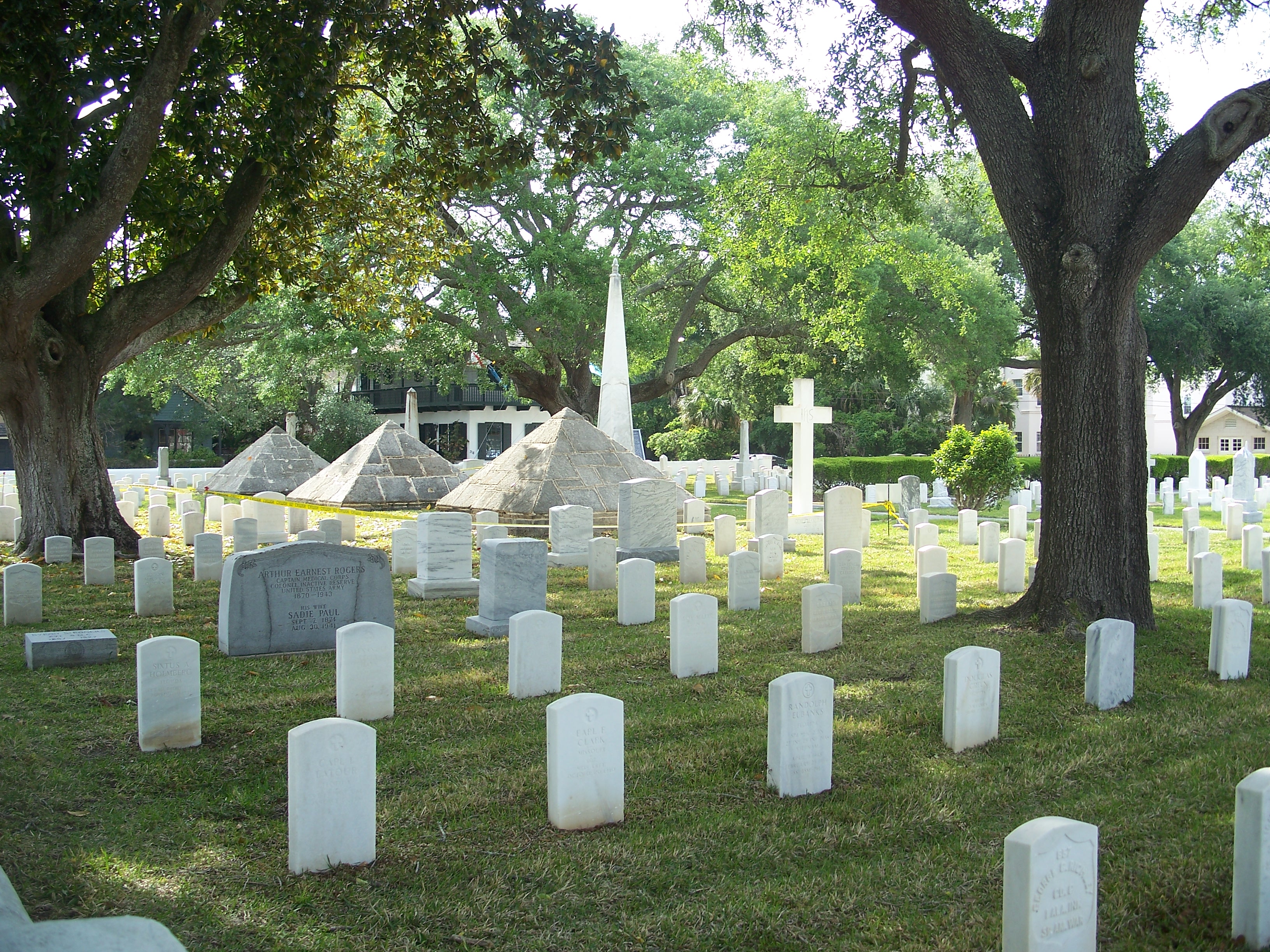
    Why Are There Pyramids At St. Augustine National Cemetery (Florida) - The Dade Massacre

    "The cemetery's most notable graves, topped by three 8-foot-tall" coquina "stone pyramids and a marble obelisk, are those of Maj. Francis Dade and his soldiers, who were ambushed by Seminole Indians in December 1835.  The attack, known as the Dade Massacre, fueled the Second Seminole War.  (Miami-Dade County, FL; Dade City, FL; and Dade County, MO, are named for the major.)"

    Maj. Dade was marching with 7 officers and 110 men.  Maj. Dade was on a horse.  The indian surprise attack started after Chief Micanopy fired the first shot, which killed Maj. Dade.  Only 3 soldiers survived the massacre, barely.  There were 180 indians.  The battle lasted several hours.  Only 3 indians were killed.  General Edmund P. Gaines and 1100 men reached the Dade Massacre battlefield two months later (!!!!) on February 20, 1836-the first U.S. soldiers to do so.  They identified the bodies for burial and buried them at the site.

    The Second Seminole War did not end until 1842.  The remains were then disinterred and buried in St. Augustine National Cemetery under the 3 coquina stone pyramids along with over 1,300 other soldiers who died in the war.

    (Also, as a footnote, "the grave of Margaret Worth is in the cemetery.  She is the widow of Maj. Gen. William Jenkins Worth, a hero of the Second Seminole War and the Mexican-American War.  Fort Worth, TX; Lake Worth, FL; and Palm Beach's Worth Avenue are named for him.)


    Thank you to Wikipedia and to The Philadelphia Article, Sunday, January 13, 2013, Page N1, Travel, "In St. Augustine's shadows" by Roberta Sandler.


    File:St Aug Nat Cemetery Dade mnmts01.jpg