Showing posts with label london. Show all posts

Friday, April 20, 2018

London’s KILLER FOG kills 12,000, 150,000 hospitalized in 1952 .?! 4,000 animals killed.


http://www.history.com/news/the-killer-fog-that-blanketed-london-60-years-ago

https://www.cbsnews.com/news/londons-1952-killer-fog-cause-revealed/

Scientists determine cause of London's 1952 "killer fog"

Despite the deaths of thousands, the killer fog largely remained a mystery for decades.
 
 COURTESY OF TEXAS A&M UNIVERSITY
London may be known for its drizzly weather, but in 1952 the city’s quintessential fog cover turned deadly, and no one knew exactly why — until now.
For five days in December 1952, a fog that contained pollutants enveloped all of London. By the time the dense fog cover lifted, more than 150,000 people had been hospitalized and at least 4,000 people had died. Researchers now estimate that the total death count was likely more than 12,000 people, as well as thousands of animals. Despite its lethal nature, the exact cause and nature of the killer fog has largely remained a mystery. Recently, a team of researchers has determined the likely reasons for its formation.
Researchers have for a long time connected emissions from burning coal with the killer fog, but the specific chemical processes that led to the deadly mix of pollution and fog were not fully understood. To determine what turned the fog into a killer, an international team of scientists from China, the U.S. and the U.K. recreated the fog in a lab using results from laboratory experiments and atmospheric measurements from Beijing and Xi’an, two heavily polluted cities in China. [In Photos: World’s Most Polluted Places]
Study lead author Renyi Zhang, an atmospheric scientist at Texas A&M University, said that sulfate was a big contributor to the deadly London fog. Sulfuric acid particles, which formed from the sulfur dioxide that was released from the burning of coal, were also a component of the fog. The question was, How did sulfur dioxide get turned into sulfuric acid?
“Our results showed that this process was facilitated by nitrogen dioxide, another co-product of coal burning, and occurred initially on natural fog,” Zhang said in a statement. “Another key aspect in the conversion of sulfur dioxide to sulfate is that it produces acidic particles, which subsequently inhibits this process.”
The natural fog contained larger particles, Zhang explained, with the smaller acidic particles evenly distributed throughout. When those fog particles evaporated, an acidic-haze was left covering the city.
The 1952 killer fog led to the creation of the Clean Air Act, which the British Parliament passed in 1956. Researchers still consider it the worst air pollution event in European history.
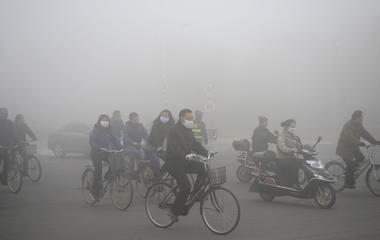
The air of cities in China, which is often heavily polluted, has a chemistry that’s similar to the killer fog in London, Zhang and his colleagues found. China has battled air pollution for decades, and it is home to 16 of the world’s 20 most polluted cities, according to the researchers. For instance, air pollution in Beijing often far exceeds the U.S. Environmental Protection Agency’s acceptable air standards.
The researchers said that the main difference between China’s smog and the killer London fog is that China’s haze is made up of much smaller nanoparticles. Also, the formation of sulfate is only possible with ammonia, the scientists added.
“In China, sulfur dioxide is mainly emitted by power plants. Nitrogen dioxide is from power plants and automobiles, and ammonia comes from fertilizer use and automobiles,” Zhang said. “Again, the right chemical processes have to interplay for the deadly haze to occur in China. Interestingly, while the London fog was highly acidic, contemporary Chinese haze is basically neutral.”
A better understanding of air chemistry is key to developing effective regulatory actions in China, Zhang said.
“We think we have helped solve the 1952 London fog mystery and also have given China some ideas of how to improve its air quality,” Zhang said. “Reduction in emissions for nitrogen oxides and ammonia is likely effective in disrupting this sulfate-formation process.”
The research was published online Nov. 9 in the journal Proceedings of the National Academy of Sciences.
Original article on Live Science.


Friday, November 1, 2013

In London, Jack the Ripper Still Slays Them, 125 Years Later


Originally published Friday, November 1, 2013 at 10:05 AM

In London, Jack the Ripper still slays them

Tours of grisly murder sites mark the 125th anniversary this fall of the murders.

The New York Times
MOST POPULAR COMMENTS
HIDE / SHOW COMMENTS
No comments have been posted to this article.
Start the conversation >
advertising
Just before 9 p.m. on a recent Thursday in London, five guided tour groups, about 150 people in all, converged on a nondescript courtyard on the eastern edge of the central financial district. Some tour guides wore 19th-century top hats and long, dark cloaks. Others grasped photographs of mortuary corpses. And each guide jostled for the best spot: Near the tiny flower bed in the far corner where, in 1888, Jack the Ripper murdered a prostitute named Catherine Eddowes — slitting her throat, slashing her face, pulling out her innards and walking off with her uterus.
This fall marks the 125th anniversary of the Whitechapel murders, carried out by Jack the Ripper, perhaps the world’s most infamous serial killer. So many years later, interest in the Ripper endures. “It’s probably the greatest whodunit in the history of crime,” said Richard Cobb, a beefy northern Irishman who operates the Jack the Ripper Tour, a histrionics-heavy production.
The demand for, and supply of, these tours have increased in the lead-up to the anniversary. And the competition between tour operators has intensified. With about 15 companies in the game, novelty is no longer a sufficient customer draw. One operator boasts that its guides are “all retired British Army and Royal Marine Sergeant Majors.” Cobb has trademarked something called Ripper-Vision: essentially, a handheld projector that flashes grisly mortuary photographs onto the pavement.
“It’s become a big business,” Cobb said. “Loads of companies looking to make a fast buck ... trying to get up with the big boys.” Every night in what is now hipster-vogue East London, between 7 and 9 p.m., a gore-drenched battle for tourist dollars rages.
In 1888, things were not looking good in the East London district of Whitechapel. Even as Queen Victoria’s empire was marinating in riches, the slums in London’s East End were overcrowded. Ladies of the night roamed the cobblestone streets. And then Jack the Ripper struck. His heinous murders, five prostitutes in 12 weeks (the victim count is sometimes disputed), drew the world’s gaze. He was never caught.
“Ripperologists”
Today, many tour guides compete on the strength of their in-house “Ripperologists,” often published authors with blogs and YouTube channels and contributions in the Britain-based Ripperologist magazine. Richard Jones, founder of Discovery Tours, has led Ripper tours since 1982.
“I’ve probably done about 9,000,” he speculated.
A former postman, Jones now publishes Ripper history books and articles and appeared in an informative DVD accompanying the 2001 movie “From Hell,” which cast Johnny Depp as the Ripper.
Donald Rumbelow of London Walks is another Ripperologist — though he bristles at the designation.
“I have a lot of other interests,” he said over a noontime glass of wine at the Ten Bells, where Annie Chapman was reputedly seen boozing before her murder. “Jack pays for my pleasures, as it were.”
Rumbelow is a retired police officer who used to patrol Mitre Square, where Catherine Eddowes met her fate. He prides himself on his bare-bones tour guiding: no photos, no hyperbolic hushes, “and I won’t dress up.”
New rivals now bring flash and frill — and turf wars. “I’ve had a lot of run-ins,” Cobb admitted. Stylistically, he opts for the big personality — costumes, actors and “CSI crime scene-style descriptions” of limbs askew and organs littering the streets.
These days, gaggles of tourists pay 8 pounds to 10 pounds ($12.50 to $15.50, at $1.55 to the pound) to spend about two hours retracing Jack’s steps. Popular stops include Dorset Street, where Mary Kelly had her skin peeled off in the early hours of Nov. 9, and Wentworth Street, where the Ripper scrawled a cryptic note on the wall in chalk.
All this has been tough on residents who, year round, find their vintage shop- and cafe-studded neighborhood transformed into a circus. But Kathryn Olivarius, 24, a Ph.D. student who lives above one stop on Gunthorpe Street, often listens to the tours from her balcony, over a glass of wine: “I just hope people remember that these women who Ripper killed were real people who lived extremely hard lives.”